


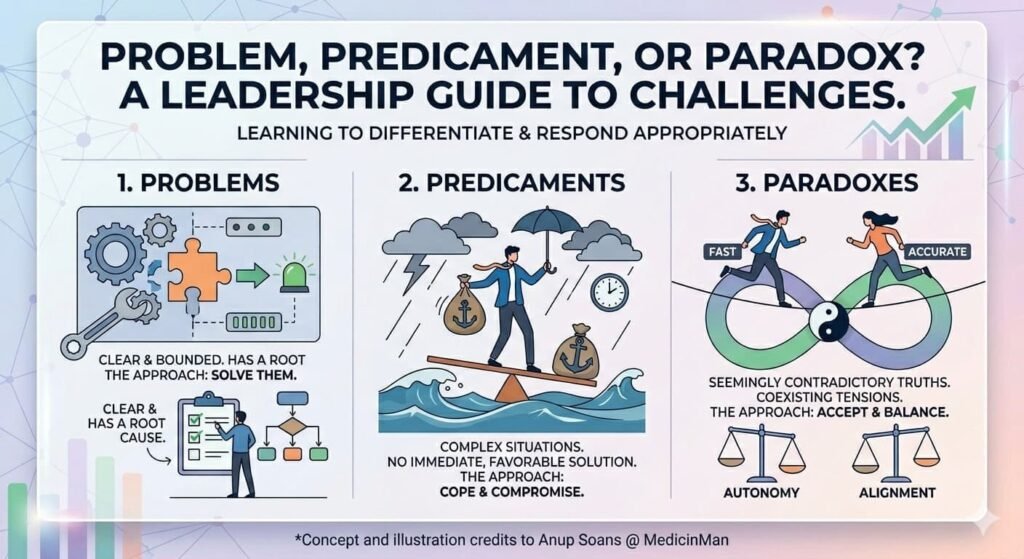
As professionals, we are conditioned to be “fixers.” We see a challenge, and our immediate instinct is to find a solution, build a framework, or optimize a process. But one of the most liberating lessons in leadership and career growth is realizing that not everything is a problem to be solved. To avoid burnout and lead effectively, we must learn to differentiate between three distinct realities:
1. Problems
- What they are: Clear, bounded challenges with a definable root cause.
- The approach: Solve them. Find the bugs, patch the leaks, and implement strategic solutions.


2. Predicaments
- What they are: Complex situations with no immediate or favorable solution (e.g., navigating a market recession, balancing a tight budget with high growth demands).
- The approach: Cope and compromise. You can’t “fix” a macroeconomic shift, but you can manage your response, adapt your expectations, and build resilience.

3. Paradoxes
- What they are: Seemingly contradictory yet simultaneous truths that will always coexist (e.g., needing to move fast vs. needing to be accurate; fostering autonomy vs. maintaining alignment).
- The approach: Accept and balance. Paradoxes aren’t meant to be resolved; they are ongoing tensions to be managed through continuous calibration.

The Takeaway
Treating a predicament like a problem leads to frustration.Treating a paradox like a problem leads to a never-ending game of whack-a-mole.
True maturity—both organizational and personal—lies in knowing when to fix, when to compromise, and when to simply accept.
How do you differentiate between these in your day-to-day work?
References:
- Smith, W. K. & Lewis, M. W. (2011). Toward a theory of paradox. Academy of Management Review
- Heifetz, R. et al. (2009). The Practice of Adaptive Leadership
- Nielsen, R. K. et al. (2023). Navigating Leadership ParadoxÂ