
The Anomaly
Unless you learn to accept that chaos is the natural order (just look at the traffic in any major Indian city), you cannot survive, much less thrive.
Much of sales management is about making sense of chaos in the market. Meanwhile, most marketing professionals assume they can neatly slice and dice doctors and patients, simply to feel in control.

As philosopher Roger Scruton once noted, Intellectuals are naturally attracted to the idea of a planned society, believing they will be in charge of it.
The same applies to corporate strategy. Brand teams sit in head offices creating immaculate segmentations and rigid frameworks, assuming the market will behave like a predictable spreadsheet. But the moment the field force steps into the real world, that beautifully planned structure collapses into pure, unpredictable human chaos.
When getting access to doctors is the primary challenge, marketing’s job isn’t to pretend the chaos doesn’t exist by drawing neater boxes on a PowerPoint slide. Their job is to equip the field force to navigate it.

How can we better help our field force face this reality?
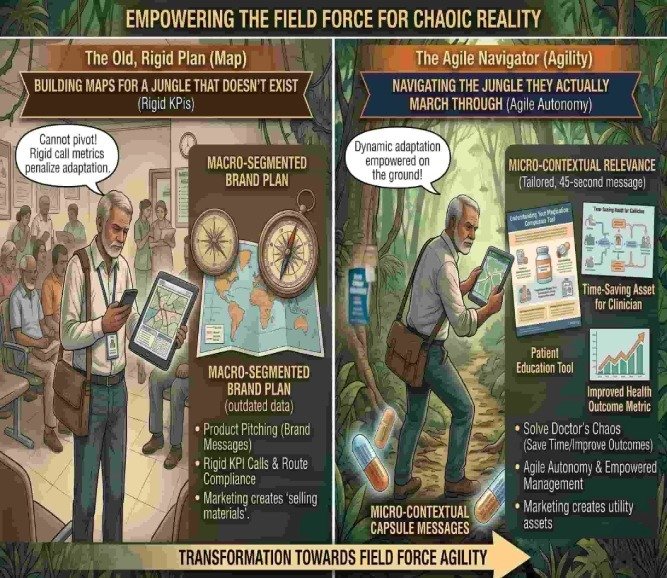
Shift from Product Pitching to Micro-Contextual Relevance: If a medical representative only has a 45-second window in a chaotic waiting room, they cannot deliver a macro-segmented brand message. They need high-impact capsule messages tailored precisely to what that specific doctor is facing that day.
Solve the Doctor’s Chaos, Don’t Just Sell a Drug: Clinicians restrict access because they are overwhelmed by their own chaos, high patient volumes and acute time poverty. If marketing creates utility assets (like patient education tools) that save the doctor time, drive patient compliance, and improve health outcomes, the door opens naturally.
Move from Rigid KPIs to Agile Autonomy: Corporate systems demand rigid call metrics, but chaos requires the freedom to pivot. Sales management needs to empower the field force to dynamically adapt their routes and strategies on the ground without being penalized by a rigid, outdated plan.
If we want our teams to thrive, we have to stop building beautiful maps for a jungle that doesn’t exist, and start giving them the agility to navigate the jungle they actually march through every day.

The Remedy From Planning for Control to Engineering for Flow
The anomaly is clear: marketing builds neat segmentations, the field fights chaos, and the two never meet. So how does pharma remedy this disconnect?
Not by better planning. That’s just fighting fire with a blueprint.
The remedy is to stop treating chaos as a bug in the system and start treating it as the operating system. Here is what that looks like in practice:
- Replace the Brand Plan with Battle Rhythms. Annual brand plans are actuarial fiction in a chaotic market; by month three, they are obsolete. Instead, move to 10-day battle rhythms:Friday: Field inputs (real-time data on doctor access, patient walk-ins, and competitor tactics) are uploaded. Monday Morning: Marketing synthesises this into a Chaos Brief, highlighting three micro-opportunities and two emerging obstacles.The Rule: No 50-slide decks. No quarterly re-forecasts. Just adaptive tactics.
- Train for Chaos Fluency, Not Product Mastery. Most training assumes a calm, attentive doctor. That is delusional. Instead, run waiting-room simulations: Challenge reps with a 35-second window, background noise, and constant interruptions. Teach them to read the room’s chaos level (Is patient volume high? Did an angry patient leave? Is the nurse short-staffed?) and deliver a one-sentence utility rather than a product feature. Example: Doctor, I know you’re packed today. Here’s a 30-second patient compliance checklist for your diabetic foot care patients to save you time. Keep it.
- Kill the Rigid Call Frequency KPI. The current model dictates: See Dr Sharma 6 times this quarter. But what if Dr Sharma is impossible to reach in week 2, yet highly reachable in week 4? Rigid targets punish street-smart adaptation. Instead, measure adaptive reach. Did the rep find someone valuable at that clinic (a nurse, a junior doctor, or a patient counsellor) and provide relevant help? Did they recognize when to skip, wait, or come back at 2 PM instead of 11 AM?

4. Embed Marketing People in Field Chaos Literally. Once a quarter, every brand manager should spend two full days riding with a medical representative. No phone, no laptop. Just sitting in waiting rooms, being told to come back later, and watching prescriptions get written in 20-second windows. The Golden Rule: You cannot propose a new brand tactic until you have personally experienced access failure three times in a single day. That humility changes everything.
5. Shift from Annual Target Setting to Ecosystem Optimisation. Annual sales targets are downstream manifestations of a stable market, a market that no longer exists. When head offices manage purely by top-down volume targets, the field force is forced to treat stakeholders as transaction variables. To survive chaos, the primary metric must shift toward removing friction across the entire value chain. The Doctor: Are we reducing their time poverty and operational overwhelm? The Patient: Are we improving compliance, access, and clarity of care?The Trade (Distributors and Retailers): Are we ensuring predictable stock velocity and simplifying terms?
When you optimise for ecosystem satisfaction, market share stops being something you desperately chase; it becomes the natural byproduct of a friction-free network.

The Path Forward
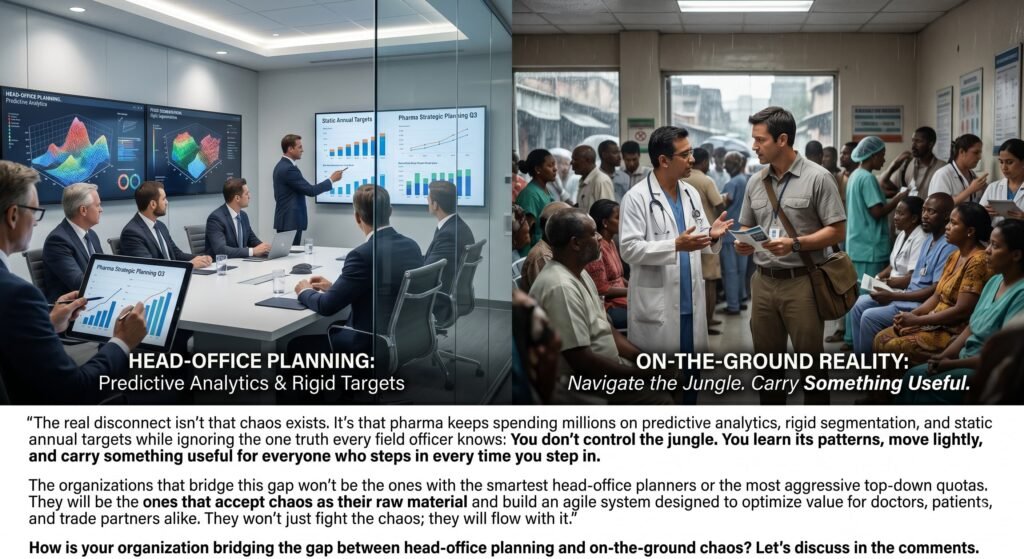
The real disconnect isn’t that chaos exists. It’s that pharma keeps spending millions on predictive analytics, rigid segmentation, and static annual targets while ignoring the one truth every field officer knows: You don’t control the jungle. You learn its patterns, move lightly, and carry something useful for everyone who steps in every time you step in.
The organizations that bridge this gap won’t be the ones with the smartest head-office planners or the most aggressive top-down quotas. They will be the ones that accept chaos as their raw material and build an agile system designed to optimize value for doctors, patients, and trade partners alike. They won’t just fight the chaos; they will flow with it.
How is your organization bridging the gap between head-office planning and on-the-ground chaos? Let’s discuss in the comments.