
Friday, May 29, 2026
24.2 C
Bengaluru

The Tragic Genius of Yellapragada Subbarow

Every day, doctors worldwide prescribe methotrexate, doxycycline, and folic acid. Few know the name of the man who made them possible. Even fewer know that Harvard refused him tenure—and an American bowling alley refused him entry because of the color of his skin.

The Oath in a Village

In 1913, in the town of Bhimavaram, India, an 18-year-old boy watched his father and two brothers die from a wasting disease called tropical sprue. He decided then that he would spend his life fighting illness.

That boy was Yellapragada Subbarow.

The path was brutal. He failed his school exams twice. When he finally entered Madras Medical College, he defied the British occupation by wearing a khadi gown—a symbol of Mahatma Gandhi’s boycott of foreign goods. The punishment was severe: despite passing his written exams, he was denied a full MBBS degree and granted only a Licentiate of Medicine and Surgery (LMS). It was a second-class credential, rendering him unfit for prestigious government service.

Refusing to surrender, he worked as a lecturer in an Ayurvedic college and cleaned the Harvard Club of Boston at night to afford third-class passage to America.

The Discovery of ATP

October 1922. Boston. Broken English. Borrowed money.

Subbarow joined Harvard Medical School, eventually landing in the laboratory of Dr. Cyrus Fiske. For two years, they developed a method to measure phosphorus in biological tissues. In 1925, they published the Fiske-SubbaRow Assay—a colorimetric method so precise it became a cornerstone of biochemistry, laying the analytical groundwork for modern tests tracking metabolic and kidney function.

Then came the discovery that rewrote textbooks.

In 1926, while analyzing muscle pulp frozen with liquid air, Subbarow noticed an anomaly: phosphorus levels kept rising long after they should have stabilized. He had stumbled upon a mysterious compound. By 1929, he identified it as Adenosine Triphosphate (ATP)—the molecule that stores and transfers energy in every living cell. This single discovery disproved the Nobel Prize-winning theory that glycogen directly powered muscles. ATP did.

But the credit slipped away.

German biochemist Karl Lohmann published a paper on ATP just 16 days before Subbarow presented his findings at the 13th International Physiological Congress. Fiske suspected that their Harvard visitor, Nobel laureate Otto Meyerhof, had tipped off Lohmann after seeing Subbarow’s raw laboratory notes. Lohmann received the historical credit; Subbarow was relegated to a footnote.

The Harvard Wall

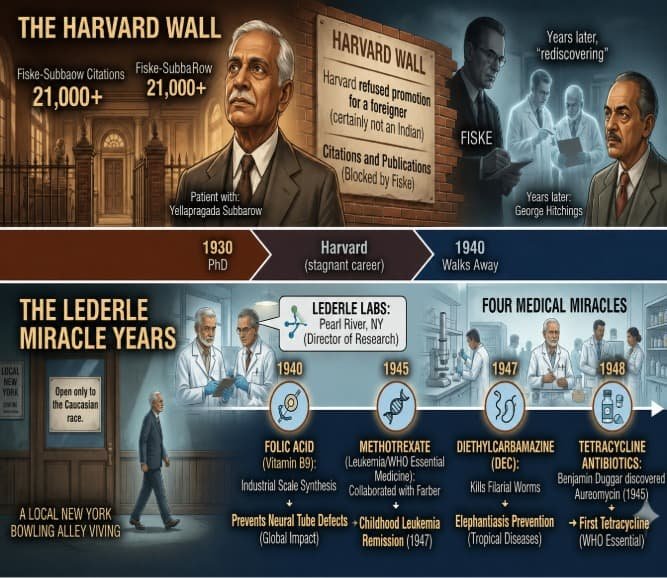
Subbarow earned his PhD in 1930. He stayed at Harvard for another decade, producing paper after paper. His Fiske-SubbaRow method became one of the most cited in biochemistry history, racking up over 21,000 citations.

Yet, every year, Harvard refused to promote him. Tenure never came. The biochemistry department had never granted tenure to a foreigner—certainly not an Indian.

His colleague George Hitchings (who later won a Nobel Prize for work built directly on Subbarow’s foundation) noted that Fiske actively blocked Subbarow’s findings from publication out of professional jealousy, forcing some discoveries to be “rediscovered” years later by other scientists.

The Lederle Miracle Years

In 1940, facing a stagnant career at Harvard, Subbarow walked away. Lederle Laboratories in Pearl River, New York, recognized his genius and hired him as Director of Research. In eight years, he changed the trajectory of modern medicine.

Yet, outside the laboratory, the racial walls remained literal. Even as a Director of Research, a local New York bowling alley refused him entry. The sign on the door read: “Open only to the Caucasian race.”

Subbarow ignored the cruelty and focused on the science, delivering four medical miracles:

  • Folic Acid: He isolated and synthesized vitamin B9 on an industrial scale. Today, folic acid supplementation prevents catastrophic neural tube defects in millions of pregnancies worldwide.
  • Methotrexate: Collaborating with legendary pediatrician Sidney Farber, Subbarow developed aminopterin, the first drug to induce remission in childhood leukemia (1947). He then refined it into methotrexate, which remains a WHO Essential Medicine for leukemia, lymphoma, breast cancer, rheumatoid arthritis, and psoriasis.
  • Diethylcarbamazine (DEC): An oral breakthrough that kills the filarial worms responsible for elephantiasis. The WHO still relies on DEC to combat tropical diseases that had previously crippled millions.
  • Tetracycline Antibiotics: Under his direct supervision, Benjamin Duggar discovered Aureomycin (chlortetracycline) in 1945—the world’s first tetracycline antibiotic. It opened the door to doxycycline and minocycline, still used daily against plague, anthrax, cholera, and drug-resistant infections.

The Last Bow

On August 8, 1948, Subbarow suffered a fatal heart attack at his New York home. He was only 53.

No American newspaper ran a front-page obituary. No university held a grand memorial. The Nobel Committee never nominated him. In 1950, Argosy magazine published a rare feature titled “Miracle Man of the Miracle Drugs.” The opening line read:

“You’ve probably never heard of Dr. Yellapragada Subbarow. Yet because he lived you may be alive and are well today. Because he lived you may live longer.”

Harvard has never officially honored him, and most Western medical schools do not teach his name.

India Remembers. The World Uses.

The Indian government issued a postage stamp for his centenary, his childhood home became a museum, and Indian medical schools proudly teach his legacy. But the country where he made his discoveries—the same country whose doctors write methotrexate prescriptions daily—barely knows his face.

If you have ever taken methotrexate for an autoimmune disease, taken folic acid during pregnancy, or been prescribed doxycycline for an infection, you owe your health to the tragic, quiet genius of Yellapragada Subbarow.

Appendix: Verified Academic and Historical Sources

  1. Biographical Details & Chronology: Gupta, S. P. K. (1987). In Quest of Panacea: Successes and Failures of Yellapragada Subbarow. New Delhi: Evelyn Publishers. (Details early life, family tragedy in 1913, and the Madras Medical College khadi gown incident).
  2. The Fiske-Subbarow Assay: Fiske, C. H., & Subbarow, Y. (1925). The colorimetric determination of phosphorus. Journal of Biological Chemistry, 66(2), 375-400.
  3. ATP Discovery & Citation History: Fiske, C. H., & Subbarow, Y. (1929). Phosphorus compounds of muscle and liver. Science, 70(1816), 381-382.
  4. Historical Misattribution of ATP: Radhakrishnan, J. (2025). SubbaRow: Because he lived, you may live longer. Hektoen International: A Journal of Medical Humanities. (Details the Lohmann/Meyerhof controversy and Harvard structural barriers).
  5. Methotrexate & Childhood Leukemia: Farber, S., Diamond, L. K., Mercer, R. D., Sylvester, R. F., & Wolff, J. A. (1948). Temporary remissions in acute leukemia in children produced by folic acid antagonist, 4-aminopteroyl-glutamic acid (aminopterin). New England Journal of Medicine, 238(23), 787-793. (Acknowledges Subbarow’s chemical synthesis synthesis contribution).
  6. Dermatological and Rheumatological Legacy: Bharti, A. H., & Marfatia, Y. S. (2017). Yellapragada SubbaRow – The unsung Indian biochemist behind methotrexate and other drugs. Indian Journal of Dermatology, Venereology and Leprology, 83(6), 733-735.
  7. Lederle Laboratories & Civil Rights Obstacles: Posner, G. (2020). Pharma: Greed, Lies, and the Poisoning of America. New York: Avid Reader Press. (Excerpts highlighting New York racial discrimination and the Lederle research years).
  8. Antibiotic Breakthroughs: Modern History of Chemotherapy Retrospective. University of Bristol Academic Archives (2004/2026 update). The Isolation of Aureomycin under the Direction of Y. Subbarow.
  9. Media Recognition: Argosy Magazine (1950, NY Edition). Feature Article: “Miracle Man of the Miracle Drugs” archived press records.
  10. Modern Clinical Relevance: Longo, D. L., & Armitage, J. O. (2025). Considerations on Cancer Drug Development and Essential Medicines. The ASCO Post. (Validating methotrexate and tetracycline statuses on the WHO Model List of Essential Medicines).

Hot this week

Private Equity Funds in Indian Healthcare: Who Wins? Who Loses?

The Two Headlines That Should Not Coexist Two recent news...

Gen Z Healthcare: Review of the Decoding Gen Z Report

Gen Z is not waiting to get sick. But...

Character: The Ultimate Differentiator in Healthcare and Pharma

My friend Salil Kallianpur, in his Substack post "The...

Has the Pharmacy of the World Missed the Animal Health Bus?

In 2025, the Indian animal health market stood at...

Do Retail Pharmacies Really Care about Patients?

The chemist shop—jammed between a chai stall and a...

Topics

Private Equity Funds in Indian Healthcare: Who Wins? Who Loses?

The Two Headlines That Should Not Coexist Two recent news...

Character: The Ultimate Differentiator in Healthcare and Pharma

My friend Salil Kallianpur, in his Substack post "The...

Has the Pharmacy of the World Missed the Animal Health Bus?

In 2025, the Indian animal health market stood at...

Do Retail Pharmacies Really Care about Patients?

The chemist shop—jammed between a chai stall and a...

Indian Oncology: An Unasked Question, the Challenges Ahead

A Brief History of Scale and an Unasked Question In...

Are Quick Remedies Keeping Patients Away from Doctors?

The recent Mint Lounge analysis captured a striking consumer...

From Tragedy to Trust: What the CDCSO Can Learn from Dr. Frances Oldham Kelsey

Abstract The U.S. Food and Drug Administration (FDA) evolved from...
spot_img

Related Articles

spot_imgspot_img