
Two pharmaceutical giants are currently locked in a high-stakes battle over a 100 billion-dollar obesity drug market, and the weapon of choice is no longer just a molecule. It is a federal lawsuit.
Recently, Novo Nordisk filed a lawsuit against Eli Lilly in the United States District Court for the District of New Jersey, alleging false advertising under the Lanham Act. This is not a dispute about clinical trial methodology alone. It is a battle for market share that has expanded from the laboratory to the courtroom. When direct clinical comparisons become a central marketing feature, legal strategy becomes inseparable from commercial strategy.


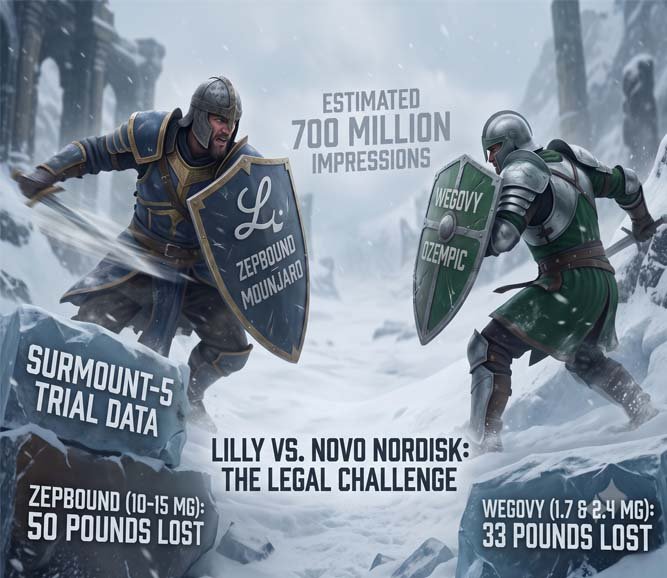
Here is what led to the legal challenge. Lilly executed a nationwide advertising campaign for Zepbound and Mounjaro comparing their weight loss results directly against Novo Nordisk’s Wegovy and Ozempic. The numbers used in the campaign originated from the landmark SURMOUNT-5 trial. That trial evaluated Zepbound at its highest doses, specifically 10 to 15 milligrams, against Wegovy at its previously established doses of 1.7 milligrams and 2.4 milligrams. The outcome produced a striking marketing claim for Lilly: advertisements highlighted an average of 50 pounds lost on Zepbound versus 33 pounds lost on Wegovy. The campaign reached an estimated 700 million impressions.
The commercial landscape shifted in March 2026, when the FDA approved a higher 7.2 milligram dose of Wegovy (Wegovy HD). Novo Nordisk subsequently sent Lilly a cease-and-desist letter, asserting that the comparative advertising claims were now outdated and misleading. Lilly maintained the campaign while adding a clarifying disclaimer that the historical trial data remained accurate. That response prompted Novo Nordisk to file its federal complaint.

Lilly’s nationwide advertising campaign for Zepbound and Mounjaro directly targeted Novo Nordisk’s Wegovy and Ozempic, triggering a high-stakes legal challenge. The numbers featured in the campaign originated from the landmark SURMOUNT-5 trial, which evaluated Zepbound at its highest approved doses (10 to 15 mg) against Wegovy at its earlier established doses (1.7 to 2.4 mg). The resulting marketing claim was striking: advertisements highlighted an average weight loss of 50 pounds on Zepbound compared to 33 pounds on Wegovy. Generating an estimated 700 million impressions, the campaign established a massive market footprint that Novo Nordisk now claims distorts reality.
At the core of the legal dispute is whether these advertised comparisons remain accurate as new clinical data emerges. Cross-trial analyses suggest that when comparing the highest approved doses of both medications, the efficacy gap narrows significantly—with Zepbound at 15 mg showing approximately 48 pounds of weight loss and Wegovy at 7.2 mg approaching 47 pounds. Crucially, however, no head-to-head clinical trial comparing these specific higher doses has yet been conducted.
This analytical gap sits at the centre of Novo Nordisk’s suit. The company is seeking a court order compelling Lilly to withdraw the campaign, issue corrective advertising, and disgorge profits tied to the claims. Novo Nordisk contends that continuing to broadcast comparative figures derived from lower baseline doses misleads patients and prescribers. Lilly counters that the SURMOUNT-5 trial results remain valid, peer-reviewed, and published data.
Under the Lanham Act, comparative advertising grounded in scientific studies must not only be accurate at publication but must also refrain from creating a misleading impression as market conditions evolve. While the design of SURMOUNT-5 was standard, the continued use of its historical figures in ongoing promotion highlights a growing regulatory friction between static clinical trial data and dynamic market realities.

The lawsuit highlights the aggressive marketing tactics defining the metabolic care market. By taking legal action, Novo Nordisk is working to protect its brand positioning against heavy comparative advertising. At the same time, Eli Lilly has leveraged its dual GIP and GLP-1 receptor agonist mechanism to gain substantial market momentum.
This dispute also illustrates the broader landscape among key players in metabolic health. Novo Nordisk, the early pioneer with semaglutide, continues to defend its market footprint while advancing high-dose and combination therapies. Eli Lilly continues an aggressive expansion strategy built on tirzepatide while facing the challenge of defending its promotional campaigns in court.
Meanwhile, Sanofi presents a stark contrast. The French pharmaceutical company largely stepped back from the initial GLP-1 weight loss wave, redirecting major resources toward immunology and rare disease pipelines. Rather than competing in the intensive commercial arena for injectable obesity treatments, Sanofi chose to focus on areas where it maintains a distinct strategic advantage.

The long-term trajectory of the obesity market will ultimately be shaped by novel therapies rather than courtroom decisions. The industry is rapidly advancing toward oral small-molecule formulations and combination triple agonists. If oral daily treatments can deliver strong clinical efficacy with greater convenience, the current debate over injectable dosing schedules will quickly evolve.
For now, the commercial battle continues across both healthcare channels and legal venues. Novo Nordisk is acting to protect its market presence, Eli Lilly is defending its commercial strategy, and the broader industry continues to advance the next generation of metabolic treatments.

Appendix: Sources and References
- Market Size and Financial Projections
Bloomberg Intelligence. Obesity Drug Market Projections. Analysis on total addressable market trends for GLP-1 and incretin-based therapies.
Evaluate Pharma. World Preview Report. Financial analysis projecting market share and revenue trajectories for leading metabolic treatments.
- Clinical Trial Data and Efficacy Comparisons
The New England Journal of Medicine. SURPASS-2 Trial. Head-to-head clinical study evaluating tirzepatide versus semaglutide in patients with type 2 diabetes.
The New England Journal of Medicine. SURMOUNT-5 Trial Data. Primary source comparing clinical efficacy between tirzepatide and semaglutide at initial standard dosing protocols.
- Regulatory Updates and FDA Approvals
U.S. Food and Drug Administration. Official Prescribing Information for Wegovy (semaglutide). Regulatory documentation including approvals for high-dose semaglutide formulations.
U.S. Food and Drug Administration. Official Prescribing Information for Zepbound (tirzepatide). Regulatory documentation detailing approved dosing protocols and trial outcomes.
- Legal Proceedings and Advertising Regulations
United States District Court, District of New Jersey. Novo Nordisk Inc. v. Eli Lilly and Company. Official court filings regarding Lanham Act false advertising claims.
PharmaComplianceMonitor. Comparative Claims and Fair Balance Under the Lanham Act. Legal analysis covering currentness and context in direct-to-consumer pharmaceutical advertising.
- Corporate Strategy and Pipeline Insights
Novo Nordisk. Investor Relations Briefings. Executive updates on production capacity, pipeline developments including oral combinations, and commercial strategy.
Eli Lilly and Company. Strategic Earnings Briefings. Company updates on incretin pipeline developments, manufacturing expansion, and commercial operations.
Sanofi. Strategic Strategy Updates. Company briefings outlining resource allocation toward immunology and rare diseases.
- Clinical Trial Registry Data
ClinicalTrials.gov. Public database records for completed and ongoing metabolic disease trials, confirming current head-to-head trial status across high-dose protocols.