
Sunday, August 30, 2026
24.6 C
Bengaluru

Why The Government Must Stop Playing Market Trader And Start Being The Sheriff

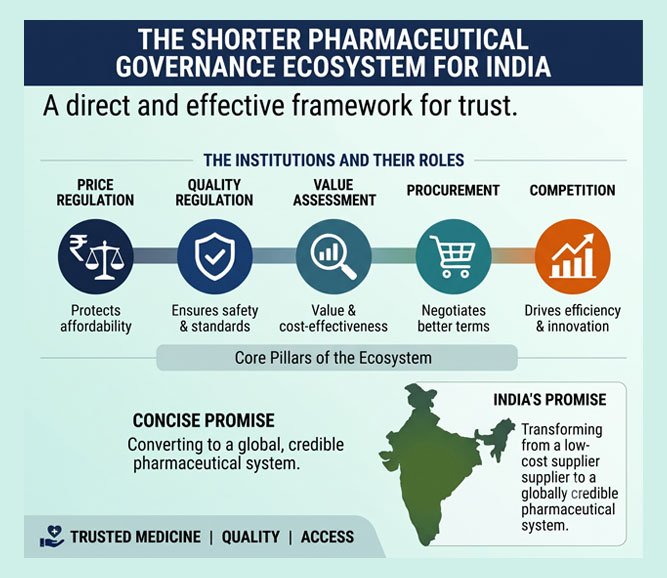
India has two very different pharmaceutical regulators living inside the same government. Through the National Pharmaceutical Pricing Authority, or NPPA, the state acts like a market referee, setting ceiling prices for essential medicines, monitoring price revisions, and pursuing overcharging under the Drugs Prices Control Order, 2013. Through the Central Drugs Standard Control Organisation, or CDSCO, and in partnership with State Licensing Authorities, it plays a more fundamental role: ensuring that the medicine inside the pack is what the label says it is.

Both jobs matter. But they are not equally important. A government can influence whether a paracetamol tablet costs one rupee or two. Only a drug regulator can determine whether that tablet has been manufactured consistently, contains the required amount of active ingredient, is free from unacceptable contamination and complies with applicable quality standards. That distinction should sit at the centre of Indian pharmaceutical policy. Price control cannot compensate for weak quality control. And when quality is hard for the buyer to assess, excessive emphasis on price can create the wrong competitive incentives.


Two Ministries, Two Very Different Jobs

NPPA operates under the Department of Pharmaceuticals in the Ministry of Chemicals and Fertilisers. Drug regulation is primarily a health function, administered by the CDSCO and the State Licensing Authorities under the Drugs and Cosmetics framework. The split is understandable. Affordability is a legitimate public-policy objective. The Drugs Prices Control Order places scheduled formulations under price control, while various provisions govern ceiling prices, price lists and sales above permitted prices. But affordability and quality solve different problems.

One asks: What may this medicine cost?

The other asks: Is this actually a medicine worthy of being sold?

India risks confusing the two.

The Pricing Regime Is Still Evolving

The distinction has become especially relevant after the Drugs Prices Control Amendment Order, 2026. The June 30 amendment modified provisions on overcharging liability and the dissemination of revised prices. Where specified requirements are met, a manufacturer may be able to limit liability for stock already in the market where overcharging occurs further down the distribution chain. The amendment also strengthened the importance of demonstrating that revised prices were properly communicated through price lists, trade communication, public notices, websites and stock information.

Yet the pricing debate is moving again. On August 29, The Economic Times reported that NPPA officials were considering changes under which manufacturers could bear greater responsibility for overpricing while enforcement exposure for retailers, hospitals and nursing homes may be reduced. Importantly, this is a proposal, not the present law. This continuing argument over who bears responsibility for every rupee of overcharging reveals something about regulatory priorities.

India is extraordinarily attentive to the price printed on the pack. It needs to become equally uncompromising about what happens inside the factory that produced it.

The False Economy Of The Ceiling

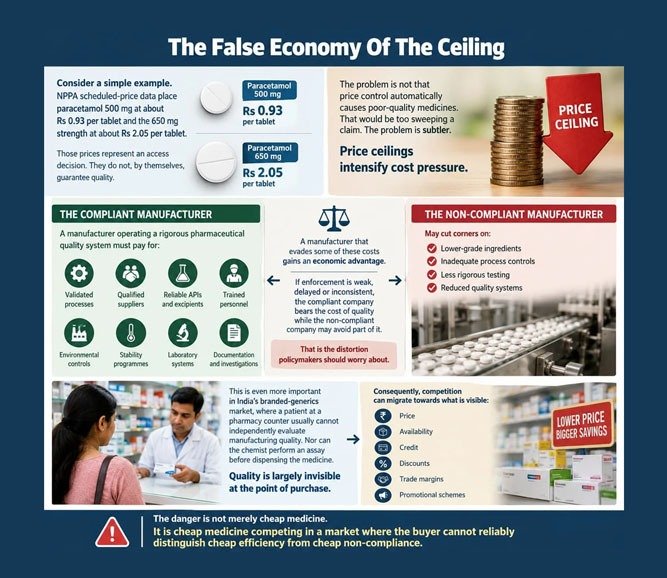
Consider a simple example. NPPA scheduled-price data place paracetamol 500 mg at about Rs 0.93 per tablet and the 650 mg strength at about Rs 2.05 per tablet. Those prices represent an access decision. They do not, by themselves, guarantee quality. The problem is not that price control automatically causes poor-quality medicines. That would be too sweeping a claim. The problem is subtler. Price ceilings intensify cost pressure.

A manufacturer operating a rigorous pharmaceutical quality system must pay for validated processes, qualified suppliers, reliable APIs and excipients, trained personnel, environmental controls, stability programmes, laboratory systems, documentation and investigations when something goes wrong.

A manufacturer that evades some of these costs gains an economic advantage. If enforcement is weak, delayed or inconsistent, the compliant company bears the cost of quality while the non-compliant company may avoid part of it. That is the distortion policymakers should worry about. This is even more important in India’s branded-generics market, where a patient at a pharmacy counter usually cannot independently evaluate manufacturing quality. Nor can the chemist perform an assay before dispensing the medicine. Quality is largely invisible at the point of purchase. Consequently, competition can migrate towards what is visible: price, availability, credit, discounts, trade margins and promotional schemes.

The danger is not merely cheap medicine. It is cheap medicine competing in a market where the buyer cannot reliably distinguish cheap efficiency from cheap non-compliance.

India Is Too Big For Quality To Remain Opaque

The stakes are enormous. According to Pharmarack data reported for FY26, India’s domestic pharmaceutical market reached approximately Rs 2.46 lakh crore, growing 8.8 per cent from around Rs 2.26 lakh crore in FY25. A market of that scale cannot rely indefinitely on brand reputation as the principal proxy for manufacturing trust. India needs a regulatory environment in which confidence increasingly attaches not merely to a company name but to the system itself. In other words, a patient should be able to assume that any legally marketed medicine has crossed a meaningful minimum quality threshold. That is what a strong sheriff provides.

To Its Credit, CDSCO Is Changing

It would be unfair to portray Indian drug regulation as static. Since December 2022, CDSCO and state regulators have conducted risk-based inspections of more than 960 pharmaceutical premises. Government data say those inspections generated more than 860 regulatory actions, including show-cause notices, stop-production orders, licence suspensions and cancellations, and warning letters.

The government has also subjected more than 1,100 cough-syrup manufacturers to intensive audits, increased market-surveillance sampling and continued publishing monthly alerts on medicines found to be Not of Standard Quality.

Revised Schedule M is another important step.

The rules were strengthened in December 2023 to bring pharmaceutical GMP requirements closer to international standards and explicitly strengthen quality-management systems.

They took effect earlier for larger manufacturers, while smaller manufacturers were given additional transition time.

These are significant reforms. The argument, therefore, should not be that India has no sheriff. The argument is that the sheriff still needs greater reach, consistency, and authority across states. Manufacturing licences and routine enforcement remain deeply dependent on State Licensing Authorities. The central regulator can coordinate, inspect jointly and establish standards, but execution ultimately depends heavily on state capacity. That creates the possibility of uneven enforcement across a national pharmaceutical market.

What Quality-First Competition Would Look Like

Imagine instead that serious GMP enforcement becomes unavoidable. A manufacturer unable or unwilling to maintain compliant systems would face genuine commercial consequences: remediation, stop-production orders, suspension or loss of licence. Once poor-quality supply is systematically removed, competition changes. Efficient manufacturers can still compete aggressively on cost. Indeed, India should celebrate companies that can produce high-quality medicines cheaply. But they would compete through process efficiency, not regulatory arbitrage. Retailers could compete on availability, credit, convenience and service. Manufacturers could compete through supply reliability, physician confidence, evidence, formulation improvement and operational excellence.

NPPA could continue protecting affordability where public-health considerations justify price ceilings. But price regulation would no longer be expected to solve a problem it was never designed to solve: assuring pharmaceutical quality.

The Access Objection

There is an obvious counterargument. Millions of Indians need inexpensive medicines. NLEM price ceilings and Jan Aushadhi exist precisely because medicines cannot be treated like ordinary consumer goods. That argument is correct. India should not abandon price discipline for essential medicines. But neither should affordability be confused with access. A medicine is accessible only if it is affordable and works as intended.

A cheap tablet that fails assay is not access.

A contaminated syrup is not affordability.

A product manufactured under an unreliable quality system is not a healthcare bargain.

It is a false economy sold to the patient.

The policy objective therefore cannot be cheap medicines.

It must be reliably good medicines at the lowest sustainable price.

That requires NPPA and CDSCO to do their jobs differently and exceptionally well.

From Price Policeman To Quality Sheriff

India’s pharmaceutical industry wants to move from global leadership by volume towards leadership in complex generics, biosimilars, biologics and innovation. That ambition raises the regulatory bar dramatically. The world will not judge India’s future pharmaceutical credibility by how precisely it can calculate the ceiling price of a paracetamol tablet. It will judge India by whether regulators can consistently guarantee the integrity of increasingly complex medicines manufactured across thousands of facilities. When government debates the last rupee of medicine pricing more intensely than the consistency of the medicine itself, an uncomfortable question arises: Are we regulating what is easiest to measure rather than what matters most?

India needs both the market referee and the sheriff. NPPA should protect patients from unjustified pricing where the law requires it. But CDSCO and the State Licensing Authorities must ensure that regulatory non-compliance is never a viable business model. Because when a manufacturer can save more by avoiding quality costs than it risks losing through enforcement, the market is signalling the wrong thing. The ultimate regulatory compact should be simple. Government can determine what an essential medicine may cost. But its first responsibility is to ensure that whatever the patient buys at that price is actually a medicine worthy of trust.

That is the difference between playing market trader and being the sheriff.

Sources

1.     Drugs Prices Control Order, 2013

Department of Pharmaceuticals, Government of India. Relevant provisions cover scheduled formulation pricing, price lists, the dissemination of revised prices, and restrictions on sales above permitted prices.

2.     Drugs Prices Control Amendment Order, 2026 S.O. 3516(E), notified June 30, 2026. The amendment revised provisions relating to overcharging liability and price-dissemination obligations. It also introduced conditions under which manufacturer liability may be limited where revised prices were properly communicated and overcharging occurred further down the distribution chain.

3.     NPPA Proposal on Overcharging Liability, The Economic Times, August 29, 2026. The report describes an NPPA proposal concerning manufacturer responsibility and enforcement against retailers, hospitals and nursing homes. This remains a reported proposal and should not be presented as enacted law.

4.     Scheduled Paracetamol Prices. National Pharmaceutical Pricing Authority. NPPA scheduled-price data list paracetamol 500 mg tablets at approximately Rs 0.93 per tablet and paracetamol 650 mg tablets at approximately Rs 2.05 per tablet.

5.     Indian Pharmaceutical Market Size. Pharmarack FY26 data, reported by Financial Express. Domestic pharmaceutical sales were approximately Rs 2.46 lakh crore in FY26, compared with around Rs 2.26 lakh crore in FY25.

6.     Risk-Based Pharmaceutical Inspections. Ministry of Health and Family Welfare, parliamentary replies and Press Information Bureau releases. Government data show that CDSCO and state regulators have jointly inspected more than 960 pharmaceutical manufacturing premises since December 2022 and taken more than 860 regulatory actions.

7.     Schedule M and Manufacturing Quality Reforms. Government notifications and statements from the Ministry of Health and Family Welfare. Revised Schedule M strengthened pharmaceutical manufacturing and quality-management requirements, with phased implementation across large and small manufacturers.

8.     Cough Syrup Manufacturing Audits. Ministry of Health and Family Welfare and Press Information Bureau statements. Government reports indicate that more than 1,100 cough syrup manufacturers have undergone intensive audits, along with increased surveillance sampling and quality monitoring.

PUBLICATION NOTE

The central argument of this article is about regulatory incentives, not an allegation that price-controlled manufacturers generally compromise quality. No evidence establishes a universal causal relationship between NLEM price ceilings and poor manufacturing quality.

The policy concern is narrower and more defensible. Where enforcement is inconsistent, a manufacturer that avoids legitimate quality-system costs can gain an unfair economic advantage over manufacturers that fully invest in GMP compliance. India therefore needs both affordability and quality. But the two should not be confused. Price regulation can determine how much a medicine costs. Only strong pharmaceutical regulation can ensure that the medicine offered at that price is worthy of the patient’s trust.

Hot this week

MedicinMan Pharma Pulse: August 2026

🚀 The Mega-Merger That Wasn't Early August saw the...

GLP-1: When the Molecule Becomes a Commodity, What Becomes the Moat?

STOP PRESS August 10, 2026: Regulatory Authorisation — The UK...

How To See Dr Reddy’s Nestle In The Wellness Shift

GLP-1 medicines such as semaglutide and tirzepatide are changing...

How To Power The India Biopharma Regulatory Revolution Now

Beyond the Pharmacy of the World: Why India's Biopharma...

Will Mounjaro Disrupt Existing Therapy Areas Like Cardiology?

Something remarkable has happened in the Indian pharmaceutical market....

Topics

MedicinMan Pharma Pulse: August 2026

🚀 The Mega-Merger That Wasn't Early August saw the...

GLP-1: When the Molecule Becomes a Commodity, What Becomes the Moat?

STOP PRESS August 10, 2026: Regulatory Authorisation — The UK...

How To See Dr Reddy’s Nestle In The Wellness Shift

GLP-1 medicines such as semaglutide and tirzepatide are changing...

How To Power The India Biopharma Regulatory Revolution Now

Beyond the Pharmacy of the World: Why India's Biopharma...

Will Mounjaro Disrupt Existing Therapy Areas Like Cardiology?

Something remarkable has happened in the Indian pharmaceutical market....

Can India Pivot From Low-Cost Medical Tourism to Trusted Medical Value Travel?

C-Suite Executive Summary India stands at a pivotal juncture in...

Will President Trump’s Diktat Improve Drug Quality For Indian Patients?

Executive Summary The geopolitical landscape of pharmaceutical manufacturing is shifting...
spot_img

Related Articles

spot_imgspot_img