
RPG Active Pharma’s agreement to acquire the API and intermediates business of Raghava Life Sciences for up to Rs 135 crore is not, by pharmaceutical M&A standards, a mega-deal.
But it is strategically revealing.
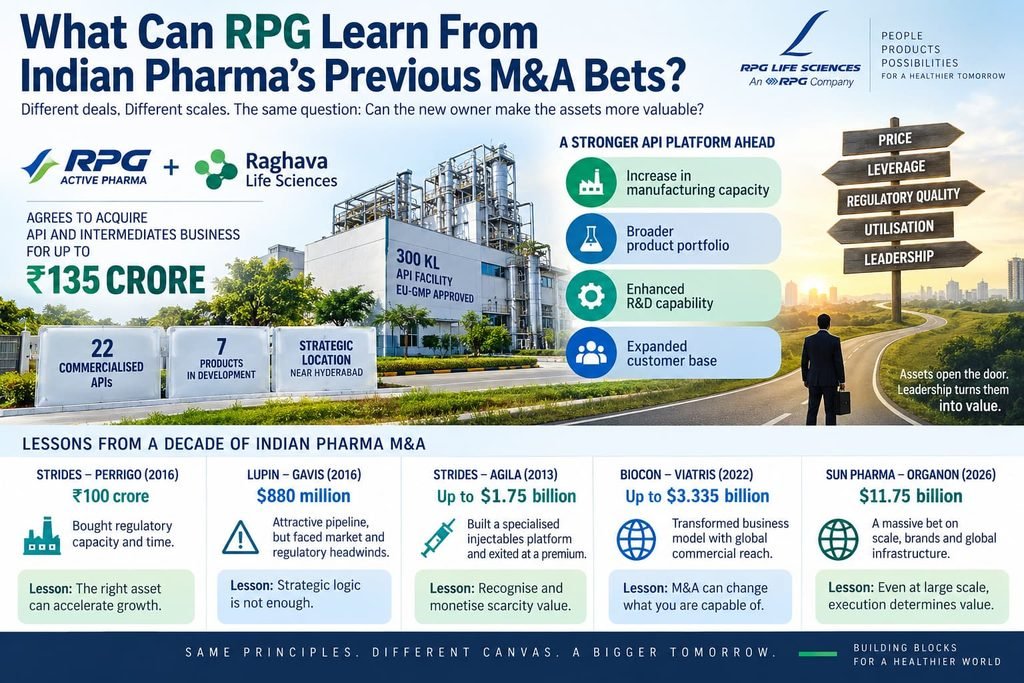
The transaction gives RPG Active Pharma access to a 300 KL API manufacturing facility near Hyderabad, an EU-GMP-approved plant, 22 commercialised APIs and seven products under development. RPG says the acquisition will broaden its manufacturing base, product portfolio, regulatory capabilities and customer access as it builds a scaled API-focused organisation. (Moneycontrol)
The deal also comes at an important point in RPG’s evolution. RPG Life Sciences has carved out its API business into RPG Active Pharma and is pursuing a broader consolidation strategy rather than relying solely on organic capacity expansion. That makes Raghava more than a capacity purchase. It tests whether RPG can use M&A to accelerate its transformation into a larger, more competitive API platform. And Indian pharma’s experience over the last decade suggests the outcome will depend on much more than the assets acquired. It will depend on price, leverage, regulatory quality, utilisation and, ultimately, leadership.

Why Raghava Matters to RPG
The most obvious attraction is manufacturing capacity. Raghava brings a 300 KL facility near Hyderabad, EU-GMP regulatory credentials, and an established product portfolio. The acquired business includes 22 commercialised APIs and another seven products under development. (Moneycontrol) For an API company, this matters because pharmaceutical manufacturing capacity is not simply a collection of reactors and buildings. A regulated pharmaceutical facility embodies years of process development, validation, documentation, quality systems, regulatory inspections and customer approvals. Building an equivalent greenfield facility can therefore take considerably longer than constructing the physical plant itself. Buying an operating regulatory platform can effectively mean buying time. That logic is particularly relevant to RPG because its API operations were disrupted after a fire affected one manufacturing block at its Navi Mumbai facility in January 2025. The Raghava transaction therefore provides additional capacity and geographic diversification as RPG rebuilds and expands the API business. The strategic question is no longer merely whether RPG needs more capacity. It is whether it can make the acquired capacity productive quickly enough to justify the price.

The Valuation Question
This is where the transaction becomes particularly interesting. The Raghava business reportedly generated approximately Rs 19 crore of revenue in FY26, while the consideration is up to Rs 135 crore. On trailing revenue alone, that implies a valuation of roughly seven times sales. That initially looks expensive. But trailing revenue may also be the wrong way to evaluate the deal. RPG is not simply acquiring Rs 19 crore of current sales. It is acquiring manufacturing infrastructure, regulatory approvals, commercialised products, development-stage molecules, R&D capability and customer relationships. The real valuation therefore depends on what RPG can make the facility produce after acquisition. If RPG succeeds in sharply improving capacity utilisation, commercialising the seven pipeline molecules, moving more products into regulated markets and using the enlarged platform to attract additional customers, the apparent premium could become economically rational. If utilisation remains low, the same purchase price will look considerably less attractive. That distinction is fundamental to pharmaceutical M&A.
An underutilised regulated facility can look expensive on today’s revenue and inexpensive on tomorrow’s revenue. The buyer has to create tomorrow’s revenue.

The Strides Lesson: Buying Regulatory Capacity Can Work
There is a useful historical comparison. In 2016, Strides Shasun agreed to acquire Perrigo’s US FDA-approved API facility at Ambernath for Rs 100 crore. The facility had a potential capacity of approximately 600 tonnes annually, and Perrigo API India had reported FY16 revenue of Rs 73.76 crore. Strides explicitly said the facility would augment its ability to handle new-product development and commercial launches and accelerate time to market. (Strides)
The economics were very different from Raghava. Strides paid approximately 1.36 times reported revenue versus roughly seven times trailing revenue in the Raghava transaction. But the comparison should not be pushed too far. The transactions occurred a decade apart, involve different portfolios, different regulatory assets and different strategic circumstances. The more useful lesson is conceptual. Strides was willing to pay for a ready regulatory manufacturing platform because time itself has economic value in pharmaceuticals. RPG appears to be making a similar calculation.

The Lupin Warning: Strategic Logic Is Not Enough
Lupin’s acquisition of Gavis Pharmaceuticals illustrates the other side of pharmaceutical M&A. Lupin agreed to acquire Gavis for $880 million and completed the transaction in 2016. Gavis gave Lupin its first US manufacturing site, a substantial ANDA pipeline and increased exposure to niche generics. (Lupin) The strategic logic initially appeared strong. The outcome was considerably more difficult. Lupin itself has subsequently acknowledged that the Gavis acquisition did not play out as expected. The portfolio had substantial exposure to controlled substances, including opioid pain medicines, and the subsequent US crackdown materially weakened the economics of that portfolio. (Lupin) That provides an important lesson for RPG.
Acquiring assets is not the same thing as acquiring predictable earnings. Product mix, regulation, customer concentration, pricing cycles and market structure can alter the economics of an acquisition after the cheque has been written.
The question RPG must therefore ask is not simply: What products does Raghava have today?
It is: How durable and commercially scalable are those products under RPG ownership?

The Biocon Lesson: Sometimes M&A Changes The Business Model
Biocon Biologics provides another useful comparison. Its acquisition of Viatris’ global biosimilars business for consideration of up to $3.335 billion was transformational rather than incremental. The transaction included $2 billion in cash, $1 billion in convertible preferred equity and additional deferred consideration. (Biocon Biologics) Biocon was not simply buying products. It was buying the ability to commercialise its biosimilars directly across major global markets. That distinction matters. Before the transaction, much of Biocon’s commercial reach depended on partnerships. After the acquisition and subsequent integration, Biocon Biologics assumed direct responsibility for its biosimilars business across more than 120 countries. (Biocon Biologics) The lesson for RPG is that a successful acquisition can change what a company can do, not merely increase its current revenue. The strategic value of Raghava will similarly depend on whether it expands RPG’s organisational capabilities rather than simply adding reactors to the balance sheet.

The Sun Pharma Comparison: Scale Changes, Capital Allocation Does Not
At the opposite end of the spectrum is Sun Pharma’s $11.75 billion definitive agreement to acquire Organon. The scale is almost incomparable with RPG’s Rs 135 crore transaction. Organon gives Sun Pharma a major global portfolio spanning women’s health, established brands and biosimilars, along with extensive international commercial infrastructure. The deal values Organon at an enterprise value of $11.75 billion. (Organon) But beneath the vastly different transaction sizes lies the same capital-allocation question confronting RPG:
Can the new owner make the acquired assets more valuable than they were under the old owner?
That is ultimately the central question in almost every acquisition. Sun Pharma is betting that its management system, portfolio discipline and global scale can generate greater value from Organon’s assets. RPG is making the same bet on a dramatically smaller canvas. It must make Raghava more productive under RPG ownership than it was independently.

The Leadership Factor
This is where pharmaceutical M&A stops being purely a financial exercise. Investment bankers can calculate valuation multiples. Consultants can estimate synergies. Engineers can assess installed capacity. Regulatory teams can evaluate manufacturing approvals. But leadership determines whether those pieces convert into economic value. Two Indian pharma examples demonstrate how different that leadership can look.
Arun Kumar and Strides developed a reputation for recognising scarcity value in pharmaceutical assets and recycling capital when valuations became attractive. The most dramatic example was Agila Specialities. Mylan initially agreed to acquire Agila from Strides for $1.6 billion in cash plus possible additional consideration. At completion, the transaction was structured at up to $1.75 billion, including $250 million of contingent consideration linked partly to regulatory conditions. (Mylan N.V.) Strides had built a specialised injectables platform and recognised that a global buyer would place substantially greater strategic value on that platform. That is one form of capital allocation.
Dilip Shanghvi and Sun Pharma represent another. Sun’s approach has historically emphasised acquiring portfolios and businesses that can benefit from long-term integration, operational discipline and portfolio optimisation. The Organon transaction takes that model to an unprecedented scale. Neither approach necessarily provides the template for RPG. But both demonstrate something important. Successful pharmaceutical M&A is ultimately a leadership capability, not merely a finance capability.
The Real RPG Wager
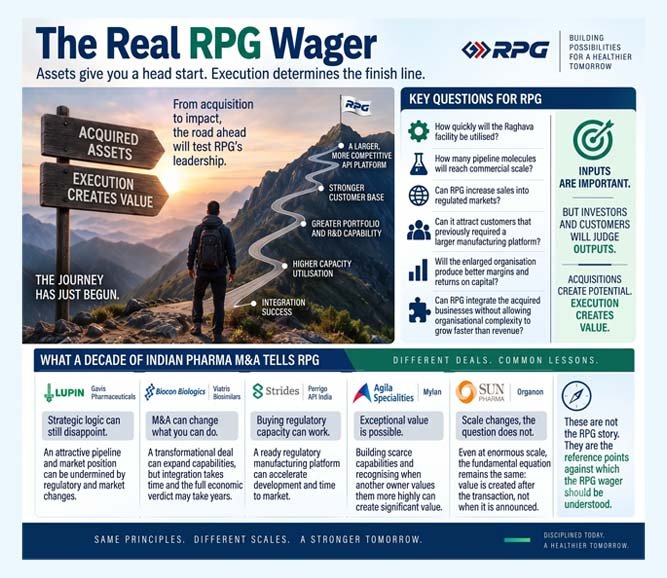
RPG’s own acquisition communication makes ambitious claims about what its recent consolidation programme could achieve: substantially greater manufacturing capacity, a broader product portfolio, stronger R&D capability and a larger customer base. These are important inputs. But investors and customers will ultimately judge outputs. How quickly will the Raghava facility be utilised? How many pipeline molecules will reach commercial scale? Can RPG increase sales into regulated markets? Can it attract customers that previously required a larger manufacturing platform? Will the enlarged organisation produce better margins and returns on capital? And perhaps most importantly: Can RPG integrate the acquired businesses without allowing organisational complexity to grow faster than revenue? That is where many acquisitions fail.

What A Decade Of Indian Pharma M&A Tells RPG
Indian pharma’s experience offers several lessons. Lupin-Gavis shows that an attractive pipeline and strategic market position can still disappoint when market and regulatory conditions change. Biocon-Viatris demonstrates how an acquisition can fundamentally expand a company’s capabilities, but also how transformational deals require years of integration before the full economic verdict becomes clear. Strides-Perrigo shows the value of acquiring regulated manufacturing capacity when it accelerates development and time to market. Agila demonstrates that exceptional value can also be created by building scarce pharmaceutical capabilities and recognising when another owner values them more highly. And Sun Pharma-Organon demonstrates that even at enormous scale, the fundamental equation remains the same: acquisition value is created after the transaction, not when it is announced. These transactions are therefore not the subject of the RPG story. They are the reference points against which the RPG wager should be understood.
The Road Ahead
Raghava gives RPG Active Pharma more manufacturing capacity, more products, stronger regulatory infrastructure and additional customers. What it does not automatically give RPG is a return on investment. That has to be created. The Rs 135 crore consideration will eventually look either expensive or inexpensive depending on what RPG does with the asset over the next several years. If the company rapidly increases utilisation, converts pipeline products into revenue, expands regulated-market exposure and creates a stronger integrated API platform, the acquisition could prove to be a highly efficient shortcut to scale. If those benefits fail to materialise, the seven-times-trailing-revenue headline will become much harder to defend. That is why the RPG-Raghava transaction deserves attention beyond its relatively modest size. It represents a larger transformation underway across Indian pharmaceuticals. As companies move beyond organic growth and increasingly use M&A to acquire technology, regulatory approvals, products, manufacturing infrastructure and customers, capital allocation is becoming as important a leadership competence as pharmaceutical manufacturing itself.
RPG has bought the opportunity. Now it has to create value.

Appendix: References And Source Notes
RPG Active Pharma and Raghava Life Sciences
Moneycontrol, September 3, 2026. Report on RPG Active Pharma’s acquisition of Raghava Life Sciences’ API and intermediates business for up to Rs 135 crore. Reports the 300 KL manufacturing facility, EU-GMP credentials, 22 commercialised APIs and seven development-stage products. (Moneycontrol)
Business Standard/Capital Market, September 3, 2026. RPG Life Sciences disclosed that its wholly owned subsidiary RPG Active Pharma entered into a Business Transfer Agreement to acquire the API and intermediates undertaking of Raghava Life Sciences on a going-concern, slump-sale basis for consideration of up to Rs 135 crore. The transaction is subject to customary closing conditions and regulatory approvals. (Business Standard)
RPG Life Sciences corporate communication supplied with this article. RPG states that its two strategic acquisitions are intended to materially increase manufacturing capacity, product portfolio, R&D capability and customer reach. These figures should be treated as management projections/transaction rationale rather than independently established post-integration outcomes.
Strides Shasun and Perrigo API India
Strides Shasun, December 9, 2016. Official announcement of the agreement to acquire Perrigo API India for Rs 100 crore. The Ambernath facility had potential capacity of approximately 600 tonnes annually, was US FDA approved and had recorded FY16 turnover of Rs 73.76 crore. Strides explicitly cited accelerated time to market and increased new-product capacity as strategic benefits. (Strides)
Business Standard, December 2016. Contemporary reporting on the transaction, including Rs 100 crore consideration, Rs 73.76 crore FY16 turnover, 600-tonne potential annual capacity and planned use for captive API requirements. (Business Standard)
Lupin and Gavis Pharmaceuticals
Lupin. Official announcement of the $880 million acquisition of Gavis Pharmaceuticals and Novel Laboratories. The transaction expanded Lupin’s US generic pipeline and gave it its first manufacturing facility in the United States. (Lupin)
Lupin. Confirmation of completion of the Gavis acquisition and details of the acquired ANDA and niche-product pipeline. (Lupin)
Lupin, 2026 management commentary. Retrospective assessment acknowledging that Gavis did not develop as anticipated, including the effect of its exposure to controlled substances and the subsequent US opioid crackdown. (Lupin)
Biocon Biologics and Viatris
Biocon Biologics, February 2022. Official announcement of the acquisition of Viatris’ biosimilars business for consideration of up to $3.335 billion, structured through cash, convertible preference shares and deferred consideration. (Biocon Biologics)
Biocon Biologics, November 2022. Confirmation of transaction completion, including $2 billion upfront cash consideration and $1 billion in convertible preferred equity. (Biocon Biologics)
Viatris, November 2022. Confirmation that the biosimilars transaction had closed and description of the transition-services arrangement. (Viatris)
Biocon Biologics. Subsequent integration update confirming completion of the integration of the acquired biosimilars business across approximately 120 countries and the transfer of direct commercial responsibility to Biocon Biologics. (Biocon Biologics)
Strides and Agila Specialities
Mylan, February 2013. Official announcement of the definitive agreement to acquire Agila Specialities from Strides Arcolab for $1.6 billion cash plus up to $250 million of additional potential consideration. (Mylan N.V.)
Mylan, December 2013. Completion announcement. Final structure provided for consideration of up to $1.75 billion, including $250 million in contingent consideration partly tied to regulatory conditions. (Mylan N.V.)
Sun Pharma and Organon
Sun Pharma and Organon, April 2026. Definitive agreement under which Sun Pharma will acquire Organon for $14 per share in cash, valuing the company at an enterprise value of approximately $11.75 billion. (Organon)
The transaction is included in this article solely as a contemporary capital-allocation comparison with RPG-Raghava, not as evidence that RPG’s transaction will follow the same strategic or financial trajectory.