
Friday, August 21, 2026
27.3 C
Bengaluru

Will Mounjaro Disrupt Existing Therapy Areas Like Cardiology?

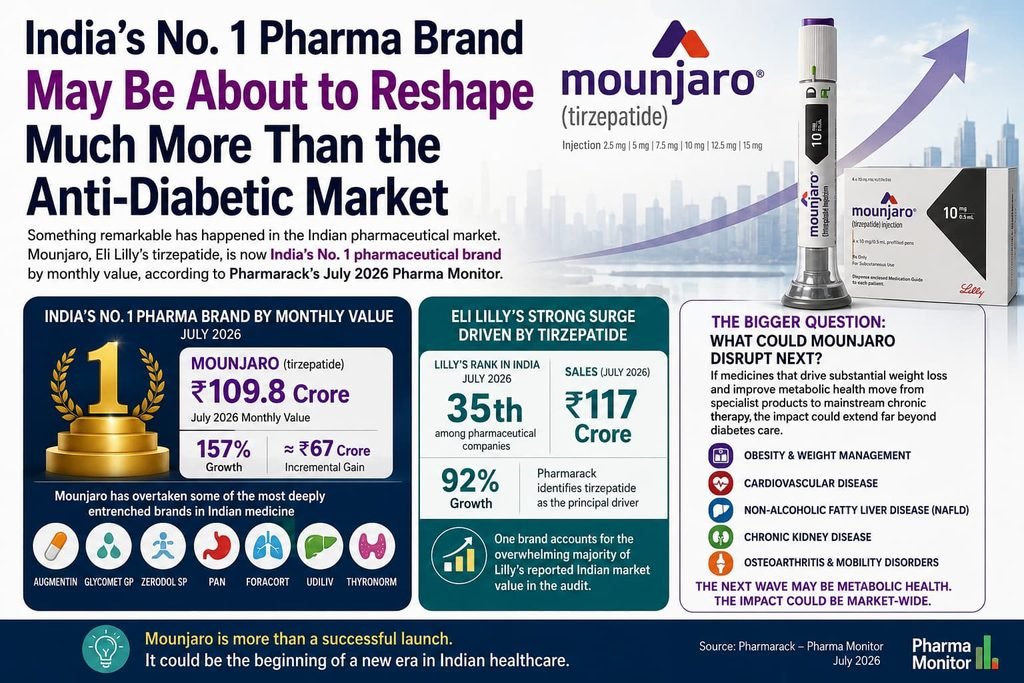
Something remarkable has happened in the Indian pharmaceutical market. Mounjaro, Eli Lilly’s tirzepatide, is now India’s No. 1 pharmaceutical brand by monthly value, according to Pharmarack’s July 2026 Pharma Monitor. At approximately Rs 109.8 crore for July, Mounjaro has overtaken some of the most deeply entrenched brands in Indian medicine, including Augmentin, Glycomet GP, Zerodol SP, PAN, Foracort, Udiliv, and Thyronorm. It recorded 157 per cent growth and an incremental gain of approximately Rs 67 crore.

The rise is even more striking at the corporate level. Eli Lilly ranked only 35th among pharmaceutical companies in India in July, with sales of approximately Rs 117 crore. Yet the company grew 92 per cent, with Pharmarack explicitly identifying tirzepatide as the principal driver.


In other words, one brand accounts for the overwhelming majority of Lilly’s reported Indian market value in the audit. That makes Mounjaro more than another successful pharmaceutical launch. It raises a much bigger question: What happens if medicines that can produce substantial weight loss and improve metabolic health move from specialist products to mainstream chronic therapy?

The answer could affect several of Indian pharma’s largest therapy areas.

Indian Pharmaceutical Market Snapshot (July 2026)

Therapy AreaMonthly Value (Rs Crore)Year-over-Year Growth
Total Indian Pharmaceutical Market (IPM)23,19312.0%
Cardiac3,29914.7%
Gastroenterology2,820N/A
Anti-Infectives2,470N/A
Anti-Diabetics2,23717.6%
Pain and Analgesics1,634N/A

Key Therapy Area Disruptions

1. Anti-Diabetics: The First and Most Obvious Disruption

This is where the disruption has already begun. Anti-diabetics is India’s fourth-largest pharmaceutical therapy area, worth approximately Rs 2,237 crore in July 2026 and growing at 17.6 per cent, substantially faster than the overall Indian Pharmaceutical Market at 12 per cent.

Mounjaro sits directly inside this market. Tirzepatide changes the competitive conversation because physicians are no longer looking only at glucose reduction. For an appropriate patient with type 2 diabetes and obesity, treatment can potentially address glycaemic control and body weight simultaneously.

That creates competitive pressure across established diabetes classes:

  • Metformin will not disappear.
  • Insulin will remain indispensable.
  • SGLT2 inhibitors have important cardiorenal roles.
  • Other oral anti-diabetic medicines will continue to serve large patient populations.

The centre of gravity is changing. The question is moving from: How do we lower blood glucose? to How do we manage the patient’s overall metabolic risk?

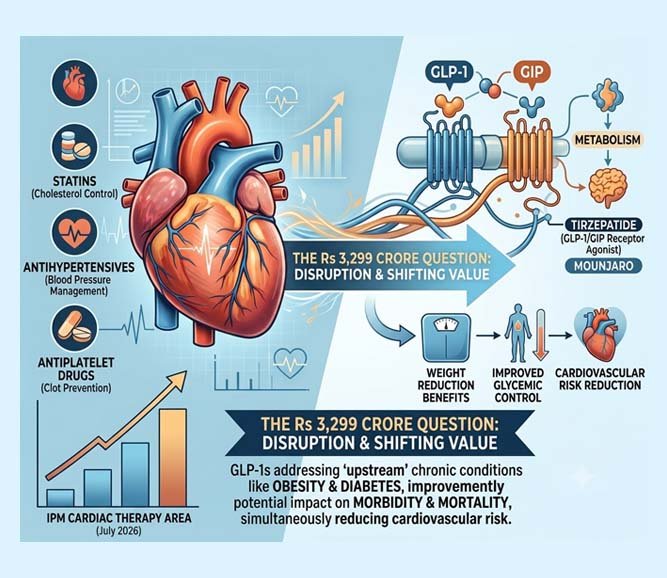
2. Cardiovascular: The Rs 3,299 Crore Question

Here, the implications become much bigger. Cardiology is currently the largest therapy area in the Indian Pharmaceutical Market, worth approximately Rs 3,299 crore in July 2026 and growing 14.7 per cent.

Obesity, diabetes, hypertension, and dyslipidaemia frequently coexist. Meaningful and sustained weight reduction can improve several cardiovascular risk factors. Tirzepatide also has a growing cardiovascular evidence base.

Does this mean Mounjaro will replace statins, antihypertensives, or antiplatelet drugs? No. That would be both clinically and commercially simplistic.

The disruption is subtler. If physicians increasingly treat obesity as an upstream chronic disease rather than merely advising patients to lose weight, some pharmaceutical expenditure could gradually shift toward metabolic medicines that influence several risk factors simultaneously. Indian pharma companies with large cardiac portfolios need to watch GLP-1 and GIP medicines very carefully. The threat is not necessarily substitution; it is the redistribution of therapeutic value.

3. Obesity: From Lifestyle Problem to Pharmaceutical Market

Perhaps the biggest disruption is occurring in a therapy area that Indian pharma historically did not treat as a major pharmaceutical category: Obesity.

For decades, obesity management largely revolved around diet, exercise, behavioural intervention and, in severe cases, bariatric surgery. Mounjaro changes the economics of obesity. It turns obesity into a potentially large, long-duration, prescription pharmaceutical market.

That creates an entirely new commercial ecosystem involving:

  • Endocrinologists and diabetologists
  • General physicians and obesity specialists
  • Nutritionists and wider prescribing networks

For Indian pharma, this may be more important than stealing share from another diabetes drug. GLP-1 medicines are helping create a pharmaceutical market that barely existed before.

4. Bariatric Surgery: Competitor or Complement?

For selected patients with severe obesity, bariatric surgery remains one of the most effective interventions available. Mounjaro does not make bariatric surgery obsolete, but it changes the patient pathway.

Some patients who might previously have considered surgery may first try pharmacotherapy. Others may use medicines before surgery, or after surgery to help manage recurrent weight gain.

The disruption may not be the disappearance of bariatric surgery; it could be the emergence of a much larger medical-surgical obesity ecosystem, with pharmacotherapy increasingly occupying the space between lifestyle intervention and surgery. That has implications for pharma companies, hospitals, and obesity clinics alike.

5. Fatty Liver Disease: A New Metabolic Frontier

Metabolic dysfunction-associated steatotic liver disease (MASLD) represents another key area. Obesity, insulin resistance, and type 2 diabetes are major drivers of fatty liver disease.

Historically, hepatology and diabetology operated as relatively separate therapeutic domains. Metabolic medicines increasingly blur that boundary. This does not mean Mounjaro should be regarded as a universal liver treatment—approved indications must always be distinguished from emerging clinical evidence.

Strategically, the metabolic patient is replacing the single-disease patient. A patient does not conveniently have diabetes on Monday, obesity on Tuesday, hypertension on Wednesday, and fatty liver on Thursday. These conditions frequently share underlying metabolic drivers, and pharmaceutical strategy will increasingly have to reflect that reality.

6. Sleep Apnoea: Entering Respiratory Medicine

One of the clearest demonstrations of cross-specialty disruption is obstructive sleep apnoea (OSA). Obesity is an important risk factor for OSA, and tirzepatide has demonstrated clinically meaningful benefits in adults with obesity and moderate-to-severe OSA.

That takes a metabolic medicine into territory traditionally associated with pulmonologists, sleep physicians, and devices such as CPAP. Treating obesity itself can become part of treating the disease. Instead of managing only the downstream manifestation, medicine increasingly has the opportunity to intervene in an upstream contributor.

7. Orthopaedics: Impact on the Pain Market

This requires greater caution. India’s pain and analgesics market is enormous, at approximately Rs 1,634 crore in July 2026, making it one of the country’s largest therapy categories. The key question is not market size, but whether obesity treatment will alter pain demand over time.

Obesity increases mechanical stress on weight-bearing joints and is strongly associated with osteoarthritis. Significant weight reduction can improve mobility and symptoms in some patients.

It would be premature to claim that Mounjaro will substantially reduce analgesic consumption or joint replacements. The more important strategic question is whether successful obesity treatment changes the long-term demand trajectory for some musculoskeletal interventions.

8. Women’s Health and PCOS

Polycystic Ovary Syndrome (PCOS) represents another intersection between obesity, insulin resistance, and reproductive medicine. Here, GLP-1 receptor agonists are being investigated and used in selected women where obesity and metabolic dysfunction are important components of PCOS.

They should not be portrayed as replacing established PCOS management. Rather, the strategic direction is significant: metabolic medicine is beginning to cross from diabetology into gynaecology.

9. Gastroenterology: Disruption Cuts Both Ways

The gastrointestinal market is India’s second-largest therapy area, worth approximately Rs 2,820 crore in July 2026.

Here the story becomes more complicated. Weight reduction and metabolic improvement may ultimately benefit some obesity-associated gastrointestinal and hepatic conditions. At the same time, GLP-1 and GIP therapy itself commonly produces gastrointestinal adverse effects such as nausea, vomiting, diarrhoea, and constipation.

Disruption does not necessarily mean market destruction. The central point is that one therapy may reduce demand in one part of medicine while creating clinical management requirements elsewhere. Simple forecasts that GLP-1s will eliminate established therapy markets should be treated cautiously.

10. Rethinking the Pharma Business Model

India’s pharmaceutical market was approximately Rs 23,193 crore in July 2026, built around traditional therapeutic silos:

  • Cardiologists have cardiac portfolios.
  • Diabetologists have diabetes portfolios.
  • Gastroenterologists have GI portfolios.
  • Orthopaedicians have pain portfolios.
  • Gynaecologists have women’s health portfolios.

Mounjaro does not fit comfortably into this traditional architecture. Its relevance cuts across diabetology, endocrinology, obesity medicine, cardiology, hepatology, sleep medicine, and other specialities, which is why it challenges the existing model.\

That could force pharma companies to rethink field-force structures, medical affairs, key-account management, and how they define therapy areas. The conventional Disease-to-Diagnosis-to-Doctor-to-Drug model becomes more interconnected. One metabolic patient may require several specialities, and one medicine may influence several parts of that patient’s journey.

The Shift from Disease Silos to Metabolic Medicine

Mounjaro is not simply an anti-diabetic or weight-loss drug; it signals a broader shift in how metabolic disease is being treated.

The Pharmarack numbers provide an early commercial signal: Mounjaro has reached the No. 1 position in the Indian pharmaceutical market while Eli Lilly itself ranks 35th among companies, showing unusual brand concentration.

Today’s sales ranking may ultimately prove less important than what the brand represents. Indian pharma has traditionally built businesses around diseases and specialities. Mounjaro and the wider incretin revolution challenge that model because metabolic dysfunction cuts across diabetes, obesity, cardiovascular risk, sleep apnoea, fatty liver disease, musculoskeletal burden, and reproductive metabolic disorders.

The real question for Indian pharma is not which drugs Mounjaro will replace.

Which therapy markets will have to redefine themselves because medicines such as Mounjaro allow physicians to intervene further upstream in metabolic disease?

Judging by India’s July 2026 pharmaceutical market data, that disruption is already underway.

Editorial Note

Mounjaro is a prescription medicine. Approved indications vary by country and regulatory jurisdiction. Discussion of therapy areas in this article distinguishes established indications from broader clinical and commercial implications. It should not be interpreted as suggesting that tirzepatide is approved for every condition discussed.

Source: Pharmarack Pharma Monitor, July 2026, supplemented by published regulatory and clinical evidence.

Hot this week

Can India Pivot From Low-Cost Medical Tourism to Trusted Medical Value Travel?

C-Suite Executive Summary India stands at a pivotal juncture in...

Rajesh Bhogavalli has been appointed as Chief Commercial Officer of ACG Group.

With over 25 years of leadership experience across commercial...

Will President Trump’s Diktat Improve Drug Quality For Indian Patients?

Executive Summary The geopolitical landscape of pharmaceutical manufacturing is shifting...

Mounjaro is the Exceptional Growth Story: Ranks #1

The July Brand Monitor by Pharmarack shows a healthy...

Sun Pharma: In the Eye of the Storm of Ophthalmologists

The Two-Tier Reality of Indian Pharma: Patient Safety, Pharmacovigilance,...

Topics

Can India Pivot From Low-Cost Medical Tourism to Trusted Medical Value Travel?

C-Suite Executive Summary India stands at a pivotal juncture in...

Will President Trump’s Diktat Improve Drug Quality For Indian Patients?

Executive Summary The geopolitical landscape of pharmaceutical manufacturing is shifting...

Mounjaro is the Exceptional Growth Story: Ranks #1

The July Brand Monitor by Pharmarack shows a healthy...

Sun Pharma: In the Eye of the Storm of Ophthalmologists

The Two-Tier Reality of Indian Pharma: Patient Safety, Pharmacovigilance,...

Does India Need to Reinvent the Wheel on Junk Foods?

In a written reply in the Lok Sabha in...
spot_img

Related Articles

spot_imgspot_img