
Beyond the Pharmacy of the World: Why India’s Biopharma Ambition Requires a Regulatory Revolution
The historical trajectory of global biopharmaceuticals reveals a recurring pattern: major regulatory systems rarely undergo structural leaps purely out of administrative foresight. Almost invariably, systems are transformed after a crisis exposes the true economic and human cost of weak oversight.

- The American Blueprint: Tragedy as Institutional Catalyst
The United States provides the classic archetype of crisis-driven transformation.
In the late 1950s and early 1960s, thalidomide caused severe birth defects in thousands of infants across Europe and the United Kingdom. The US largely escaped this catastrophe due to Dr. Frances Kelsey, a medical officer at the US Food and Drug Administration (FDA), who steadfastly refused to approve the drug despite relentless pressure from its sponsor, Richardson-Merrell, judging the safety data profoundly inadequate.
The political fallout transformed American medicine. In October 1962, US Congress unanimously passed the Kefauver-Harris Drug Amendments, fundamentally strengthening federal oversight:
- Proof of Efficacy: Manufacturers were required to prove a drug was not just safe, but effective for its intended use through adequate and well-controlled clinical investigations prior to marketing.
- Affirmative Approval and Oversight: The FDA was granted explicit authority to affirmatively approve New Drug Applications, enforce informed consent, mandate adverse-event reporting, and establish Good Manufacturing Practices.
- Retrospective Review: The FDA subsequently initiated the Drug Efficacy Study Implementation review to evaluate more than 3,400 medicines approved solely on safety grounds between 1938 and 1962.
America did not respond to a pharmaceutical crisis by penalising a single firm. It rebuilt the entire systemic architecture. That distinction matters enormously for India.

- The Chinese Model: Uncoupling Enforcement from Regulatory Upgrade
China’s pharmaceutical transformation offers a distinct yet complementary lesson. China demonstrated that state enforcement could impose real consequences while simultaneously rebuilding regulatory capability–two separate initiatives that collectively reshaped its life-sciences landscape.
Phase I: Corporate Enforcement (2013-2014)
In 2013, Chinese authorities launched a massive corruption investigation into GlaxoSmithKline. In September 2014, the Changsha Intermediate People’s Court fined GSK’s China operation RMB 3 billion (approximately $489 million)–at the time, the largest court fine in Chinese history. Five GSK executives received suspended prison sentences, and former China head Mark Reilly was deported.
This crackdown was fundamentally an anti-bribery and commercial enforcement action rather than a drug-quality reform. However, it sent an unmistakable structural signal: even global multinational giants were not immune to Chinese legal enforcement.

Phase II: Regulatory Clean-up and Harmonization (2015-2017)
Concurrently, China tackled a systemic regulatory crisis. By mid-2015, the China Food and Drug Administration faced a staggering backlog of approximately 22,000 drug registration applications.
In July 2015, the CFDA issued Announcement No. 117, ordering mandatory self-examinations and inspections of clinical trial data across 1,622 registration applications:
- Under threat of criminal penalties for fraudulent data, clinical trial sponsors voluntarily withdrew over 80 percent of affected applications.
- The CFDA expanded reviewer headcounts, introduced priority review channels, and aggressively cleared deficient submissions. By late 2017, the application backlog was virtually eliminated.
- In June 2017, the CFDA officially joined the International Council for Harmonisation, aligning China’s clinical data and manufacturing guidelines with global standards.
The sequence was methodical: Enforce laws. Purge fraudulent data. Clear the backlog. Build internal scientific capability. Align internationally. Fuel domestic innovation. China did not build a world-class biopharma ecosystem simply by subsidizing biotech startups; it upgraded the institutional environment surrounding them.
- India Has Had Its Warnings
India can no longer argue that it lacks warning signs.
The 2022 Gambian pediatric tragedy dealt a severe blow to the reputation of Indian pharmaceutical manufacturing. Laboratory testing coordinated by the World Health Organization identified lethal levels of diethylene glycol and ethylene glycol–industrial solvents that cause acute kidney injury–in four pediatric cough syrups manufactured by Haryana-based Maiden Pharmaceuticals.
- The WHO confirmed that contaminated syrups were linked to 66 deaths among 78 reported acute kidney injury cases in The Gambia during the 2022 outbreak.
- The global contaminated-syrup crisis across multiple nations–including Indonesia, Uzbekistan, and Cameroon–was ultimately associated with more than 300 fatalities, predominantly in children under five.
This should have marked a watershed moment for Indian pharma. The reputational risks extend far beyond low-cost oral liquids.

- The Bridge Between Cough Syrups and Biologics Ambitions
At first glance, a contaminated bottle of generic pediatric syrup appears disconnected from India’s ambition to become a global hub for monoclonal antibodies, biosimilars, mRNA vaccines, and cell therapies. In reality, they are bound by a single imperative: Trust.
If a regulatory ecosystem cannot consistently guarantee the purity of basic excipients (like propylene glycol or glycerin) in a simple oral liquid, foreign regulators and global biopharma partners will naturally question whether that same ecosystem can oversee the far more volatile manufacturing processes of complex biologics.
Technical Variable | Small-Molecule Generics | Complex Biologics and Biosimilars
Manufacturing Origin | Chemical synthesis; predictable structures | Living cell lines; highly sensitive bioprocesses
Critical Process Parameters | Pure chemical identity, standard dissolution | Culture conditions, protein folding, glycosylation
Key Regulatory Risks | Chemical impurities, physical stability | Immunogenicity, aggregation, cold-chain breaches
Analytical Requirements | Routine HPLC or UV testing | Advanced mass spectrometry, bioassays, batch consistency
This does not imply that India’s leading biopharma companies lack elite capabilities; many operate facilities that rival the finest in Boston, Basel, or Singapore. The problem is collective reputational drag. A biologic is defined by its process; when systemic trust is compromised, the weakest links dictate the global perception of the whole.
- The Two-Tier Quality System Is Indefensible
India’s pharmaceutical market currently operates under an uncomfortable duality:
- The Tier-1 Export Sector: High-tech facilities built specifically to comply with USFDA, European Medicines Agency, and UK MHRA standards.
- The Domestic/Low-Regulated Tail: Thousands of smaller plants operating under variable state-level oversight, supplying domestic clinics and less-regulated export destinations.
Quality cannot depend on the shipping carton’s destination address. A child in Bengaluru or Bihar deserves a medicine made to the exact same standards of purity, identity, and integrity as a patient in Boston or Berlin.
From an industrial-policy perspective, maintaining a lower-quality tail creates a classic collective-action problem: every compliant, capital-intensive Indian manufacturer pays an ongoing tax on its global reputation caused by non-compliant actors.

- A Regulatory Reset: Beyond Incremental Paperwork
The Indian Government has taken steps in the right direction. The implementation of the revised Schedule M under the Drugs and Cosmetics Rules has elevated mandatory Good Manufacturing Practices to align more closely with WHO standards, complemented by risk-based joint facility inspections.
However, moving into advanced biopharmaceuticals requires a structural reset rather than incremental administrative tightening:
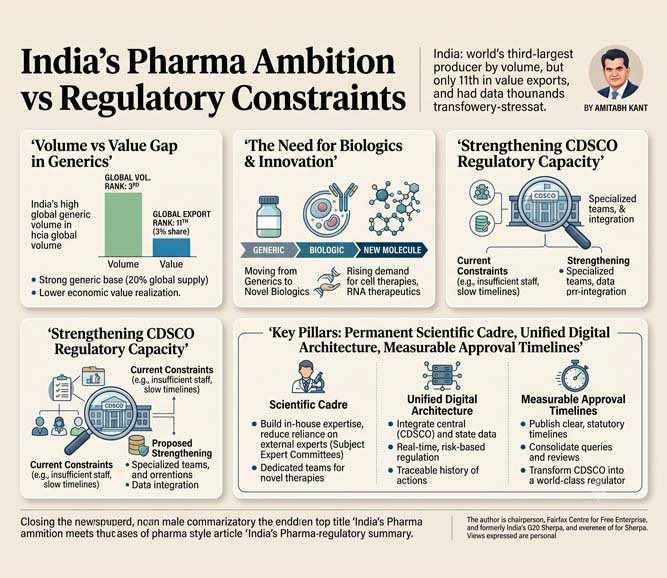
- Scientific Cadre Expansion: Substantially upgrade the technical expertise and headcount within the Central Drugs Standard Control Organisation.
- State Regulator Integration: Unify India’s fragmented state-level licensing system into a centralized, nationally integrated database for inspections, batch releases, and recalls.
- Unannounced Enforcement: Expand risk-based, unannounced inspections with real-time laboratory reporting and strict supply-chain traceability for raw excipients.
- Enforcement Transparency: Publish all inspection findings, warning letters, and license revocations on an open public platform–preventing repeat offenders from re-licensing under new names or in adjacent state jurisdictions.

- The Economic Imperative for Stringent Oversight
Stronger regulatory enforcement is often framed as a conflict between public health imperatives and economic growth. In modern biopharmaceuticals, this is a false dichotomy: regulatory credibility IS economic policy.
India seeks to transition from capturing single-digit value shares in global export markets toward capturing high-value pools in biosimilars, novel biologics, and clinical contract development. Global pharmaceutical companies deciding where to allocate multi-billion-dollar manufacturing and R&D budgets ask specific institutional questions:
“Can we trust the laboratory data? Can we trust the clinical trial integrity? Can we defend this supply chain before the USFDA or EMA? Can we stake our core global IP on this jurisdiction?”
These are institutional and regulatory questions, not labor-cost calculations.
- Volume Made India Important; Trust Will Make India Valuable
India faces a definitive choice. It can remain a master of high-volume, low-margin generic chemical production–a vital global service, but one vulnerable to price erosion and reputation shocks. Or it can elevate itself into high-value biopharmaceutical innovation.
- The U.S. lesson: Regulatory crises must be leveraged to build stronger, uncompromising public institutions.
- The China lesson: Enforcing law on industry, clearing regulatory friction, and raising standards creates the trust required for an innovative biopharma sector to flourish.
The drug-contamination tragedies must not be rationalized as isolated mistakes by a few fringe operators. They are structural signals indicating that India’s industrial scale has outgrown its historical regulatory architecture.
Biopharma SHAKTI without regulatory shakti will remain incomplete. Volume made India the Pharmacy of the World; unyielding quality and regulatory trust will determine whether the world trusts India with the medicines of the future.

APPENDIX: SOURCES AND FACT-CHECKING DOSSIER
Section and Claim | Official Primary or Credible Source | Fact / Figure Verification Status
- Frances Kelsey and FDA | US FDA History Office; Public Law 87-781 (1962). | Verified. Dr. Kelsey blocked U.S. approval of Kevadon (thalidomide). President Kennedy awarded her the President’s Award for Distinguished Federal Civilian Service (1962).
- Kefauver-Harris Amendments and DESI | US FDA Center for Drug Evaluation and Research (CDER); 21 U.S.C. 355. | Verified. Passed October 1962. Mandated efficacy proof via controlled trials. Initiated DESI review evaluating ~3,400 drugs approved between 1938 and 1962.
- GSK China Corruption Fine | Changsha Intermediate People’s Court Ruling (Sept 2014); Xinhua News Agency; Official Corporate Release. | Verified. Court imposed RMB 3 billion (~$489M USD) fine on GSK China. Mark Reilly received a 4-year suspended sentence and deportation.
- CFDA Announcement No. 117 and Backlog | China Food and Drug Administration Archives; Nature Reviews Drug Discovery (2017). | Verified. CFDA faced ~22,000 backlog applications in mid-2015. Announcement No. 117 forced clinical data self-audit; >80% of applications were voluntarily withdrawn or rejected. Backlog was reduced by >90% by end-2017.
- China ICH Membership | International Council for Harmonisation Assembly Minutes (Montreal, June 2017). | Verified. CFDA officially admitted as an ICH Assembly member in June 2017 (promoted to Steering Committee in 2018).
- Gambia DEG/EG Outbreak | WHO Medical Product Alert No. 7/2022; WHO Gambia AKI Investigation Reports (2022-2023). | Verified. Diethylene glycol and ethylene glycol contaminants confirmed in Maiden Pharma syrups. 66 confirmed pediatric deaths (among 78 diagnosed AKI cases) linked directly by WHO and Gambian Taskforce.
- Global Contaminated Syrup Fatalities | WHO Executive Board / Global Incident Reports on Contaminated Oral Liquid Medicines (2023). | Verified. WHO documented >300 infant/child fatalities globally across Gambia, Uzbekistan, Indonesia, and Cameroon linked to contaminated DEG/EG excipients.
- Revised Schedule M Implementation | Ministry of Health and Family Welfare (India), Gazette Notification G.S.R. 922(E), Dec 2023/2024. | Verified. Revised Schedule M introduced updated GMP regulations aligned with WHO-GMP standards, including Pharmaceutical Quality Systems and Risk Management.