
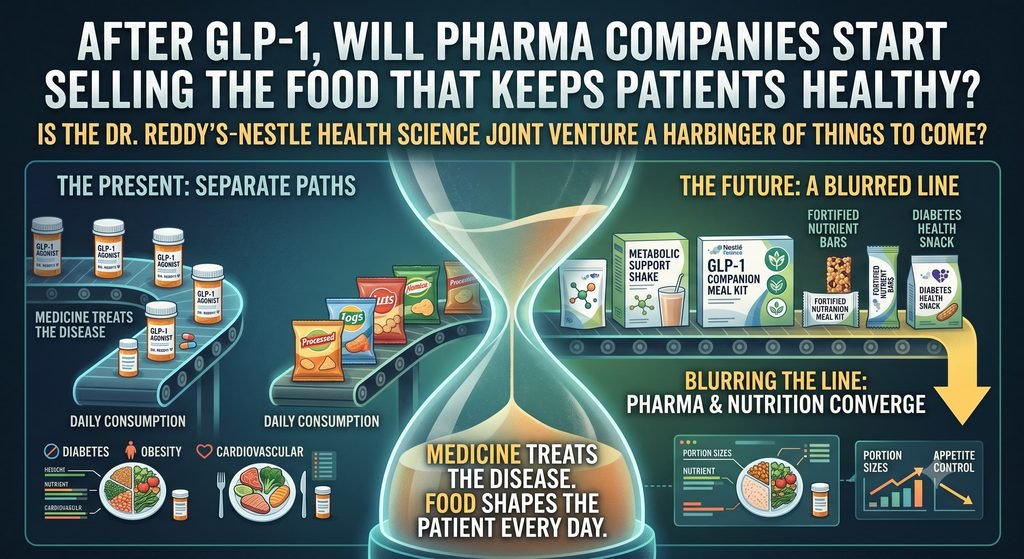
GLP-1 medicines such as semaglutide and tirzepatide are changing how we treat diabetes and obesity. But their impact may eventually extend much further because they change appetite. And when medicines change appetite, they inevitably change food consumption and the choices people make about food. New research from International Flavors & Fragrances, presented at the company’s Eat Smart Asia: The GLP-1 Shift Knowledge Symposium in New Delhi, suggests exactly that. Among GLP-1 users studied in Delhi, Mumbai and Bengaluru, consumers reported substantially smaller portions, altered taste and texture experiences, greater scrutiny of food labels and changes in social eating behaviour. (IFF Press Release, August 25, 2026)
That raises a question the pharmaceutical industry should perhaps be asking itself: If pharma companies are increasingly treating diseases closely connected with metabolism, nutrition and lifestyle, why should their relationship with the consumer end with the medicine—and not extend to what they eat? Could pharmaceutical companies eventually become important direct-to-consumer players in health foods, medical nutrition, functional nutrition and nutraceuticals, with a new commercial opportunity? And is the alliance between Dr. Reddy’s Laboratories and Nestlé India an early indication of this direction?

Medicine Treats The Disease. Food Shapes The Patient Every Day
Consider the major noncommunicable diseases, which provide a useful lens here. Diabetes, cardiovascular disease, hypertension, obesity and several other chronic conditions are influenced by combinations of genetics, ageing, environment and behaviour. But nutrition and metabolic health play an important role in this landscape. WHO identifies unhealthy diet and physical inactivity as major behavioural risk factors for NCDs. These can contribute to metabolic changes, including obesity, raised blood glucose, hypertension and abnormal blood lipids.

This creates an interesting paradox: GLP-1 may be reshaping the divide between pharma and food.
The pharmaceutical industry spends enormous resources developing medicines to manage the consequences of metabolic dysfunction. Yet the patient spends perhaps a few seconds swallowing a tablet or administering an injection. The patient spends the rest of the day living, eating, and drinking. Historically, pharma has largely occupied one side of that divide, and food companies the other. GLP-1 could begin to break down the wall, with major implications for both industries.
GLP-1 Changes The Economics Of Appetite. IFF’s India research offers an early indication of why. Among the GLP-1 consumers studied, the report found significant changes in portion sizes across everyday Indian foods. Consumers reported moving from three to four chapatis to one or two, from five or six idlis to two, and from 2.5 bowls of rice to half a bowl. (IFF Press Release, August 25, 2026) But these consumers don’t simply want less food; they seem to want more from less food. The research found that 90 per cent experienced changes in how food tastes or feels, 50 per cent preferred softer, easier-to-digest textures, and 69 per cent wanted a balanced flavour impact. (IFF Press Release, August 25, 2026) Meanwhile, 74 per cent say they read labels more carefully than before starting GLP-1 medication. (IFF Press Release, August 25, 2026) This could create a completely new consumer proposition, with major implications for food companies.
For a person eating substantially less, every meal may need to work harder: More protein. More fibre. Greater nutrient density. Better hydration. Smaller portions. Better digestibility. And enough taste and pleasure to make the smaller eating experience satisfying, with implications for how food is formulated. IFF identifies opportunities in smaller formats, protein, fibre, nutrient density, hydration, sensory design, packaging transparency, and smaller indulgences. (IFF Research Findings, Eat Smart Asia 2026)
Now ask the obvious question:
Who understands this consumer better: the traditional food company or the pharmaceutical company already treating the patient’s metabolic disease?

Pharma Has Something FMCG Does Not: The Healthcare Ecosystem
Pharmaceutical companies have an unusual advantage if nutrition becomes more integrated with chronic disease management: they already sit inside the healthcare ecosystem, where medicine, patients, and clinical decision-making meet. That position matters.
- They understand disease pathways.
- They understand clinical evidence.
- They understand doctors.
- They understand patients with chronic diseases.
- They have medical affairs capabilities.
- They understand regulatory environments.
- They already operate within diabetes, cardiovascular disease, renal disease, women’s health, paediatrics and other chronic-care ecosystems.
- Most importantly, they have relationships with the healthcare professionals who influence what patients do after diagnosis.
That could give pharma a clear advantage in the emerging space between medicine and food, where the strategic stakes are how influence, access and trust are shaped after diagnosis. But pharma also has weaknesses. Traditional pharmaceutical companies are generally not as good as FMCG companies at consumer branding, taste, sensory science, retail execution, everyday consumer engagement and building habitual food brands. That is precisely why the Dr Reddy’s-Nestlé combination deserves attention as a test of that thesis and of how well pharma can compete in this space.
Dr Reddy’s Plus Nestlé: A Very Interesting Experiment
In April 2024, Nestlé India and Dr Reddy’s Laboratories announced a joint venture bringing together Nestlé Health Science’s nutritional health solutions, vitamins, minerals, herbals and supplements with Dr Reddy’s established commercial capabilities in India.
The stated areas included metabolic health, hospital nutrition, general wellness, women’s health and child nutrition. (Nestlé India). The portfolio itself tells the story. Nestlé brought brands including Nature’s Bounty, Osteo Bi-Flex, Ester-C, Resource High Protein, Optifast, Resource Diabetic, Peptamen, Resource Renal and Resource Dialysis. Dr Reddy’s brought brands including Rebalanz, Celevida, Antoxid, Kidrich-D3 and Becozinc. (Nestlé India)
The structure is equally interesting. Dr Reddy’s holds 51 per cent and Nestlé India 49 per cent. Nestlé India subsequently transferred its existing medical nutrition and nutraceutical business into the JV for approximately Rs 218.9 crore (Nestlé India)\. Consider what the combination could create: a sharper version of that healthcare-food bridge, and a clearer test of the strategic value of combining both sides. Dr Reddy’s brings disease understanding, healthcare credibility, pharmaceutical distribution and relationships with doctors. Nestlé brings nutrition science, food technology, sensory expertise, consumer understanding and global nutritional brands.
One understands the patient. The other understands what the patient eats.
That could be a powerful strategic combination, with meaningful implications for who shapes the space between medicine and food and how far pharma can extend its role. While the joint venture is currently India-focused—and both partners bring prior experience in nutrition—the combination of their specific capabilities, rather than the partnership’s novelty, makes the structure a useful example of what broader pharma-nutrition convergence could look like and the strategic stakes involved.

The Doctor Could Become The Bridge Between Pharma And Food
Consider a patient newly diagnosed with type 2 diabetes. Traditionally, the pharmaceutical opportunity begins with the prescription. But the patient’s needs extend far beyond medication:
- Diet.
- Weight.
- Protein intake.
- Meal composition.
- Hydration.
- Exercise.
- Monitoring.
- Adherence.
- Eventually, perhaps, obesity pharmacotherapy.
Now imagine the pharmaceutical company thinking about that individual not as a prescription for one molecule, but as a metabolic-health consumer journey lasting 20 or 30 years. Seen that way, the opportunity becomes larger and sharper. The opportunity grows, and the strategic stakes rise.
- A diabetes company could potentially participate in medication, glucose monitoring, medical nutrition, protein supplementation, meal replacements and metabolic-health foods.
- A renal company could combine medicines with renal nutrition.
- An oncology company could connect treatment with specialised nutritional support.
- A women’s-health company could address nutritional needs across adolescence, pregnancy, menopause, and healthy ageing.
- A paediatric company could combine therapeutics with child nutrition.
The commercial unit is no longer the prescription; it becomes the patient’s health journey. The commercial unit becomes the patient’s health journey.
GLP-1 Makes This Convergence Much More Urgent
Before GLP-1, pharma and food could comfortably occupy separate worlds. GLP-1 makes that separation harder, because the medicine itself changes eating behaviour. GLP-1 makes that separation harder. The medicine itself changes eating behaviour. IFF’s research found that 65 per cent of respondents experienced significantly reduced appetite, while 64 per cent experienced social-eating discomfort at least occasionally. (IFF Research Findings, Eat Smart Asia 2026). Hydration becomes more deliberate. In the study, 74 per cent view hydration as a daily wellness goal, with many gravitating toward coconut water and electrolyte-based beverages. Protein and nutrient density become more important. Portions shrink. Taste preferences can change.
In other words, the pharmaceutical intervention creates the nutritional need, making the strategic stakes clearer. That is strategically significant. A pharma company marketing a GLP-1 medicine may know that its consumer is eating less. Should it simply sell the injection and leave that opportunity to somebody else, or should it build an ecosystem around the medicine? Or should the future metabolic-health company build an ecosystem around the medicine?
From Share Of Prescription To Share Of Health
This could force pharma companies to rethink one of their most fundamental commercial concepts. For decades, pharma competed for share of prescription. Consumer-health companies competed for share of wallet. Food companies competed for share of stomach. The convergence of metabolic medicine and nutrition could bring all three together, creating a more strategic competitive set and clarifying the stakes.
The future competitive question may become: Who owns the consumer’s metabolic-health journey, and what is at stake? That company may not necessarily be a traditional pharmaceutical company or a traditional food company. It could be a hybrid. That is what makes the Dr Reddy’s-Nestlé Health Science JV strategically interesting: it bridges pharma and food, and makes the stakes clearer.
It combines complementary capabilities and clarifies the strategic logic.

But Pharma Must Not Turn Food Into Medicine
There is an important caution: Pharmaceutical companies entering nutrition should not turn ordinary food into medicine; their role is to apply science where genuine consumer needs exist, and define the strategic boundary between nutrition and therapeutics.
A healthy diet is much broader than branded nutraceuticals, protein powders or “metabolic health” products. WHO emphasises dietary adequacy, balance, moderation and diversity, with minimally processed foods forming the foundation of healthy diets.
Nor should companies imply that a health food can prevent, treat or reverse disease without appropriate evidence and regulatory authorisation, because doing so raises both scientific and strategic risks.
The opportunity therefore lies not in turning the supermarket into a pharmacy.
Rather, it lies in applying scientific credibility and disease understanding to nutrition where genuine consumer needs exist, and in showing why that approach matters strategically. That distinction will be crucial for competitive positioning and for determining which companies can lead this category.
The Regulatory Reality
Regulatory frameworks reinforce this distinction. Health claims on food products face rigorous scrutiny in most markets, and the boundary between “medical nutrition” and “functional food” is legally enforced, not optional. Companies pursuing this convergence must navigate separate regulatory frameworks for drugs, medical devices, foods and supplements, each with different evidentiary standards and marketing restrictions.
In India, for example, the Food Safety and Standards Authority of India (FSSAI) regulates health claims on foods, while the Central Drugs Standard Control Organisation (CDSCO) oversees pharmaceuticals. A product positioned as both requires compliance with both regimes, creating complexity that many companies may not anticipate.
This regulatory reality may slow—but not stop—the convergence, making the strategic winners those that respect legal boundaries while building credible bridges across them.
The Bigger Opportunity: From Pharmaceutical Company To Health Company
Perhaps the most important question raised by GLP-1 is not what happens to the obesity market, but what it means for the definition of a pharmaceutical company—and, in turn, the strategic stakes of that definition.
It is what happens to that definition—and how it begins to change strategically.
If chronic disease increasingly sits at the intersection of genetics, metabolism, behaviour, nutrition and lifestyle, companies may find it difficult to remain purely medicine businesses—and the strategic logic of the category may change.
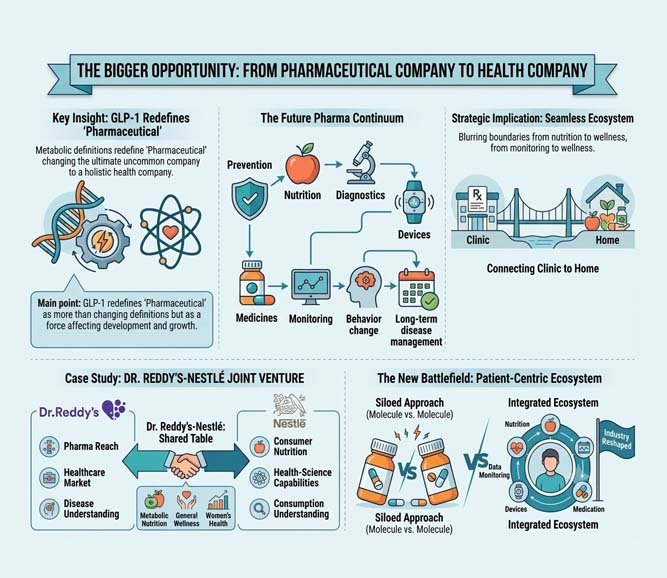
The pharmaceutical company of the future may need to operate across a broader continuum, with clear strategic implications, including:
1. Prevention
2. Nutrition
3. Diagnostics
4. Devices
5. Medicines
6. Monitoring
7. Behaviour change
8. Long-term disease management
That does not mean every pharmaceutical company should start manufacturing breakfast cereal. It means the traditional boundary separating what the doctor prescribes from what the patient consumes every day may become increasingly artificial—and strategically important for competition.
Is Dr Reddy’s-Nestlé A Harbinger? Possibly.
One joint venture does not establish an industry trend, but its timing is strategically telling about where the market may be heading. Nestlé brings consumer nutrition and health-science capabilities. Nestlé brings consumer nutrition and health-science capabilities. Dr Reddy’s brings pharmaceutical reach and healthcare-market capabilities. Their combined portfolio already spans metabolic nutrition, hospital nutrition, renal nutrition, general wellness, women’s health and child nutrition. (Nestlé India) And now, GLP-1 medicines are creating a population whose pharmaceutical treatment directly changes appetite, portions, sensory preferences and nutritional behaviour. The pieces are beginning to fit together, and the strategic implications are becoming clearer.
The next great battle in chronic disease should not be fought only between one pharmaceutical molecule and another; it should also be fought over who builds the most credible ecosystem around the patient—and who sets the strategic terms. It may be fought over who builds the most credible ecosystem around the patient, who defines the next competitive frontier, and how the industry is reshaped.
Pharma understands disease.
Food companies understand consumption.
GLP-1 is bringing the two worlds together.
And the Dr Reddy’s-Nestlé experiment may give us an early glimpse of what happens when they stop competing from opposite sides of the table and start sitting at the same one—and what that means strategically. The Dr Reddy’s-Nestlé joint venture may ultimately be remembered not as a one-off partnership, but as the moment the pharmaceutical industry glimpsed its future: not just treating disease, but nourishing health. The question is not whether others will follow—it is how this convergence will reshape competition, strategy, and the industry itself, and what the stakes will be.

This thesis strikes at the central strategic tension modern healthcare faces: GLP-1 therapeutics are forcing a permanent shift from transactional illness treatment to integrated, lifelong metabolic management.
By directly altering satiety pathways, gastric emptying, and appetite cues in the brain, GLP-1 receptor agonists redefine consumer behavior at a biological level. A patient on GLP-1 therapy isn’t just taking a drug; their entire daily relationship with calorie density, nutrient absorption, micro-nutrition, and volume changes.
Why the “Pharma to Health” Shift is Accelerating
- Muscle Preservation & Medical Nutrition: A major clinical challenge with GLP-1 weight loss is lean muscle mass loss (sarcopenia). Pharma cannot solve muscle retention with an injection alone—it requires targeted, high-protein clinical nutrition alongside strength monitoring.
- GI Tolerability & Micronutrient Gaps: Gastric side effects and extreme calorie restriction frequently lead to GI distress and nutritional deficiencies, creating a massive market for specialized formulations (e.g., Nestlé Health Science companion lines).
- Adherence & Off-Ramp Ecosystems: Long-term patient retention requires continuous digital monitoring, behavior nudges, and dietary tracking to ensure sustainable metabolic health once medication dosages adjust.
Strategic Playbook: Pharma vs. Consumer Health Alliances
| Capability Dimension | Traditional Pharma Model | Consumer Food & Health (e.g., Nestlé) | Convergence Ecosystem Model |
| Core Value Drivers | Molecular R&D, Clinical Trials, IP | Brand Loyalty, Daily Consumption, Scale | Integrated Metabolic Outcomes |
| Patient Engagement | Episodic (Prescriptions & Refills) | Continuous (Daily meals & lifestyle) | 24/7 Lifestyle & Therapeutic Loop |
| Market Expansion | High-Margin Treatment of Disease | High-Volume Preventive Nutrition | Co-branded Clinical & Medical Foods |
| Data Ownership | EMR & Prescribing Data | Purchase & Behavioral Habits | Combined Biomarker & Lifestyle Insights |
The Dr. Reddy’s–Nestlé joint venture highlights how regional market access (Pharma’s distribution network into physician practices) married with specialized health science portfolios (Nestlé’s metabolic and renal nutrition brands) forms a defensible ecosystem.
The competitive moat of the next decade will likely belong to companies that bundle therapeutics, medical nutrition, diagnostics, and digital adherence into a single holistic standard of care.
Editor’s Note: The proposition that pharma could evolve from competing for “share of prescription” towards competing for “share of health”, and that the Dr Reddy’s-Nestlé JV could foreshadow wider pharma-nutrition convergence, is MedicinMan’s strategic interpretation of these developments rather than a conclusion made by IFF, Nestlé, Dr Reddy’s or WHO.

APPENDIX: SOURCES
1. International Flavors & Fragrances Inc. Inside the India GLP-1 Consumer Journey: How a Smaller Appetite Could Reshape the Future of Food and Beverage. Eat Smart Asia: The GLP-1 Shift, Knowledge Symposium 2026, New Delhi. Research based on qualitative in-home depth interviews (Delhi, Mumbai, Bengaluru), quantitative research among GLP-1 consumers across India, sensory exploration and product tasting. Proprietary IFF research presented August 2026.
2. International Flavors & Fragrances Inc. IFF Report Finds GLP-1 Is Reshaping Food Choices and Eating Behaviors Among Indian Consumers. Press Release. August 25, 2026. Released in conjunction with the Eat Smart Asia Knowledge Symposium in New Delhi. Study conducted among GLP-1 users in Delhi, Mumbai and Bengaluru.
3. Nestlé India. Nestlé India and Dr. Reddy’s to Form Joint Venture to Take Health Science Nutraceutical Portfolio to Consumers Across India and Other Agreed Territories. April 25, 2024. Official announcement describing the strategic rationale, categories and brands being contributed to the JV.
4. Nestlé India regulatory disclosures. August 2024 disclosures confirming the 51:49 Dr. Reddy’s-Nestlé India ownership structure and transfer of Nestlé India’s medical nutrition and nutraceutical business to the JV.
5. World Health Organization. Noncommunicable Diseases. WHO identifies unhealthy diets, insufficient physical activity, tobacco and harmful alcohol use among major behavioural NCD risk factors and identifies hypertension, overweight/obesity, raised blood glucose and abnormal blood lipids among the major metabolic risk factors.
6. World Health Organization. Healthy Diet, January 2026. WHO notes the relationship between diet and NCD risk while emphasising adequacy, balance, moderation and diversity as core principles of healthy eating.