

The disease is real. So is the markup. Confusing the two turns a treatable protocol into a financial death sentence. This article keeps that distinction clear: it is about the markup and its consequences.
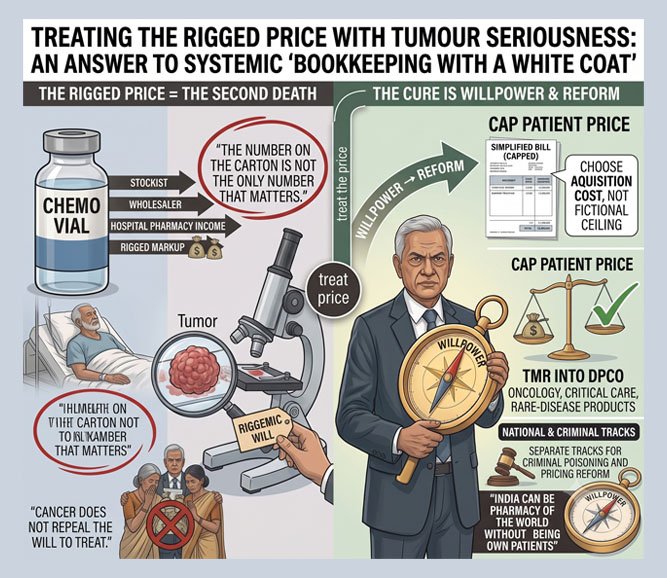
In the same 48 hours this week, two institutions said what every oncology ward in India already knows. Karnataka’s Health Minister wrote to the Union Health Minister that hospitals can buy high-value cancer medicines at deeply discounted institutional rates and then bill in-patients at printed Maximum Retail Price — a gap the state says can run from 30 times to more than 70 times in some cases. A day earlier, the Supreme Court of India looked at a cancer drug sold to the retailer at ₹2,700 with an MRP of ₹27,000 and called it “broad daylight dacoity.”
Cancer kills. So does a pricing architecture that prints a fictional ceiling, harvests the difference inside a captive hospital pharmacy, and then presents the bill as destiny. The first is biology. The second is design. This article is about that design and who it hurts.