
C-Suite Executive Summary
India stands at a pivotal juncture in its cross-border healthcare economy. The transition from low-cost medical tourism to trusted Medical Value Travel (MVT) represents a shift from selling cheap individual procedures to exporting an integrated, high-value healthcare ecosystem.
Strategic Value Trajectory: Moving from Price Arbitrage and Low-Margin Volume to Institutional Trust and High-Value Complexity, while diversifying beyond a single source market.

Core Strategic Findings
- Demonstrated Demand, Shift from Arbitrage: India recorded approximately 644,000 foreign medical arrivals in 2024. However, sustainable advantage cannot rely solely on price differentials. The market requires a transition from cost arbitrage to an institutional trust advantage built on clinical outcomes and continuity of care.
- Acute Concentration Risk: Bangladesh accounted for roughly 75% (about 482,000) of foreign medical arrivals in 2024. India must diversify into the Middle East, Central Asia, East Africa, and select Western markets while preserving its regional leadership.
- Infrastructure Transformation: The Union Budget 2026 proposal to support states in establishing five Regional Medical Hubs signals a shift toward treating MVT as economic infrastructure rather than retail tourism marketing.
- Key Policy Bottlenecks: Growth is constrained by discontinuous post-discharge digital care, legal/malpractice uncertainties, ethical risks in transplantation, and unresolved tensions between foreign patient capacity and domestic healthcare equity.

Key Metrics at a Glance
| Metric | Figure | Primary Source / Context |
|---|---|---|
| Medical Arrivals (2024) | ~644,000 | Bureau of Immigration (down slightly from ~659,000 in 2023) |
| Market Value (2025 estimate) | ~US$8.7 billion | Industry estimates cited by Government of India |
| Projected Market Value (2030) | ~US$16.2 billion | Implied CAGR of ~13% over 5 years |
| Dominant Source Market | Bangladesh (~482,000) | Represents ~75% of total foreign medical arrivals |
| Global MVT Market (2030 Project) | ~US$286.1 billion | Industry baseline from US$115.6B in 2022 |
| Strategic Imperative | Price-to-Trust Shift | Transitioning from price arbitrage to an institutional healthcare platform |
1. Medical Tourism as a Healthcare Export Industry
Traditional tourism exports experiences: hospitality, transit, and culture. Medical travel exports healthcare capacity.
An overseas patient purchasing complex treatment in India consumes a bundle of cross-border services: surgical expertise, tertiary diagnostics, specialty pharmaceuticals, rehabilitation, and long-term management. International trade frameworks classify this as Mode 2 Trade in Services (consumption abroad).
Cross-Border Service Footprint:
- Clinical Services: Specialist Care, Surgery, Rehabilitation
- Technical & Diagnostic: Advanced Imaging, Therapeutics & Pharma, Remote Tele-Follow-up
- Support Infrastructure: Long-Stay Lodging, Attendant Services, Transit & Logistics
India is not merely competing with destination markets like Thailand, Tรผrkiye, or Malaysia for tourists; it is competing for a structural share of global healthcare expenditure.

2. Structural Drivers of Cross-Border Patient Demand
2.1 Healthcare Cost Differentials
India combines internationally trained clinical talent with a structural cost base significantly lower than high-income nations. Price, however, is an entry condition, not a closing proposition. Patients undergoing complex interventions purchase outcome confidence:
Winning Value Proposition = Competitive Price + Demonstrated Quality + Trusted Brand + Seamless Journey
2.2 Capacity Constraints and Queue Reduction
In many national healthcare systems, access is constrained by waiting lists. International medical travel allows patients to exchange geographical distance for immediate clinical access. For elective or time-sensitive specialty interventions, India’s private sector offers time arbitrage.
2.3 Disease Burden Shift
Rising global prevalence of chronic cardiovascular conditions, oncology, diabetes, and musculoskeletal disorders expands long-term international demand for tertiary clinical specialties.

3. Post-Pandemic Arrival Dynamics
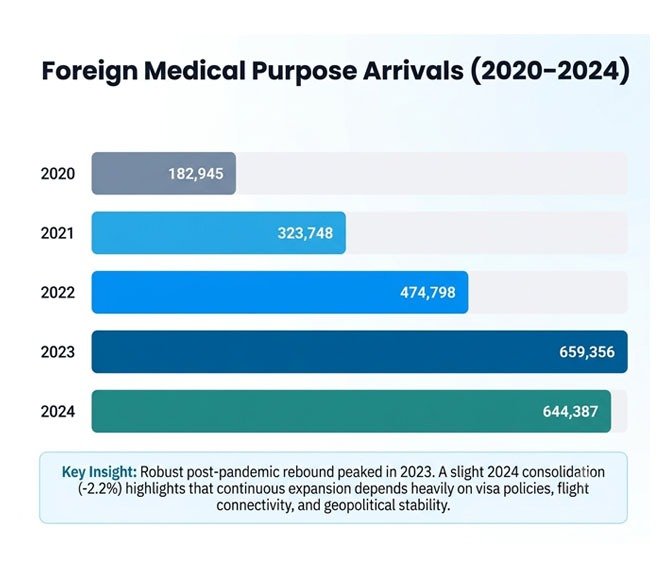
Official arrival data provides a clearer demand measure than aggregate market valuations alone.
| Year | Foreign Medical Arrivals | Year-over-Year Trajectory |
|---|---|---|
| 2020 | 182,945 | Pandemic contraction baseline |
| 2021 | 323,748 | Early post-lockdown rebound (+77%) |
| 2022 | 474,798 | Acceleration phase (+46.6%) |
| 2023 | 659,356 | Peak post-pandemic demand (+38.9%) |
| 2024 | 644,387 | Slight consolidation (-2.2%) |
Source: Bureau of Immigration data reported by the Ministry of Tourism.
The modest drop between 2023 and 2024 underscores that growth is not linear. External variablesโincluding visa facilitation policies, bilateral ties, flight connectivity, and origin-market economic stabilityโdirectly dictate actual patient flows.

4. Concentration Risk: The Bangladesh Corridor
2024 Foreign Medical Arrivals by Origin:
- Bangladesh: 482,336 (~75%)
- Iraq: 32,008
- Somalia: 11,717
- Oman: 10,431
- Uzbekistan: 8,921
Source: Bureau of Immigration Data.
The concentration of foreign arrivals from Bangladesh (~75%) represents a successful regional referral network driven by proximity and cultural familiarity, but it also creates strategic vulnerability.
Political, diplomatic, or economic shifts within a single corridor can disproportionately affect aggregate national figures. Strategic policy must focus on diversifying geographic corridors across Central Asia, the Middle East, East Africa, and select Western markets without eroding the core South Asian volume.

5. Architectural Framework: India’s Healthcare Stack
Indiaโs core strength goes beyond individual clinician expertise. It rests on a multi-layered healthcare stack:
- Layer 6: Traditional Medicine & Wellness (AYUSH, Integrated Care)
- Layer 5: Hospitality & Transit Infrastructure (Attendants, Concierge Support)
- Layer 4: Quality & Accreditation Infrastructure (NABH, ISQua Alignment)
- Layer 3: Diagnostics & Specialty Pharmaceuticals
- Layer 2: Complex Tertiary & Quaternary Hospitals
- Layer 1: Human Capital (Specialist Physicians, Nurses, Clinical Staff)
- Human Capital & Complex Care: Highly specialized clinical talent capable of delivering advanced interventions in oncology, cardiology, organ transplantation, and neurosciences.
- Accreditation Infrastructure: The National Accreditation Board for Hospitals & Healthcare Providers (NABH)โbenchmarked internationally via ISQuaโserves as an essential trust signal for foreign buyers.
- Integrative Wellness: Formal incorporation of AYUSH (Ayurveda, Yoga, Naturopathy, Unani, Siddha, Homeopathy) offers integrative recovery models, provided these are framed with rigorous evidence standards.

6. Redefining the Model: The Complete MVT Journey
The shift from “medical tourism” to “Medical Value Travel” reframes the clinical interaction from a discrete procedure to an integrated, end-to-end patient journey.
Pre-Arrival Phase
- 1. Tele-Consultation
- 2. Medical Records Review
- 3. Treatment Quotation
- 4. Visa & Travel Logistics
In-Destination Treatment Phase
- 5. Airport Reception
- 6. Diagnostic Workup
- 7. Tertiary Procedure
- 8. Inpatient Recovery
- 9. Rehabilitation Care
Post-Care & Continuity Phase
- 10. Discharge Synchronization
- 11. Digital Record Transfer
- 12. Remote Tele-Follow-Up
- 13. Home Physician Coordination
Economic value creation occurs across the entire pathway. Capturing value requires building strong supporting infrastructure around pre-arrival diagnostics and post-discharge continuity.

7. Policy Landscape: Regional Medical Hubs
The 2026 Union Budget announced support for states to establish five Regional Medical Hubs via public-private partnerships.
These hubs are designed as economic clusters combining tertiary hospital systems, diagnostic networks, AYUSH centers, MVT facilitation infrastructure, med-tech, and post-acute rehabilitation. Clustering lowers transaction costs, simplifies navigation for international patients, and creates operational efficiencies across the care ecosystem.
8. Evaluating Market Projections vs. Physical Demand
Industry projections suggest India’s MVT market will grow from US$8.7 billion in 2025 to US$16.2 billion by 2030 (a 13% CAGR).
- Valuation Methodologies Vary: Commercial market research models bundle differing combinations of hospital billing, wellness travel, hospitality, and facilitator fees.
- Primary Metric Baseline: Hard immigration arrival figures (~644,000 in 2024) serve as the most reliable indicator for evaluating physical capacity and actual demand dynamics.
Policy and investment frameworks should evaluate physical arrivals, case-mix complexity, and clinical revenues independently from top-line market projections.
9. Value Maximization: Case Complexity over Pure Volume
Growing sector revenue does not depend solely on increasing patient numbers. Maximizing value requires increasing the proportion of complex, high-margin procedures.
Total MVT Value = Patient Volume x Clinical Complexity x Care Relationship Duration
Recommended MVT KPIs
| Financial & Market Expansion | Clinical Quality & Governance |
|---|---|
| Average Revenue Per User (ARPU) Case-Mix Index (Complexity Weight) Origin Corridor Diversification Institutional Insurer Contracts | Risk-Adjusted Mortality Rates Surgical Site Infection (SSI) Rates 30-Day Readmission Metrics Digital Continuity Compliance |
10. Digital Infrastructure and Care Continuity
Discontinuity of care remains a key structural risk in cross-border health services. Post-treatment complications often emerge after a patient returns to their home country, where local physicians may lack access to original treatment documentation.
Digital Continuity Bridge Model: Connecting the Indian Tertiary Hub (Surgical Record and Rehabilitation Plan) via Interoperable EHR Sync to the Foreign Patient & Doctor (Remote Monitoring and Tele-Consultation).
By leveraging digital health architecturesโincluding standardized Electronic Health Record (EHR) export modelsโIndian providers can convert single surgical interventions into long-term digital care relationships.

11. Quality Assurance: Beyond Facility Accreditation
While NABH accreditation demonstrates institutional safety standards, global healthcare buyers increasingly demand transparent, risk-adjusted clinical outcome data.
Trust Transition Model: Moving from Historical Positioning (Low Price Point, Basic Accreditation, Facility Amenities) to Mature MVT Positioning (Verified Outcomes, Cost Transparency, Managed Continuity).
Publishing audited, specialty-level clinical outcome metricsโsuch as graft survival rates, cardiac surgery mortality, and joint revision frequenciesโcreates a durable competitive advantage less vulnerable to price competition.
12. Unlocking Institutional Market Access
Most international medical travel remains consumer-driven and self-funded. Moving toward scale requires contracting directly with institutional payers: international health insurers, national health authorities, foreign corporate employers, and embassies.
Securing institutional contracts requires clear clinical outcome data, standardized pricing structures, explicit malpractice frameworks, and compliant cross-border data management.
13. Balancing International Demand with Domestic Health Equity
Expanding international care capacity within a health system serving a large domestic population requires deliberate policy management. Unchecked diversion of clinical resources to international demand risks exacerbating domestic access disparities.
Policy frameworks should encourage net additive clinical capacity via mandatory public-service commitments, shared medical education models, and transparent cross-subsidization of public healthcare infrastructure.
14. Regulatory Standards and Malpractice Frameworks
Legal uncertainty surrounding cross-border malpractice liability, cross-jurisdictional dispute resolution, and post-discharge complications adds to foreign patient risk.
Establishing clear, streamlined dispute-resolution mechanisms and standardized malpractice insurance requirements for international patients builds trust and reduces institutional friction.
15. Safeguards in Organ Transplantation
Cross-border organ transplantation carries significant clinical, regulatory, and ethical risks. Aligning practice with international norms requires strict donor-recipient verification, legal authorization frameworks, and active enforcement against illegal commercial brokerage.
Maintaining strict ethical standards in specialized procedures is essential to protecting the broader national healthcare brand.

16. Evidence-Based Wellness Integration
Indiaโs traditional medical practices (AYUSH) provide an avenue for post-acute recovery and wellness services. Strategy must distinguish between complementary wellness programs and acute medical treatments, grounding clinical claims in verifiable evidence standards to protect patient safety and institutional trust.
17. International Competitive Landscape
| Country | Core Advantage | Primary Challenge |
|---|---|---|
| India | Specialist scale, value offering, complex care | Corridor concentration, fragmented follow-up |
| Thailand | Hospitality integration, mature tourist ecosystem | Lower high-complexity tertiary focus |
| Singapore | High regulatory confidence, institutional trust | Higher operating costs |
| Tรผrkiye | Proximity to Europe/MENA, strong flight networks | Variable quality standards across facilities |
18. Strategic Roadmap to 2030
- Outcome Transparency: Publish audited specialty metrics
- Corridor Diversification: Expand Central Asia & MENA ties
- Integrated Transit: Unified visa, arrival, & stay pathway
- Mandated Digital Follow-Up: Standardize EHR transfer
- Institutional Contracting: Partner with global insurers
- Dispute Resolution: Standardize legal/malpractice rules
- Capacity Expansion: Reinvest in additive domestic care
19. Strategic Scenarios for 2030
| Dimension | Scenario A: Volume Destination | Scenario B: Regional Hub | Scenario C: Global Value Platform |
|---|---|---|---|
| Market Position | Low-cost medical provider | Dominant South Asian/African referral hub | Internationally recognized value-based platform |
| Primary Driver | Unadjusted price advantage | Regional scale and specialty access | Verified clinical outcomes and institutional access |
| Patient Profile | Price-sensitive self-payers | Mixed specialty referrals | High-complexity, insurer-backed international cases |
| Economic Returns | Low margins; vulnerable to cost inflation | Moderate margins; stable regional volumes | High-value, sustainable returns |
Scenario C represents the highest-value trajectory, requiring a deliberate pivot from selling low-cost procedures to exporting trusted healthcare services.
Conclusion
India possesses the core clinical talent, institutional scale, and infrastructure needed to establish itself as a primary global medical hub. Achieving the US$16.2 billion market projection by 2030 requires addressing key structural challenges: corridor concentration, post-discharge continuity, legal clarity, and outcome transparency.
By addressing these structural needs, India can build a globally competitive healthcare export model centered on clinical value, institutional trust, and long-term care continuity.

Appendix: Footnotes & Primary References
- CUTS International. Trade in Health Services and Mode 2 Opportunities. Regulatory and Service Trade Report, 2023.
- PubMed Central. Medical Tourism in India: Perceptions of Physicians in Tertiary Care Hospitals. PMC3901785.
- Ministry of Tourism / Bureau of Immigration, Government of India. Foreign Tourist Arrivals by Purpose, Parliamentary Reply Data, August 2025; India Tourism Data Compendium 2025.
- National Accreditation Board for Hospitals & Healthcare Providers (NABH). Standards and International ISQua Benchmarking Framework, 2025.
- Press Information Bureau (PIB), Government of India. Backgrounder on Medical Value Travel and Healing in India, May 2, 2026.
- Ministry of Finance, Government of India. Union Budget 2026 Announcement: Development of Five Regional Medical Hubs, Press Information Bureau, February 1, 2026.
- Indian Medical Association (IMA). Policy Advisory on Foreign Medical Travel, Continuity of Care, and Cross-Border Risk Management.
- South Eastern European Journal of Public Health. “Medical Tourism in India: Analysing Legal Obstacles and Proposing Frameworks for Sustainable Growth,” 2024.
- Declaration of Istanbul Custodian Group. Guidelines on the Management of Patients Receiving Transplants Abroad, PubMed ID: 29019810.
- Indian Journal of Nephrology. “SWOT Analysis of India’s Organ Transplantation Regulatory Framework,” 2024.