
Saturday, July 4, 2026
25.9 C
Bengaluru

Innovation Without Access to Millions of Poor People is Unethical

What the Trikafta Stand-Off Teaches Us About the Future of Global Pharma

The traditional approach of the global pharmaceutical industry is undergoing an unprecedented structural stress test. Historically, the distinction between innovation-driven multinational corporations (MNCs) and volume-based generic manufacturers was clearly defined by geographic boundaries and international legal frameworks. However, a notable case has emerged at the intersection of orphan drug pricing, humanitarian needs, and international trade law: the reverse engineering of Vertex Pharmaceuticals’ highly successful cystic fibrosis drug, Trikafta, by Bangladesh’s Beximco Pharmaceuticals.

This situation goes beyond a typical patent dispute; it signals a shifting paradigm in global healthcare resilience, market access, and the ethical boundaries of intellectual property (IP). The traditional approach of the global pharmaceutical industry is undergoing an unprecedented structural stress test. Historically, the distinction between innovation-driven multinational corporations (MNCs) and volume-based generic manufacturers was clearly defined by geographic boundaries and international legal frameworks. However, a notable case has emerged at the intersection of orphan drug pricing, humanitarian needs, and international trade law: the reverse engineering of Vertex Pharmaceuticals’ highly successful cystic fibrosis drug, Trikafta, by Bangladesh’s Beximco Pharmaceuticals. This situation goes beyond a typical patent dispute; it signals a shifting paradigm in global healthcare resilience, market access, and the ethical boundaries of intellectual property (IP).


The Economics of Exclusion vs. The Agility of Duplication

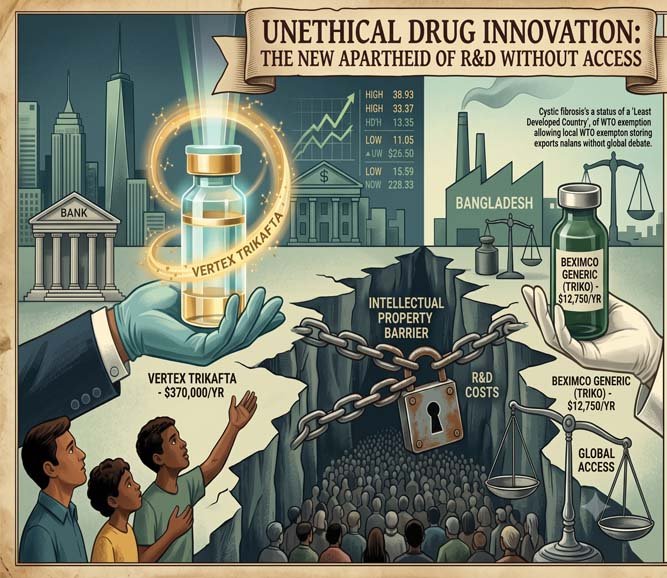
At the core of this discussion is the stark financial disparity in the pharmaceutical industry, particularly highlighted by Vertex Pharmaceuticals’ Trikafta. This drug generates around $10 billion in annual revenue, with a price tag of $346,000 to $370,000 per patient each year. For the approximately 162,000 individuals globally suffering from cystic fibrosis, such costs represent an insurmountable hurdle to necessary treatment.

In contrast, Beximco Pharmaceuticals has stepped in with a game-changing response. Leveraging decades of expertise in reverse engineering within the South Asian pharmaceutical market, they have successfully developed a generic version called Triko. Their pricing model offers a radical disruption to the conventional cost structure:

  • Pediatric Version: $6,350 to $6,375 per year
  • Adult Version: $12,750 per year

By reducing the cost of therapy by over 96%, Beximco transforms Trikafta from a luxury item into an accessible therapeutic option. This shift means that dozens of children can receive life-saving treatment for the same expenditure that would cover treatment for just one child with the original branded drug. Such affordability not only underscores the importance of equitable access to essential medicines but also challenges the existing paradigms of the pharmaceutical industry.

The Geopolitical Safety Valve: WTO’s LDC Exemptions

How does a regional player legally bypass a global monopoly? The answer lies in the geopolitical architecture of international trade.
Under current World Trade Organisation (WTO) rules, Bangladesh holds a unique classification as a Least-Developed Country (LDC). This specific designation grants the nation a legal exemption from the enforcement of standard international patent laws on pharmaceutical products. Furthermore, this regulatory framework permits LDC manufacturers to export these generic equivalents to other nations where the innovator company has either failed to secure a patent or neglected to register one.

While MNCs frequently view these exemptions as a threat to the multi-billion-dollar cost of drug discovery and clinical development pipelines, they serve as a critical safety valve for global health equity. When the pandemic forced supply chains to narrow, regional aggregators like Beximco stepped into the vacuum, demonstrating that emerging markets are no longer just consumers of low-end APIs but agile formulation engines capable of addressing highly complex therapeutic areas.

A Grassroots Victory for Patient Sovereignty

The development of this product was not a typical corporate expansion; rather, it was inspired by a grassroots global movement known as the Right to Breathe Campaign. Recognizing Beximco’s agility during the COVID-19 pandemic, a coalition of parents and patient advocates chose to bypass traditional access routes. They collaborated closely with Beximco to establish a supply mechanism managed on a named-patient basis through a revived CF Buyers’ Club.

As a result, patients and their families from various countries have begun travelling to Dhaka to collect their first life-saving doses. This situation provides a powerful example of how patient groups are influencing global distribution.

The Strategic Takeaway for Modern Pharma Leaders

The Trikafta stand-off presents a pivotal moment for pharmaceutical strategists, executives, and innovators as it underscores three essential realities that are reshaping the industry:

  1. The BANI Environment Rules Supply Chains: In a Brittle, Anxious, Non-linear, and Incomprehensible (BANI) global environment, the reliance on single-source, highly centralized manufacturing hubs for critical therapies poses significant systemic risks. This shift underscores the necessity for regional self-reliance as it becomes pivotal to national security.
  2. Reputational Equity is the New Commercial Currency: Innovator firms can no longer justify high drug prices solely based on research and development costs. When exorbitant prices force families to witness their children’s health decline, the backlash can severely damage a company’s reputation and its social license to operate.
  3. The Rise of the Agile Fast-Follower: The gap between Western innovators and top-tier generic manufacturers in developing countries has narrowed significantly. Companies that can swiftly reverse-engineer complex small molecules or biologics and deliver them compliantly will consistently challenge traditional monopolies in the pharmaceutical landscape.

As the industry evolves, the challenge for leadership will be to strike a balance—protecting financial incentives that foster significant scientific innovation while also devising creative tiered pricing models to avoid a global survival gap. This equilibrium is crucial for ensuring equitable access to essential therapies in a rapidly changing healthcare environment.

Appendix: Key Institutional, Legal, and Media References

To provide broader industry context, legal frameworks, and journalistic credibility to the themes discussed in this analysis, the following sources are referenced:

1. Global Media Coverage and Corporate Announcements

  • The New York Times and The Guardian Reports: Investigative reporting documenting Vertex’s 10 billion dollar annual revenue monopoly on Trikafta vs. the humanitarian crisis faced by families priced out by the 346,000 dollar list price.
  • Financial Times and London Stock Exchange Regulatory News Service (RNS): Regulatory updates detailing the official handover of Triko to international patients in Dhaka and the 96 percent price compression.
  • The Business Standard and Bangladesh Sangbad Sangstha (BSS): Chronics outlining the roles of Beximco leadership and the Right to Breathe campaign lead Gayle Pledger.
  • Citeline Insights and Generics Bulletin: Highlighting global distribution logistics managed via the CF Buyers’ Club on a named-patient basis.

2. International Trade and Intellectual Property Frameworks

  • WTO TRIPS Agreement LDC Provisions: The legal framework granting Least-Developed Countries exemptions from pharmaceutical patent compliance, permitting local manufacturing and cross-border distribution under named-patient legal flexibilities.

3. Academic and Epidemiological Context

  • Global Vaccine and Therapeutic Repurposing: Research outlining how regional hubs effectively pivot to address critical unmet needs during public health crises. Reference: Saha, R. P., et al. (2020). Repurposing Drugs, Ongoing Vaccine, and New Therapeutic Development Initiatives. Frontiers in Pharmacology, 11, 1258.
  • Pulmonary Health in South Asian Populations: Research analyzing respiratory health and CFTR channel performance variations in localized demographics. Reference: Lee, M. S. S., et al. (2025). Airflow obstruction and sweat chloride concentration metrics among adults in South Asia. PLOS One, 20(5), e0311711.

Hot this week

Dr. Rishubh Gupta has been appointed Head of Subregion Africa for Roche Diagnostics

Dr. Rishubh Gupta has been appointed Head of Subregion...

Meril Life Sciences is India’s Top Medtech Company

India's MedTech Mavericks: The Profitability Paradox: Balancing Rapid Growth...

The Data Graveyard: Why India’s Private Hospitals Fail at Medical Research

The Data Graveyard: Why India’s Private Hospitals Fail at...

What Leadership is Not! Position, Authority, or Activity

Leadership is not Measured by Position, Authority, or Activity. It...

Topics

Meril Life Sciences is India’s Top Medtech Company

India's MedTech Mavericks: The Profitability Paradox: Balancing Rapid Growth...

The Data Graveyard: Why India’s Private Hospitals Fail at Medical Research

The Data Graveyard: Why India’s Private Hospitals Fail at...

What Leadership is Not! Position, Authority, or Activity

Leadership is not Measured by Position, Authority, or Activity. It...

Cipla appoints Shivam Puri as CEO of One India Business

Shivam Puri has been appointed Chief Executive Officer of...

Mounjaro Upends Semaglutide Gold Rush: IPM May 2026

1. The Eli Lilly & Mounjaro Disruption: A New...

Why Pharma Field Force Fails: The Missing MAP of Motivation

Executive Summary Most healthcare organizations fail at execution, not...
spot_img

Related Articles

spot_imgspot_img