

Wednesday, June 24, 2026
28 C
Bengaluru

Meril Life Sciences is India’s Top Medtech Company

India’s MedTech Mavericks: The Profitability Paradox: Balancing Rapid Growth with Sustainable Margins

A striking infographic has been circulating across India’s healthcare and medical technology ecosystem. Featuring a futuristic manufacturing facility, robotic automation, and a leaderboard of India’s “Top 10 MedTech Companies (FY2026 Estimates),” the visual captures the growing confidence surrounding the country’s medical technology sector.

At the top of the list is Meril Life Sciences, followed by Poly Medicure, Transasia Bio-Medicals, Healthium Medtech, Trivitron Healthcare, Sahajanand Medical Technologies, Molbio Diagnostics, BPL Medical Technologies, and J. Mitra and Co.

While the graphic reflects the optimism surrounding Indian MedTech, a closer examination highlights an important distinction between industry estimates and publicly verifiable financial performance.


The Rise of Indian MedTech

India’s medical devices industry has entered a period of sustained expansion. Growth is being driven by rising healthcare expenditure, the rising incidence of chronic diseases, the expansion of health insurance coverage, investments in hospital infrastructure, and government initiatives promoting domestic manufacturing.

The sector is also benefiting from Production Linked Incentive (PLI) schemes, growing export opportunities, and increasing acceptance of Indian-made devices in international markets.

Against this backdrop, several Indian companies have emerged as significant players in cardiovascular devices, diagnostics, consumables, surgical products, and patient monitoring technologies.

Separating Estimates from Verified Financials

Among the companies featured in the circulating ranking, Meril Life Sciences stands out as one of the strongest examples of successful scale-up within Indian MedTech.

According to rating agency assessments and publicly available information, the broader Meril group reported consolidated revenues approaching 4,900 crore rupees in FY2025, with continued strong growth momentum entering FY2026. Based on these trends, revenue estimates above 5,000 crore rupees for FY2026 appear broadly plausible. However, these should still be treated as projections until audited results are fully released.

In contrast, some of the other figures circulating in industry presentations appear considerably higher than publicly available financial disclosures.

Poly Medicure, one of India’s most successful listed medical device manufacturers, reported audited consolidated revenue of exactly 1,875.26 crore rupees for FY2026, compared with 1,669.8 crore rupees in FY2025. While this solid 12.3 percent growth firmly places the company among India’s genuine MedTech leaders, it sits substantially below the 5,000 to 6,000 crore rupee range suggested by unofficial rankings.

Similarly, publicly available credit-rating data and financial filings suggest that several other companies frequently featured in industry discussions—including Transasia Bio-Medicals, Healthium Medtech, Molbio Diagnostics, and J. Mitra and Co.—remain significantly smaller than the figures sometimes quoted in informal industry estimates.

The discrepancy does not diminish their achievements. Rather, it illustrates the challenge of comparing privately held groups, consolidated entities, subsidiaries, and projected revenues within a rapidly evolving sector.

The Data Reality Check

To ground the sector’s enthusiasm in objective fiscal reality, it is useful to look at where the circulating hype contrasts with verifiable performance:

  • Meril Life Sciences: The infographic estimates 5,000+ crore rupees. The reality is that this is a plausible estimate based on an established FY2025 scale of approximately 4,900 crore rupees.
  • Poly Medicure: The infographic estimates 5,967 crore rupees. The reality is a verified, audited consolidated revenue of 1,875.26 crore rupees.
  • Healthium and Transasia: The infographic uses heavily overstated estimates. The reality is that available credit filings show they are operating at a significantly smaller scale.

The Profitability Paradox

The more important story is not the leaderboard itself but the tension between growth and profitability.

Indian MedTech companies are investing heavily in:

  • Research and development
  • Manufacturing capacity
  • International regulatory approvals
  • Global distribution networks
  • Product innovation

These investments are essential for long-term competitiveness but can temporarily constrain profitability.

The result is a classic scaling dilemma. Revenue may grow at double-digit or even higher rates, while operating margins remain under pressure as companies reinvest cash flows into future growth.

Poly Medicure provides a useful example. The company has consistently delivered strong revenue growth while maintaining operating margins generally in the mid-20 percent range. However, their final FY2026 consolidated EBITDA margin came in at 23.59 percent, reflecting mild compression due to upfront investment requirements for recent global acquisitions like CTF and Pendra Care.

Meril has followed a similar strategy, focusing on innovation-led products such as structural heart therapies and cardiovascular interventions. Higher-value products can improve profitability over time, but they require substantial upfront investment in research, clinical validation, manufacturing capability, and regulatory compliance.

Diagnostics companies face a different version of the same challenge. Firms operating in in-vitro diagnostics benefit from recurring reagent revenue streams and installed instrument bases, yet must continuously invest in technology, quality systems, and product development to remain competitive.

Why Margins Matter

The next phase of industry leadership will likely be determined not simply by revenue growth but by the ability to convert growth into sustainable profitability.

Several factors will influence future margin performance:

  • Vertical integration and localization of components
  • Expansion into higher-value product categories
  • Greater export diversification
  • Operational efficiency and automation
  • Improved utilization of manufacturing capacity
  • Stronger intellectual property portfolios

Companies that successfully move beyond commoditized products toward clinically differentiated technologies are likely to achieve superior profitability over time.

The Bigger Picture

India’s medical devices market is widely projected to expand significantly over the remainder of the decade. Industry estimates commonly place the current market size in the range of USD 16 to 19 billion today, with projections exceeding USD 50 billion by 2030.

Domestic companies are increasingly competing not only on cost but also on innovation, quality, and regulatory capability.

The emergence of globally competitive Indian MedTech firms represents one of the most significant developments in the country’s healthcare industry. Yet sustainable success will depend on more than rapid revenue growth.

The real winners will be companies that solve the profitability paradox: balancing innovation, scale, and operational discipline while protecting margins in an increasingly competitive global marketplace.

The infographic captures the excitement surrounding Indian MedTech. The financial data remind us that long-term value creation ultimately depends on converting growth into sustainable earnings.

Sources and Methodology

This analysis draws upon publicly available company filings, annual reports, investor presentations, earnings disclosures, credit-rating agency reports, industry research publications, and market intelligence sources available as of June 2026.

Where FY2026 results were not fully available for unlisted entities, the article relies on reported historical performance, management guidance, and consensus industry estimates. Unverified rankings and informal industry projections have been treated as estimates rather than established facts.

Hot this week

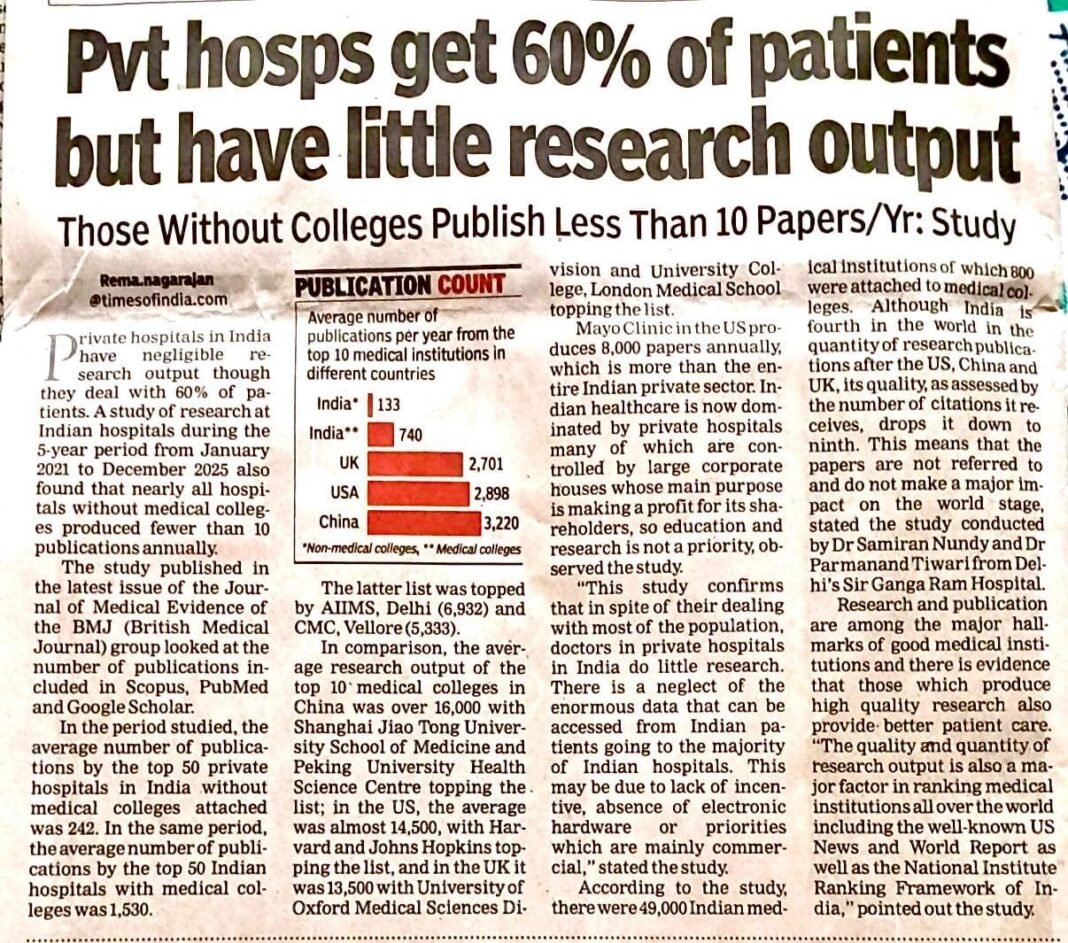
The Data Graveyard: Why India’s Private Hospitals Fail at Medical Research

The Data Graveyard: Why India’s Private Hospitals Fail at...

What Leadership is Not! Position, Authority, or Activity

Leadership is not Measured by Position, Authority, or Activity. It...

Cipla appoints Shivam Puri as CEO of One India Business

Shivam Puri has been appointed Chief Executive Officer of...

Mounjaro Upends Semaglutide Gold Rush: IPM May 2026

1. The Eli Lilly & Mounjaro Disruption: A New...

Topics

The Data Graveyard: Why India’s Private Hospitals Fail at Medical Research

The Data Graveyard: Why India’s Private Hospitals Fail at...

What Leadership is Not! Position, Authority, or Activity

Leadership is not Measured by Position, Authority, or Activity. It...

Cipla appoints Shivam Puri as CEO of One India Business

Shivam Puri has been appointed Chief Executive Officer of...

Mounjaro Upends Semaglutide Gold Rush: IPM May 2026

1. The Eli Lilly & Mounjaro Disruption: A New...

Why Pharma Field Force Fails: The Missing MAP of Motivation

Executive Summary Most healthcare organizations fail at execution, not...

Online Pharmacy:Modest but Accelerating Share of the Retail Pharma Market

India’s pharmaceutical retail landscape remains one of the world’s...
spot_img

Related Articles

spot_imgspot_img