
Wednesday, May 13, 2026
33.1 C
Bengaluru

The Forgotten HisTORy of Surendra Nath Sehgal: Discovery of Rapamycin

From the Soil of Rapa Nui to the Brainโ€™s Control Center: The Evolution of Metabolic Medicine
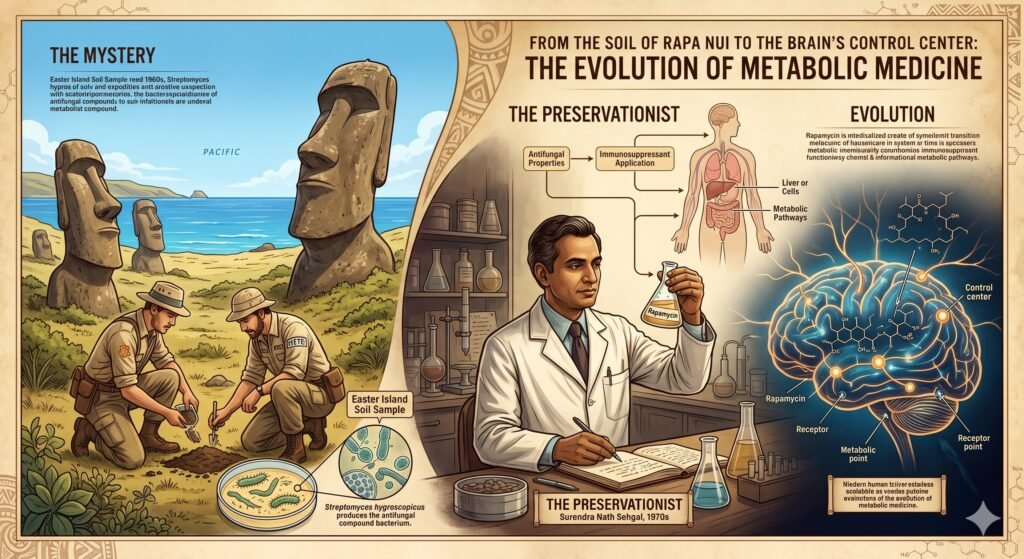
The narrative of modern metabolic medicine reminds us that transformative breakthroughs often emerge from unexpected originsโ€”like the soil of a remote island or the foresight of one scientist. These stories show how grasping the mechanisms of our key therapies can reshape entire fields.[1][2]

The Mystery of Rapa Nui

In 1964, the Canadian-led Medical Expedition to Easter Island (METEI) studied the Rapa Nui people’s health. Canadian microbiologist Georges Nรณgrรกdy collected soil samples, suspecting the island’s ecosystem held novel microbes with medicinal potential.[3][4]

These included a soil bacterium, Streptomyces hygroscopicus, producing an antifungal compound. Its full importance emerged years later, yielding a pivotal molecule in medicine.[5][1]

The Preservationist: Suren Sehgal

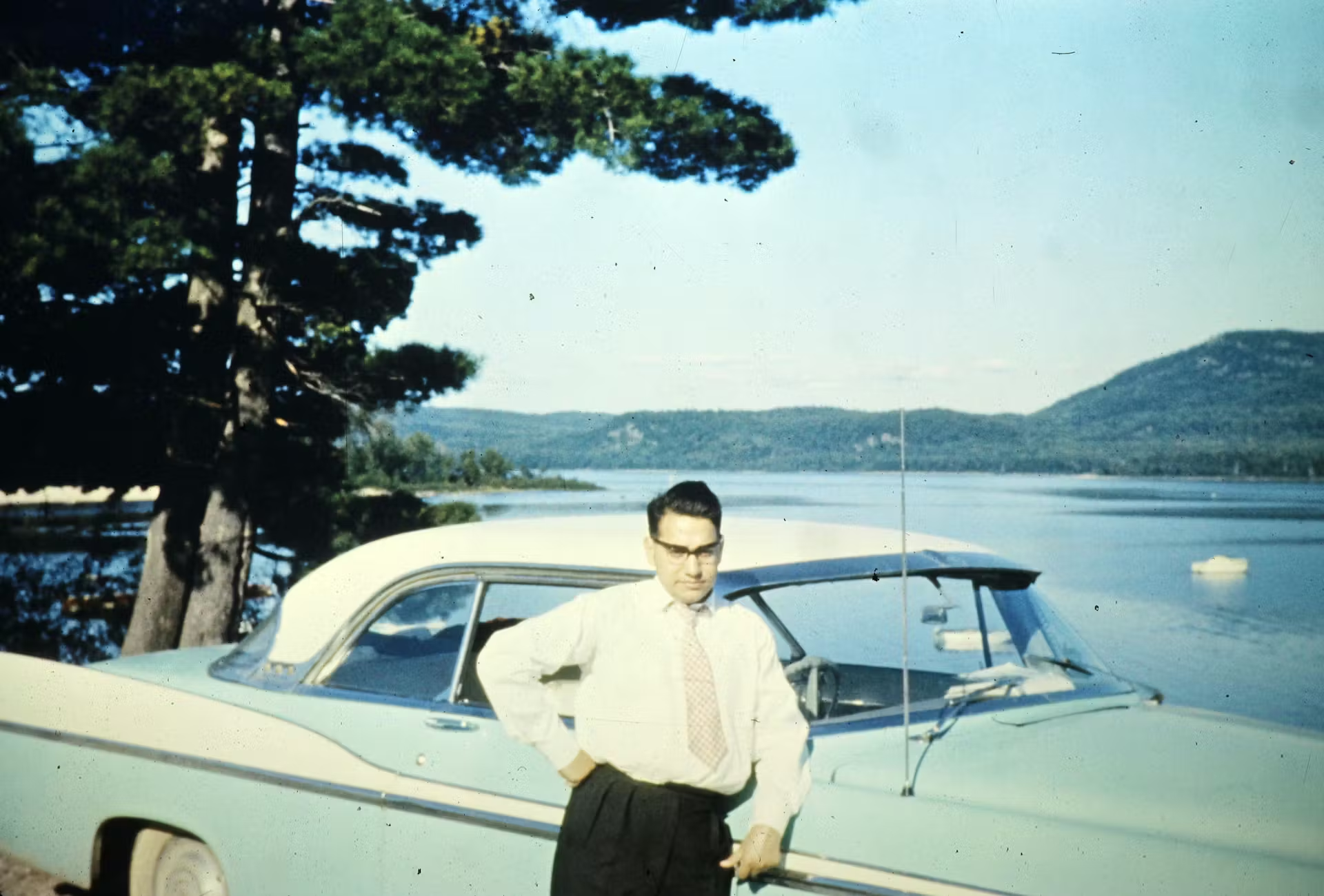
Surendra Nath Sehgal (Suren Sehgal), born in 1932 in Khushab, British India, advanced this work. At Ayerst Pharmaceuticals in Montreal, his team isolated the compound, but the lab closed in the early 1980s; Sehgal preserved a large bacterial batch at home and continued privately.[6][3]

In 1972, they named it rapamycin after Rapa Nui. Initially antifungal, it proved to be a potent immunosuppressant and an industry cornerstone.[7][8]

Source credit: https://fiftytwo.in/story/man-of-culture

Man of Culture
A bacterium discovered on a remote Pacific island first became the obsession of a Punjabi microbiologist. It later became a wonder drug that gave hope to millions around the world.


From Rapamycin to mTOR: The “Master Switch”

Rapamycin’s mechanism puzzled scientists into the early 1990s. Michael Hall’s team found yeast genes TOR1 and TOR2 (Target of Rapamycin) conferring resistance.[9][10]

The mammalian version, mTOR (mechanistic target of rapamycin), emerged soon after as the key regulator of cell growth, metabolism, and energy. Nutrient abundance activates mTOR; scarcity inhibits it, promoting repair.[10]

The Parallel Story: Metforminโ€™s Journey

Meanwhile, metformin became the top diabetes drug, rooted in medieval Galega officinalis use. For decades, it was seen to curb liver glucose output, engage the gut microbiome, and activate AMPKโ€”opposing mTORโ€”with over 200 million users today.[11]

The Hidden Pathway: Metformin Acts on the Brain

A 2025 Science Advances study from Baylor College of Medicine upends this, showing metformin targets the brain.[2]

The Discovery in Detail

Led by Dr. Makoto Fukuda, the team examined Rap1 protein in the ventromedial hypothalamus (VMH), vital for hunger and glucose control.

  • Brain Target: In diabetic mice, blocking this VMH pathway prevented metformin’s glucose-lowering effect.[2]
  • Low-Dose Potency: Brain injections of tiny amountsโ€”thousands of times below oral dosesโ€”sharply reduced blood sugar.[12][2]
  • Inhibition Mechanism: Metformin inhibits Rap1, activating glucose-regulating neurons.[2]

Why This Matters

Press reports attribute to Dr. Fukuda: “This discovery changes how we think about metformin. It’s not just working in the liver or the gutโ€”it’s also acting in the brain.” The brain responds at low levels, unlike high-dose needs elsewhere.[13][12]

Dr. Ambrish Mithal of Max Healthcare called it clarity for a 60-year staple, enabling neural-targeted therapies.[14]

A Unified Tapestry

Rapamycin and metforminโ€”from Rapa Nui soil to brain pathwaysโ€”illustrate metabolic medicine’s shift from organ silos to brain-led integration.

Beyond the Discovery: Three Key Implications for Metabolic Medicine

These revelations extend far beyond history, offering actionable insights for clinicians, researchers, and pharma leaders.

Implication 1: Precision Dosing Revolution

Metformin’s brain sensitivity suggests ultra-low central doses could match full oral efficacy with fewer side effects. VMH-targeted delivery (e.g., nasal or focused ultrasound) may redefine type 2 diabetes care, slashing gastrointestinal issues.[12][2]

Implication 2: Rapamycin-Metformin Synergy

mTOR inhibition by rapamycin pairs naturally with metformin’s Rap1/VMH effects and AMPK activation. Trials could explore combos for obesity, aging, or neurodegeneration, leveraging shared nutrient-sensing axes.[10][2]

Implication 3: Brain-Centric Drug Design

The brain as metabolic “conductor” shifts R&D paradigms. Screen candidates via hypothalamic models, not just liver assaysโ€”unlocking therapies for hunger-driven diseases like NASH or Alzheimer’s.[11][2]

Post Script

Rapamycin, also called sirolimus, is now a life-saving wonder drug. Itโ€™s used for immunosuppression in organ transplant recipients and for coronary artery stents after balloon angioplasty. Trials are underway to test its efficacy in treating ALS, Crohnโ€™s disease, and metastatic and advanced cancers. Some studies suggest that rapamycin could increase lifespan.

But all these bounties were unimagined when soil samples from Easter Island arrived on the desk of a 37-year-old microbiologist in Montreal in the year of the moon landing. Calneโ€™s painting takes some creative licence. Sehgal himself never visited Rapa Nui, but the man and his molecule are forever tied to the island.

Appendix: Sources Cited

  1. Gambari, R., et al. (2023). The Long Scientific Journey of Sirolimus (Rapamycin): From the Soil of Easter Island (Rapa Nui). Biology.[4]
  2. Nature Cell Biology. (2017). A long and winding sTORy.
  3. American Chemical Society. (2016). Molecule made by bacteria could hold the key to the fountain of youth. C&EN.
  4. Lin, H.-Y., et al. (2025). Low-dose metformin requires brain Rap1 for its antidiabetic action. Science Advances.[2]
  5. Baylor College of Medicine. (2025). Researchers uncover a new player mediating metformin’s antiโ€‘diabetic action.[12]
  6. EurekAlert via Baylor College of Medicine. (2025). How does metformin lower blood sugar?
  7. Sanchez-Rangel, E., & Inzucchi, S. E. (2017). Metformin: clinical use in type 2 diabetes. Diabetologia.
  8. Rena, G., et al. (2017). The mechanisms of action of metformin. Diabetologia.
  9. Marshall, S. M. (2017). 60 years of metformin use. Diabetologia.
  10. Hu, Y., et al. (2026). Metformin: Historical Origins and Emerging Clinical Applications. Diabetes/Metabolism Research and Reviews.
  11. Sehgal.net (archived). Suren’s Story.[3]
  12. Times of India report (2025). Citing Baylor and Dr. Ambrish Mithal.[14]

Additional Sources
[1] The HisTORy Behind the Discovery of Rapamycin | Bio-Rad https://www.bio-rad-antibodies.com/blog/history-of-rapamycin.html
[2] Low-dose metformin requires brain Rap1 for its antidiabetic action https://www.science.org/doi/10.1126/sciadv.adu3700
[3] Medical records, 1964-1965 [microform] – National Library of Australia https://catalogue.nla.gov.au/catalog/569279
[4] From the Soil of Easter Island (Rapa Nui) to Applied Research and โ€ฆ https://pubmed.ncbi.nlm.nih.gov/37759601/
[5] The rapamycin sTORy: 50-year journey from Easter Island to the frontiers of biology and medicine – PubMed https://pubmed.ncbi.nlm.nih.gov/41888005/
[6] Surendra Nath Sehgal – Wikipedia https://en.wikipedia.org/wiki/Surendra_Nath_Sehgal
[7] Suren’s Story https://www.sehgal.net/surenshistory.htm
[8] Rapamycin (AY-22989) is a new antifungal antibiotic. II. Fermentation โ€ฆ https://www.semanticscholar.org/paper/Rapamycin-(AY-22,989),-a-new-antifungal-antibiotic.-Sehgal-Baker/0a620a6dc46be9489bb4e3dc96400994c61079b2/figure/1
[9] Michael N. Hall – Wikipedia https://en.wikipedia.org/wiki/Michael_N._Hall
[10] mTOR inhibitors – Wikipedia https://en.wikipedia.org/wiki/MTOR_inhibitors
[11] Metformin’s Secret Brain Pathway Revealed In Diabetes Study https://evrimagaci.org/gpt/metformins-secret-brain-pathway-revealed-in-diabetes-study-535291
[12] Metformin’s blood sugar control starts in the brain, not just the liver, study finds https://www.news-medical.net/news/20250803/Metformine28099s-blood-sugar-control-starts-in-the-brain-not-just-the-liver-study-finds.aspx
[13] New Metformin Research by Dr Fukuda at Baylor College of Medicine https://www.linkedin.com/posts/david-allison-2917963b_low-dose-metformin-requires-brain-rap1-for-activity-7364029678103244800-7zIg
[14] Metformin’s Brain Action Clarifies Its Effectiveness | Dr Rajiv Kumar โ€ฆ https://www.linkedin.com/posts/dr-rajiv-kumar-jain-568a0910_drug-diabetes-metformin-activity-7443519656000323584-h5QV

All Images are AI Generated. E&OE

Hot this week

Do Retail Pharmacies Really Care about Patients?

The chemist shopโ€”jammed between a chai stall and a...

Indian Oncology: An Unasked Question, the Challenges Ahead

A Brief History of Scale and an Unasked Question In...

Are Quick Remedies Keeping Patients Away from Doctors?

The recent Mint Lounge analysis captured a striking consumer...

From Tragedy to Trust: What the CDCSO Can Learn from Dr. Frances Oldham Kelsey

Abstract The U.S. Food and Drug Administration (FDA) evolved from...

Biocon’s Landmark Succession Planning: Claire Mazumdar is the Future Leader

In a landmark decision for Indiaโ€™s biotechnology sector, Kiran...

Topics

Do Retail Pharmacies Really Care about Patients?

The chemist shopโ€”jammed between a chai stall and a...

Indian Oncology: An Unasked Question, the Challenges Ahead

A Brief History of Scale and an Unasked Question In...

Are Quick Remedies Keeping Patients Away from Doctors?

The recent Mint Lounge analysis captured a striking consumer...

From Tragedy to Trust: What the CDCSO Can Learn from Dr. Frances Oldham Kelsey

Abstract The U.S. Food and Drug Administration (FDA) evolved from...

Biocon’s Landmark Succession Planning: Claire Mazumdar is the Future Leader

In a landmark decision for Indiaโ€™s biotechnology sector, Kiran...

Why Private Equity is the New Kingmaker in Pharma & MedTech

The PE Playbook: Why Private Equity is the New...
spot_img

Related Articles

spot_imgspot_img