
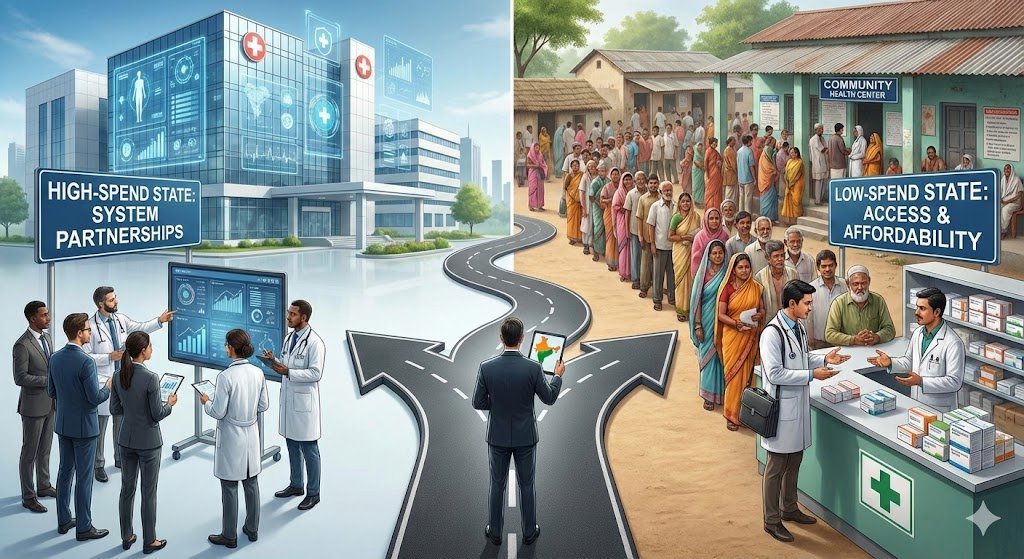

India’s health map is splitting into two distinct opportunity zones for pharma: states that are putting health near the top of their budget priorities, and those that still lean heavily on out‑of‑pocket spending and thin public systems. This divergence is no longer just a policy curiosity; it is becoming a core commercial variable that should shape portfolio strategy, go‑to‑market design, and marketing investments for every serious Indian pharma player.
The new state health economy
Over the last decade, government health expenditure has risen both as a share of GDP and of total health spending, with states now financing the bulk of public health outlays. Yet there are sharp differences in commitment: some states allocate upwards of 6–7% of their budgets to health and actively expand insurance, free‑drug schemes and public infrastructure, while others remain closer to 4–5%, leaving households to bridge the gap through out‑of‑pocket payments. Medicines continue to form the largest single component of personal health spending, which keeps drug prices, procurement efficiency and pharma margins squarely in the political spotlight.[1][2][3][4][5]
For pharma C‑suites, this means national strategies that ignore state‑wise fiscal capacity and policy ambition are increasingly obsolete. The winners will be companies that segment India not just by therapy or geography, but by “health‑spend archetype” and then calibrate offers, evidence and engagement models accordingly.