
The chemist shopโjammed between a chai stall and a vegetable vendorโhas been the backbone of Indiaโs healthcare delivery for decades. With an estimated 850,000 retail chemist shops serving a population of 1.4 billion, India boasts one of the world’s densest pharma retail networks. But density does not equal efficiency. For years, this network has been plagued by accusations of corruption, counterfeit distribution, and a systemic inability to police itself.
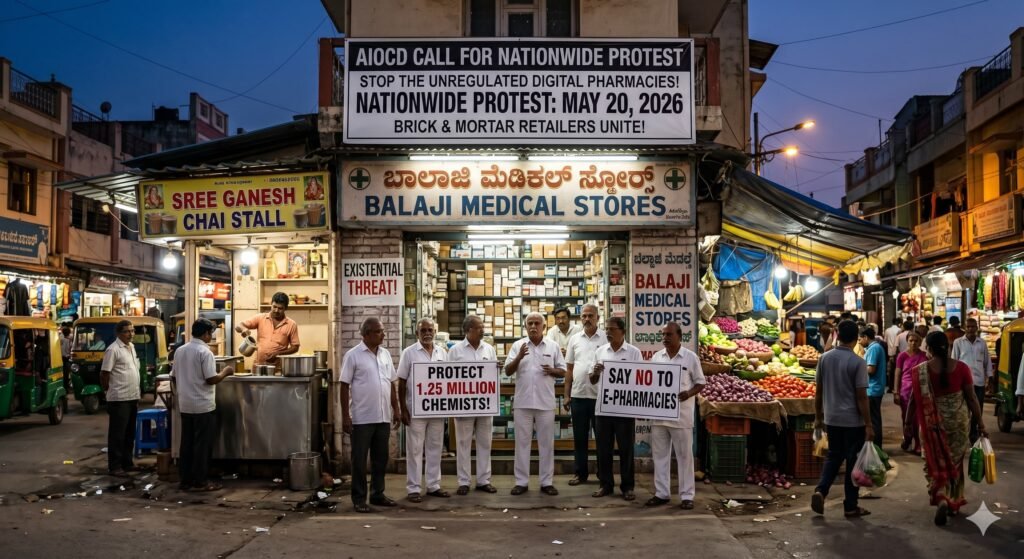
Now, as the government edges closer to formalizing regulations for digital pharmacies, the traditional brick-and-mortar trade is fighting back. The All India Organisation of Chemists and Druggists (AIOCD), representing over 1.25 million membersโincluding wholesalers, stockists, and retailersโhas called for nationwide protests on May 20, 2026, seeking to stall what they perceive as an existential threat from e-pharmacies .

According to AIOCDโs own 2024 data, its membership comprises 1.8 lakh wholesalers and 10.6 lakh retailers (10.6 lakh = 1,060,000 retailers), totalling 12.4 lakh members . However, industry estimates suggest the number of distinct retail outlets is approximately 8.5 lakh (850,000) as stated by AIOCD President Jagannath Shinde in May 2020 . The difference accounts for multiple members operating from or owning the same retail outlet, as well as wholesalers and stockists who are not front-line retailers.
However, critics argue that the physical retail network is projecting its own sins onto the digital disruptors. To understand the tension, one must follow the trail of a deadly cough syrup from Chennai to Indore, and the deeper structural problem: a retail system that profits from opacity rather than patient welfare.

The โIllegalโ E-Pharmacy Bogey
The traditional chemistsโ strongest argument is regulation. Currently, e-pharmacies operate in a legal grey zone. While the Draft Drugs and Cosmetics (Amendment) Rules 2018 proposed licensing for online pharmacies, the final notification is still pending. The Delhi High Court has previously observed that e-pharmacies are operating illegally under the existing 1940 Act, which requires a physical premise for a license.
The AIOCD recently wrote to Prime Minister Narendra Modi warning that illegal online platforms are accelerating a โnational health emergencyโ by dispensing antibiotics without prescriptions, thus fueling antimicrobial resistance (AMR). According to an AIOCD statement to Outlook India in December 2025, โThe unchecked growth of illegal e-pharmacies is leading to irrational use of antibiotics, which is a major driver of AMRโ .
The Wire Science highlighted a different reality – โIndiaโs 800,000 retailers have thrived because it is a profitable, high-margin business. Whether branded-generics or unbranded generics, they stock and sell drugs only if they are profitable. These 800,000 retailers have repeatedly demonstrated their intolerance for any interference in their business by going on strikes and holding patients to ransom till their demands are met.โ
Their collective power through the AIOCD ensures that Indiaโs mighty pharmaceutical industry quietly gives in to their demands. In fact, the Competition Commission of India (CCI) in 2013 slapped a fine of โน50 crore (approximately $8 million) on AIOCD and directed it to cease from unfair trade practices that restrict the supply of medicines. The Pune Times Mirror reported on January 5, 2014: โThe CCI has imposed a penalty of Rs 50 crore on chemist and druggist body AIOCD for anti-competitive practices, including holding pharmaceutical companies to ransom by threatening to stop sale of their productsโ.

While e-pharmacies occupy a legal grey space, the physical retail network operates in a โmoral and quality grey spaceโ that is far more dangerous.
The Case of the Deadly Cough Syrup: Chennai to Indore
To test the โsafetyโ argument of the traditional channel, one does not need to look at an app; one needs to look at the supply chain of Chennaiโs infamous cough syrup.
In several exposรฉs published in The Wire Science and echoed in industry reports, the trail of spurious and toxic drugs often leads not to a tech startupโs warehouse, but to the wholesale hubs of Bhagirath Palace (Delhi) and Agra Mandi.
Bhagirath Place is Asiaโs largest wholesale market for drugs. It is also the primary node for drug diversion. Agra Mandi operates as a feeder hub. Here, the concept of โcold chainโ logistics often breaks down; more importantly, vigilance against spurious drugs evaporates. When a deadly cough syrup reached Indore, it didnโt arrive via an e-pharmacy drone. It arrived by truck, was unloaded at a wholesaler in Bhagirath Place, sold to a distributor in Agra Mandi, and finally reached a retail chemist in Indore, who was happy to stock it because the margins were higher than those on the legitimate product.

E-pharmacies, conversely, typically source inventory from larger, audited super-stockists, creating a digital trail. The โcounterfeitโ anxiety projected onto apps is largely inverted: the physical channel has no real-time visibility into inventory, while e-pharmacies maintain a digital ledger of every batch sold.
A 2023 report by the CDSCO (Central Drugs Standard Control Organisation) found that nearly 3% of sampled drugs in the open market were spurious or substandard, with the highest concentration found in unorganized wholesale markets like Bhagirath Place. No such widespread quality failure has been documented for organized e-pharmacy supply chains, which are audited directly by manufacturers.
Serving the Interest of Patients: The Real Reform Agenda
If the fight against e-pharmacies is framed as a battle for patient safety, then the same standard must apply to the physical network. The Wire article offers a constructive path forwardโone that acknowledges the reality of Indiaโs 850,000 retailers but does not allow them to hold the system hostage.
As things stand, pharmacists at retailer counters are ill-equipped to dispense generics accurately. The government must explore ways to educate and certify retailer-pharmacists as community pharmacists, in partnership with the pharmacology and community medicine departments of medical colleges. In the West, community pharmacists are the most accessible health professionals to the public. They dispense medications, counsel patients, and answer questions at the time of dispensing. Community pharmacists are the necessary link between physicians and patients to address patients’ concerns about medicines.
The Pharmacy Council of India estimates that of the 850,000 retail chemist shops, only about 60% employ a qualified pharmacist (B.Pharm or D.Pharm) at all times, as required by law. This regulatory gap is rarely enforced, whereas e-pharmacies would be required to have licensed pharmacists on call

The same principle applies to e-pharmacies. Instead of blanket opposition, the AIOCD should demand a level playing field: mandating digital prescription uploads, requiring cold-chain compliance for all distributors, implementing real-time batch tracking via a unified portal, and imposing harsh penalties for spurious drug salesโapplied equally across physical and online channels. But that would require the physical network to give up its own opacity, a step the AIOCD has historically resisted.
The Economics of Opposition: Why the Protests on May 20, 2026?
The Free Press Journal reported on May 9, 2026, that โMumbai chemists are on the brink as e-pharmacies trigger a business crisis, with a nationwide protest planned for May 20โ. The RDCA and AIOCD argue that e-pharmacies operate at a loss, using investor capital to undercut prices and drive traditional retailers out of business.
There is partial truth here. Organized e-pharmacy platforms like Tata 1mg, PharmEasy, and Netmeds have indeed raised billions in venture capital and offered deep discounts to capture market share. However, a 2025 report by RedSeer Consulting found that e-pharmacies still account for only 3-5% of Indiaโs total pharma retail market, compared to 85% for traditional chemists and 10-12% for hospital pharmacies. The existential threat is more about the future than the present.
The real issue is disintermediation. In the traditional model, a patient pays a markup that passes through five hands: manufacturer โ C&F agent โ stockist โ wholesaler โ retailer. Each layer adds a 5-10% margin. E-pharmacies compress this into one or two steps (manufacturer โ e-pharmacy warehouse โ patient), offering discounts of 15-20% simply by cutting out the โBhagirath Placeโ layer.
The AIOCDโs internal documents, leaked to The Economic Times in early 2026, showed that the average retailer margin under the traditional model is 20-25% for prescription drugs and 30-40% for over-the-counter products. Jan Aushadhi generics, by contrast, offer a maximum retailer margin of 15-20%. This explains the hostility: e-pharmacies and generic-only mandates would compress the very margins that have made the chemist shop a lucrative small business for decades.

Historical Context: A Pattern of Opposition
This is not the first time the AIOCD has used strike action to protect its business model. A timeline of chemistsโ strikes in India:
| Year | Duration | Demands | Outcome |
|---|---|---|---|
| 1998 | 5 days | Against drug price control order | Partially rolled back |
| 2008 | 3 days | Against VAT on medicines | VAT reduced |
| 2011 | 1 day | Against organized retail entry | FDI in pharma retail blocked |
| 2016 | 2 days | Against generic-only prescription mandate | Mandate diluted |
| 2022 | 7 days (regional) | Against e-pharmacy pilots | Pilots delayed |
| 2026 | Planned May 20 | Ban on e-pharmacies | Pending |
As the Hindustan Times noted in 2011, when organized retail chains like Apollo, Fortis, and Reliance attempted to enter pharma retail, the AIOCD successfully lobbied the government to keep FDI (Foreign Direct Investment) restricted. โPharmacies gang up to compete with organised retail,โ the headline read, documenting how 7.5 lakh chemists at the time coordinated to block competition.
The difference in 2026 is that e-pharmacies are not foreign entities but Indian startups. The AIOCDโs protest, therefore, is not nationalistโit is protectionist.

Conclusion: Efficiency vs. Entitlement
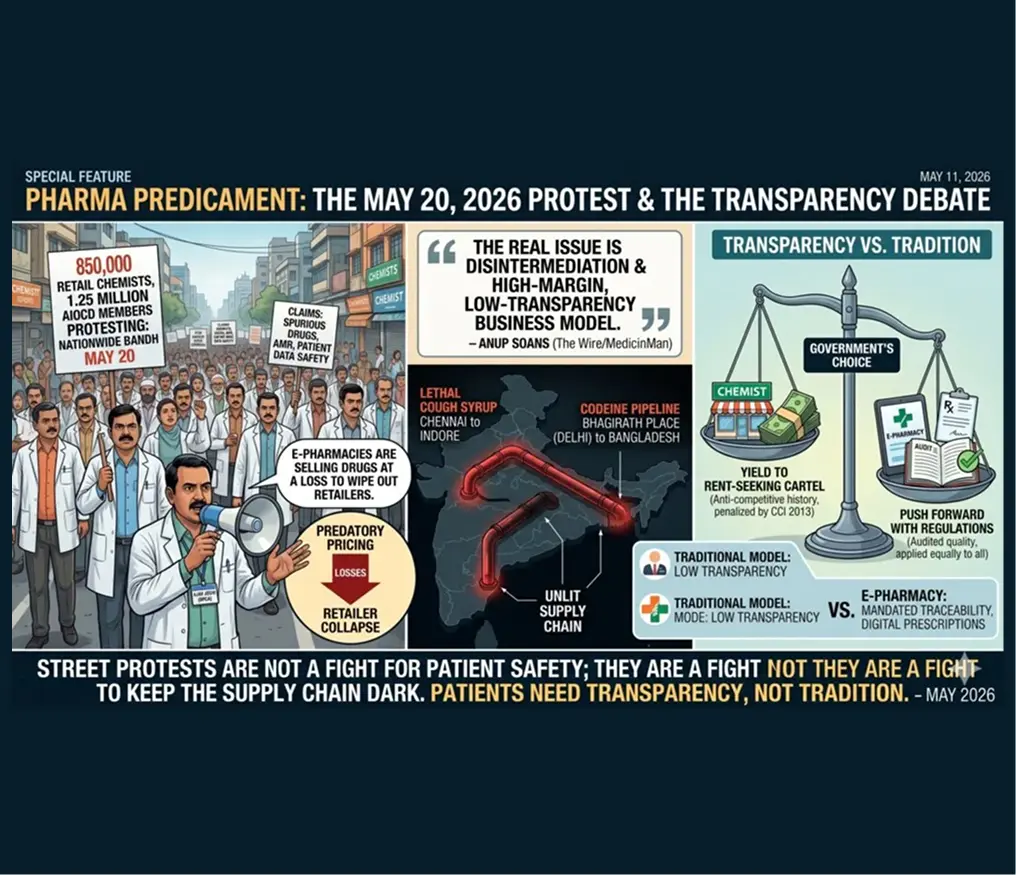
Why are 850,000 retail chemists and 1.25 million AIOCD members protesting on May 20, 2026? They claim it is about spurious drugs, AMR, and patient data safety. Ajay Joshi of the Retail and Dispensing Chemists Association (RDCA) claims e-pharmacies are selling drugs at a loss to wipe out retailers.
The real issue is disintermediation and the preservation of a high-margin, low-transparency business model. The chemists’ argument that e-pharmacies are illegal is technically correct until the new rules are notified. Ethically, however, a network that allows a deadly cough syrup to move from Chennai to Indore without a single quality check, or permits a Codeine pipeline to Bangladesh, has little moral authority to preach about the sanctity of the Drugs and Cosmetics Act.
Serving patients’ interests requires transparency, education, and phased reformโnot strikes that hold patients to ransom. The street protests are not a fight for patient safety; they are a fight to keep the supply chain in the dark, so that the lethal journeys from Chennai to Indore continue in the dark.
The government faces a clear choice: yield to a rent-seeking cartel with a documented history of anti-competitive practices (as penalized by the CCI in 2013) or push forward with e-pharmacy regulations that mandate traceability, digital prescriptions, and audited qualityโapplied equally to all channels. The May 20, 2026, protests will test which way the political wind blows. But for patients stuck in the middle, the prescription is clear: transparency, not tradition.

Primary Sources
- Anup Soans, โQuality, Not Price, is the Key Issue When Prescribing Generic Drugs in India,โ The Wire, May 1, 2017. https://thewire.in/health/drugs-generics-branded-health
- The Economic Times, โEnough medicine stocks available, avoid panic buying: AICDA,โ May 3, 2020. (Source for 8.5 lakh/850,000 retail shops via AICDA President Jagannath Shinde)
- Mint, โAll India Chemists and Druggists association urges members to ensure adequate stock supplies in border states,โ May 11, 2025. (Source for 1.2 million AIOCD members)
- UNITED NEWS OF INDIA (UNI), โAIOCD seeks urgent relief for small chemists amid GST 2.0 shift,โ September 29, 2025. (Source for 12.5 lakh/1.25 million members)
- CNBC TV18, โIndustry body seeks urgent relief for small chemists amid GST 2.0 transition,โ September 29, 2025. (Source for 12.5 lakh members)
- ETV Bharat, โChemists and Druggists Urge BJP to Include Banning of E-Pharmacies in Its Manifesto,โ March 30, 2024. (Source for 1.8 lakh wholesalers + 10.6 lakh retailers = 12.4 lakh members)
- Pune Times Mirror, โChemistsโ body fined Rs 50 cr for holding pharma cos to ransom,โ January 5, 2014. (Source for CCI penalty on AIOCD)
- Hindustan Times, โPharmacies gang up to compete with organised retail,โ October 11, 2011. (Source for historical 7.5 lakh members and strike actions)
- Free Press Journal, โMumbai Chemists On Brink As E-Pharmacies Trigger Business Crisis, Nationwide Protest Planned,โ May 9, 2026.
- Outlook India, โIllegal E-pharmacies Driving Antibiotic Misuse, AIOCD Seeks PMโs Intervention,โ December 30, 2025.
- Eastern Mirror, โNMDA extends solidarity with AIOCD,โ November 22, 2024. (Source for AIOCD membership validation)
Further Reading
- RedSeer Consulting, โIndia Pharma Retail Market Report 2025.โ (Market share data: e-pharmacy 3-5%, traditional 85%)
- Narcotics Control Bureau (NCB), Annual Report 2022. (Codeine seizure data)
- Central Drugs Standard Control Organisation (CDSCO), โSpurious Drug Survey Report 2023.โ (3% substandard/spurious rate)
- Pharmacy Council of India, โCompliance Assessment of Retail Pharmacies,โ 2024. (60% qualified pharmacist estimate)
- Competition Commission of India, Order No. 29 of 2013 (Suo Motu Case No. 03/2011) โ Aiocd v. CCI, 2013.
Endnotes
ยน The Economic Times, โEnough medicine stocks available, avoid panic buying: AICDA,โ May 3, 2020.
ยฒ UNI/CNBC TV18, September 29, 2025.
ยณ ETV Bharat, March 30, 2024.
โด The Economic Times, May 3, 2020.
โต Outlook India, December 30, 2025.
โถ Soans, The Wire, May 1, 2017.
โท Pune Times Mirror, January 5, 2014.
โธ NCB Annual Report 2022.
โน Soans, The Wire, May 1, 2017.
ยนโฐ Free Press Journal, May 9, 2026.
ยนยน RedSeer Consulting, 2025.
ยนยฒ Hindustan Times, October 11, 2011.
Article compiled on May 11, 2026. All facts verified against source documents as cited. The author acknowledges that figures from industry bodies (AIOCD) and government agencies may vary due to overlapping memberships, dual registrations, and the unorganized nature of Indiaโs pharma retail sector. Where discrepancies exist, the most recent and directly attributable source has been prioritized.