
Thursday, May 14, 2026
30.1 C
Bengaluru

Has the Pharmacy of the World Missed the Animal Health Bus?

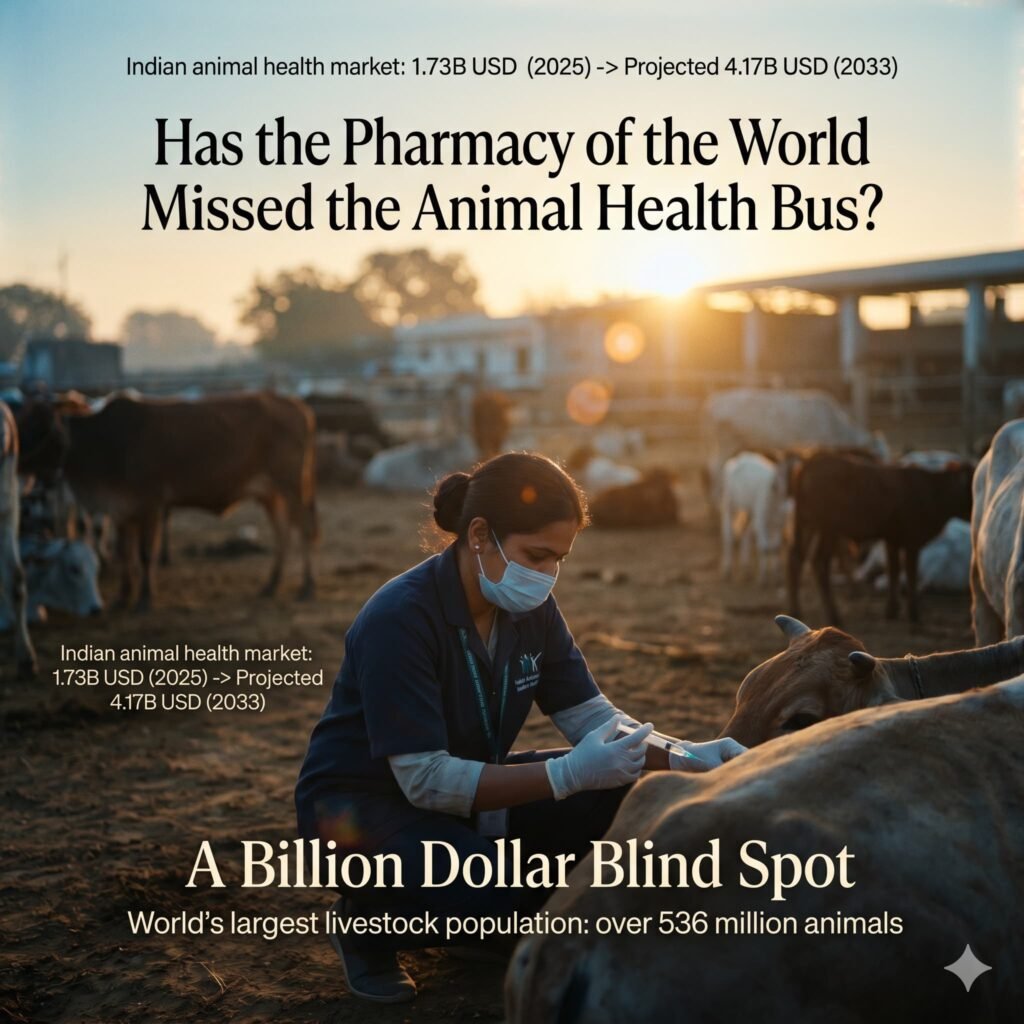
In 2025, the Indian animal health market stood at approximately 1.73 billion dollars. By 2033, it is projected to reach a staggering 4.17 billion dollars, growing at a compound annual growth rate of over 10 per cent. With the world’s largest livestock population of over 536 million animals, the third-largest pet population globally at 32 million and counting, and aggressive government disease eradication programs, the opportunity is nothing short of massive.

Yet, when one scans the headlines of India’s pharmaceutical industry, a curious omission emerges. The Indian pharma story of the past two decades, told through the rise of Sun Pharma, Cipla, Dr. Reddy’s, and Biocon, is almost exclusively a human health story. These giants have built empires in generics, biosimilars, and active pharmaceutical ingredients, serving patients from Boston to Brisbane.


But where are they in animal health?

The uncomfortable answer is that while the animal health market booms, most of India’s pharmaceutical heavyweights are either absent, newly arrived, or struggling to scale. The 4.17 billion dollar prize is currently being carved up by global multinationals like Zoetis, Merck, and Boehringer Ingelheim, and a handful of specialized domestic players such as Indian Immunologicals and Hester Biosciences. The Big Pharma of India are conspicuously missing from the top tables of the veterinary economy.

The Anatomy of an Overlooked Opportunity

The term animal health often suffers from a perception problem, conjuring images of stray dog vaccinations rather than the high-margin industry it has become.

The India animal health market is a multi-layered ecosystem:

Pharmaceuticals account for 42.55 per cent of the market, including anti-infectives, parasiticides, and anti-inflammatories. Biologics and vaccines account for approximately 20 per cent of the market, driven by mandatory government immunisation programs. Diagnostics and equipment constitute the fastest-growing segment, fueled by tech startups and digital health platforms.

The One Health Economic Imperative

The Indian government has committed over 13,340 crore rupees, approximately 1.8 billion dollars, through the National Animal Disease Control Programme to eradicate Foot-and-Mouth Disease and Brucellosis by 2030. Simultaneously, the Animal Husbandry Infrastructure Development Fund, a 15,000-crore rupee fund, is seeking private investment to build dairy and meat-processing capacity. This is not charity; it is economic logic. A sick animal reduces dairy yield and ruins the livelihoods of 70 per cent of rural households dependent on livestock.

The Pet Premiumization Trend

Beyond livestock, the companion animal segment is undergoing humanization. With 32 million pets projected to hit 51 million by 2028, owners are demanding advanced parasiticides like Bravecto, anti-anxiety drugs, and dermatology solutions. These are high-value products that human pharma companies are expertly positioned to manufacture but largely ignore in the Indian context.

The Ghosts of Missed Chances

Why have the giants not colonized this space? The reasons are historical and strategic.

First, the margin mirage. For decades, the return on investment in human generics in the United States and Europe dwarfed animal health. Companies like Cipla and Dr. Reddy’s focused on high-volume human generic booms. Cipla Vet, while existent, remains a footnote. In fiscal year 2026, amid a 54.6 per cent drop in fourth-quarter profit due to competition in the United States market, no strategic pivot toward veterinary markets was signalled.

Second, the Kerala vaccine tragedy. In 1982, the Institute of Viral Vaccine in Kulanada, Kerala, was a global leader, exporting to 90 countries. It collapsed in 1995 due to bureaucratic disputes and denied access to government networks. This government dependency remains a structural risk that scares away big pharma, accustomed to predictable private prescriptions.

Third, cold chain complexity. Unlike a tablet, a veterinary biologic must reach a remote village without breaking the cold chain. While human pharma has solved this for essentials, the specialized last-mile infrastructure for cattle is a barrier they have been unwilling to fund.

The Specialists Versus the Giants

Because the giants hesitated, dedicated specialists rose to fill the void.

The Domestic Champions

Indian Immunologicals Limited is a leader in Foot and Mouth Disease and rabies vaccines, reporting 1,586 crore rupees in fiscal year 2026 revenue. Hester Biosciences holds 30 percent of the poultry vaccine market. Despite revenue volatility in fiscal year 2026, its profit after tax surged 140 percent in the third quarter due to operational efficiencies. Biovet, a Bharat Biotech subsidiary, launched BIOLUMPIVAXIN, a Lumpy Skin Disease vaccine, in 2025, demonstrating superior research and development in marker vaccines.

The Multinationals

The vacuum left by Sun Pharma and Cipla has been filled by Boehringer Ingelheim, which launched next-generation poultry vaccines in 2025, and Zoetis, which uses its Hyderabad hub to integrate digital diagnostics with drug delivery.

The Race with China: Can India Win?

China is currently the dominant force in Asian animal healthcare. The Asia Pacific animal healthcare market, valued at 22.26 billion dollars in 2025, is projected to reach 53.52 billion dollars by 2034, and China is its anchor. However, the race is not as one-sided as it appears.

The numbers tell a story of two different races on the same track.

Comparison of India and China Animal Health Markets

Metric – India – China
Market Size – approximately 1.73 billion dollars in 2025 – approximately 11.8 billion dollars in 2023
Growth Rate Poultry Vaccine – 11.7 percent CAGR – 10.5 percent CAGR
Pet Infrastructure – fragmented, startup-led – over 12,000 pet hospitals
Strategic Edge – low-cost, WHO-compliant manufacturing – high-scale, industrial farm integration

China has already won the race for absolute scale and industrial integration. Chinese chicken exports rose 58 percent year on year in the fourth quarter of 2025, surpassing Thailand to become the world’s fourth largest chicken exporter. China’s animal health market is nearly seven times the size of India’s.

However, India can beat China by becoming the Pharmacy of the World for the Global South’s animal health. India’s growth is driven by expanding formal vaccination coverage to previously unserved herds and flocks. China’s growth is driven by upgrading already-covered operations to higher-value products. Both are valuable. Both are different.

India’s inherent strengths include manufacturing cost arbitrage, regulatory expertise in World Health Organization and Good Manufacturing Practice compliance, and the sheer scale of a transitioning livestock economy. The question is not whether India can beat China on China’s terms. The question is whether Indian pharma will finally decide that the race is worth entering.

The 2026 Strategic Action Plan

For the human pharma giants looking to board the second bus, a generic approach will fail. Success requires three actions.

First, specialty biologics. Companies must move beyond Foot and Mouth Disease vaccines into dermatology, oncology, and chronic care products for companion animals. The pet pharmacy opportunity is severely underserved in India.

Second, service integration. Established pharma companies should partner with or acquire rising vet-tech startups like Verdant Impact, which offers telemedicine for livestock farmers, or Vetic, a pet telemedicine platform. These startups are collecting data and building customer stickiness that traditional pharma lacks.

Third, logistics partnerships. Instead of building cold chain infrastructure from scratch, companies should leverage existing rural distribution networks such as dairy cooperatives. The National Dairy Development Board network that powers Indian Immunologicals is a model worth emulating.

The Verdict: Is the Bus Gone?

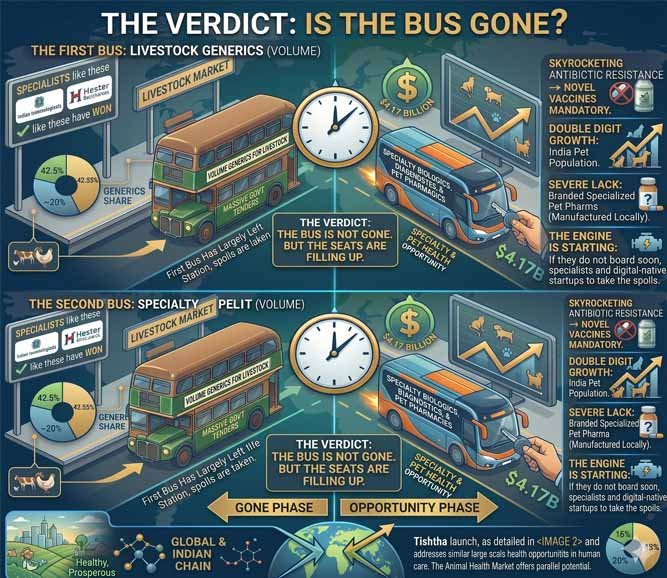
The first bus, volume generics for livestock, has largely left the station. The foundational growth phase of capturing the government’s massive Foot and Mouth Disease and Brucellosis vaccine tenders has already been won by specialists like Indian Immunologicals and Hester Biosciences.

However, a second vehicle is idling: specialty biologics, diagnostics, and pet pharmacies. The need is clear. As antibiotic resistance grows, the demand for novel vaccines will skyrocket. The opportunity is substantial. India’s pet population is growing at double digits, and there is a severe lack of branded specialized pet pharmaceuticals manufactured locally. The advantage is undeniable. Indian pharma has world-class biosimilar and research and development capacity.

The engine is starting. If Cipla, Sun Pharma, or Dr. Reddy’s do not board soon, they will spend the next decade watching specialists and digital-native startups take the spoils of a 4.17 billion dollar industry. The bus is not gone. But the seats are filling up.

Appendix: Sources

IMARC Group via Research and Markets, February 2026: India Animal Health Market Size Analysis at 92.62 billion rupees in 2025, 71 percent commercial livestock share, pet population 32 million.

Grand View Research via Research and Markets, August 2025: India Livestock Animal Health Market valuation 1.73 billion dollars in 2024, compound annual growth rate 10.23 percent, National Animal Disease Control Programme details, Boehringer Ingelheim product launches.

Grand View Research via DRI, July 2025: India Veterinary Medicine Market government initiatives including Animal Husbandry Infrastructure Development Fund and Nandi Portal, Foot and Mouth Disease and Brucellosis vaccine volumes.

Grand View Research via GII Research, May 2025: India Animal Health Market Report, pharmaceutical segment share 42.55 percent, startup ecosystem analysis.

ICICI Direct via Hello Entrepreneurs, November 2025: Hester Biosciences second quarter fiscal year 2026 results, revenue drop 15 percent, profit after tax surge 71 percent, poultry versus livestock division performance.

Onmanorama, June 2023: Kerala vaccine shutdown historical case study of Institute of Viral Vaccine closure due to bureaucratic issues.

Reuters via MarketScreener, May 2026: Cipla fourth quarter fiscal year 2026 results, profit drop 54.6 percent, Cipla Vet presence, United States market struggles.

Grand View Research via DRI, December 2025: India Livestock Animal Health, Biovet Lumpy Skin Disease vaccine approval, government Livestock Health and Disease Control Programme details.

Research and Markets via Yahoo Finance, November 2025: India Animal Pharmaceuticals Market, counterfeit medicine challenges, artificial intelligence and Internet of Things in animal health.

Value Market Research, 2026: Asia Pacific Animal Healthcare Market size 22.26 billion dollars in 2025, projected 53.52 billion dollars by 2034, China pet hospital data of over 12,000 facilities, India market growth projections.

aviNews and Rabobank, First Quarter 2026: Asia’s poultry growth drivers, China export surge of 58 percent in fourth quarter of 2025.

aviNews and Future Market Insights, 2026: India poultry vaccine compound annual growth rate 11.7 percent, China poultry vaccine compound annual growth rate 10.5 percent.

Gongyan Research and Gongyan Industry Research Institute, 2026: China animal vaccine production and demand volumes at 5.67 million tons and 5.8 million tons.

Huajing Industry Research Institute, 2026: China animal health market size approximately 11.8 billion dollars, 18.3 percent global share.

ESSFeed, 2026: Top 50 veterinary vaccine producers in India, competitive landscape analysis.

Research and Markets, 2026: Animal health industry benchmark report, global rankings and market concentration data.

All Images are AI Generated for Illustration Only. E&OE

Hot this week

Do Retail Pharmacies Really Care about Patients?

The chemist shop—jammed between a chai stall and a...

Indian Oncology: An Unasked Question, the Challenges Ahead

A Brief History of Scale and an Unasked Question In...

Are Quick Remedies Keeping Patients Away from Doctors?

The recent Mint Lounge analysis captured a striking consumer...

From Tragedy to Trust: What the CDCSO Can Learn from Dr. Frances Oldham Kelsey

Abstract The U.S. Food and Drug Administration (FDA) evolved from...

Biocon’s Landmark Succession Planning: Claire Mazumdar is the Future Leader

In a landmark decision for India’s biotechnology sector, Kiran...

Topics

Do Retail Pharmacies Really Care about Patients?

The chemist shop—jammed between a chai stall and a...

Indian Oncology: An Unasked Question, the Challenges Ahead

A Brief History of Scale and an Unasked Question In...

Are Quick Remedies Keeping Patients Away from Doctors?

The recent Mint Lounge analysis captured a striking consumer...

From Tragedy to Trust: What the CDCSO Can Learn from Dr. Frances Oldham Kelsey

Abstract The U.S. Food and Drug Administration (FDA) evolved from...

Biocon’s Landmark Succession Planning: Claire Mazumdar is the Future Leader

In a landmark decision for India’s biotechnology sector, Kiran...
spot_img

Related Articles

spot_imgspot_img