
Tuesday, April 28, 2026
28.7 C
Bengaluru

Why Private Equity is the New Kingmaker in Pharma & MedTech

The PE Playbook: Why Private Equity is the New Kingmaker in Pharma & MedTech

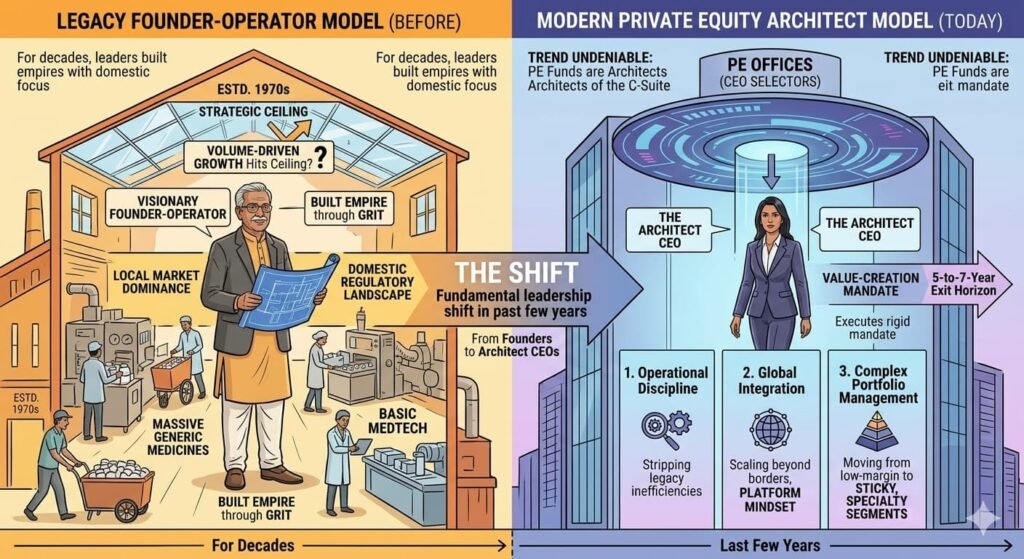
For decades, the Indian pharmaceutical and medical technology sectors were defined by the visionary founder-operator leaders who built empires through grit, local market dominance, and an uncanny ability to navigate domestic regulatory landscapes. However, the last few years have ushered in a fundamental shift. Today, the most significant leadership appointments in these sectors are being orchestrated not in the boardrooms of family-led conglomerates, but in the offices of Private Equity (PE) firms.
The trend is undeniable: PE funds are no longer just passive financiers. They are the new architects of the C-Suite, effectively acting as “CEO Selectors” to execute a rigid, value-creation mandate.
The Shift from “Founder” to “Architect”

The traditional Indian model relied on volume-driven growth. As global competition intensifies and regulatory requirements (USFDA, EMA) become more stringent, this model is hitting a ceiling.
Private Equity investors, entering with a 5-to-7-year exit horizon, cannot afford the “wait-and-see” approach of legacy management. They require CEOs who are “ready-made” for transformation. We are seeing a preference for leaders who possess three specific traits:

  1. Operational Discipline: The ability to strip out legacy inefficiencies.
  2. Global Integration: Scaling beyond domestic borders with a “platform” mindset.
  3. Complex Portfolio Management: Moving from high-volume, low-margin legacy products to sticky, specialty segments.

Case Studies in Curated Leadership

The recent reshuffling of the top deck confirms this curated approach, where the “PE-sponsored executive” has become the industry benchmark:

  • Anish Bafna (Healthium Medtech): Bafna serves as a premier example of the “Global Architect.” Since taking the helm in 2018, he has steered Healthium through a pivotal transformation, evolving it from a domestic-focused suture manufacturer into a global medical technology platform. His tenure, supported by the transition from Apax Funds to the recent 2024 acquisition by KKR, demonstrates how institutional backing empowers a CEO to aggressively expand market footprint—growing from 50 to over 90 countries—while maintaining the operational rigor required for global MedTech standards.
  • Nikhil Chopra (Formerly JB Chemicals & Pharmaceuticals): Chopra’s tenure at JB Chemicals stands as a masterclass in this model. Brought in following KKR’s acquisition, his mandate was clear: revitalize the business and institutionalize professional management. By focusing on therapeutic areas like respiratory, urology, and probiotics, and overseeing strategic acquisitions, he successfully pivoted the company from a legacy player to a high-growth, PE-backed success story.
  • Sanjiv Navangul (Bharat Serums & Vaccines): Navangul is widely regarded as the gold standard of this PE-led transformation. His tenure, supported by KKR’s investment, demonstrated how a seasoned professional with a deep understanding of values-driven culture can turn an asset into a sophisticated, high-growth entity. His focus on specialty segments rather than broad-spectrum generics was a clear alignment with the financial goals of the sponsor.
  • Umang Vohra (Cohance Lifesciences): Vohra’s appointment at Cohance (an Advent International-backed platform) signals the next frontier: the consolidation of the CDMO space. By bringing in a veteran with deep industry experience, the sponsors are signaling a move toward rapid institutionalization—building a “platform” that is scalable, compliant, and attractive to global strategic buyers.
  • Vikas Gupta (ChrysCapital): The movement of talent like Vikas Gupta into investment-aligned operational roles indicates that PE firms are not just hiring CEOs—they are hiring “fixers.” These leaders are often tasked with bridging the gap between the investment committee’s IRR expectations and the factory floor’s daily reality.

The “Homogenization” Risk

While this trend brings professionalization and capital efficiency, it invites a pertinent question: Does this create a “homogenization” of strategy?
When PE firms appoint CEOs based on a standardized “value-creation playbook”—often focusing on similar margin-expansion metrics and portfolio pruning—there is a risk that the unique, entrepreneurial character of Indian healthcare companies may be diluted. We are seeing a move toward a “corporate” culture where strategy is often dictated by the next liquidity event rather than long-term, decade-spanning R&D bets.

The Verdict

The era of the “Founder-Operator” is yielding to the era of the “PE-Sponsored Executive.” For the healthcare professional, this means the path to the C-Suite has changed. The premium is no longer just on industry tenure; it is on the proven ability to deliver quantifiable operational turnarounds within a strict timeframe. For the PE firms, this is the ultimate de-risking strategy: if they cannot change the market, they will change the person who runs the machine.

Appendix: Selected References

  • Healthium Medtech & KKR Transaction: VCCircle (May 2024). Coverage of KKR’s definitive agreement to acquire Healthium Medtech from Apax Funds and Anish Bafna’s role in scaling the business from 50 to 90+ countries.
  • J.B. Chemicals & Pharmaceuticals Leadership Transition: Medical Dialogues (April 2026) and NSE Corporate Filings (August 2025). Detailed coverage of Nikhil Chopra’s tenure, strategic focus on therapeutic areas, and his transition out of the organization.
  • Cohance Leadership Transition: NSE Corporate Filings, April 2026. Official announcement regarding Umang Vohra’s appointment as Executive Chairman and Group CEO to drive CDMO transformation.
  • BSV Group Leadership Profile: Official company documentation detailing Sanjiv Navangul’s strategy of blending niche products with global market standards.
  • CII Pharma & Lifesciences Summit 2025: Insights into the transition from volume-led to innovation-led models, featuring industry perspectives on the necessity of operational discipline in a post-founder era.
  • Express Pharma (2021): My role is to act as a catalyst – Interview with Nikhil Chopra regarding the PE-driven mandate at JBCPL post-acquisition.

All Images are AI Generated for Illustration Only. E&OE

Hot this week

Tez Health and the New Race to Bring Healthcare Home

Tez Health and the New Race to Bring Healthcare...

Is Pharma M&A Slowing Down Amidst Geopolitical Friction?

The pharmaceutical industry stands at a critical juncture in...

Will the GLP Battle Now Shift from Injectable to Oral?

In India’s million-strong retail pharmacy universe, oral weight-loss pills...

The Semaglutide Paradox: Anatomy of a High-Stakes Commodity Trap

The Semaglutide Shift: From Blockbuster to Commodity Why the $50...

Topics

Tez Health and the New Race to Bring Healthcare Home

Tez Health and the New Race to Bring Healthcare...

Is Pharma M&A Slowing Down Amidst Geopolitical Friction?

The pharmaceutical industry stands at a critical juncture in...

Will the GLP Battle Now Shift from Injectable to Oral?

In India’s million-strong retail pharmacy universe, oral weight-loss pills...

The Semaglutide Paradox: Anatomy of a High-Stakes Commodity Trap

The Semaglutide Shift: From Blockbuster to Commodity Why the $50...

Ritesh Desai has joined Standard Chartered India as Executive Director

Ritesh Desai has joined Standard Chartered India as Executive...
spot_img

Related Articles

spot_imgspot_img