
Monday, April 27, 2026
30.7 C
Bengaluru

Tez Health and the New Race to Bring Healthcare Home

Tez Health and the New Race to Bring Healthcare Home

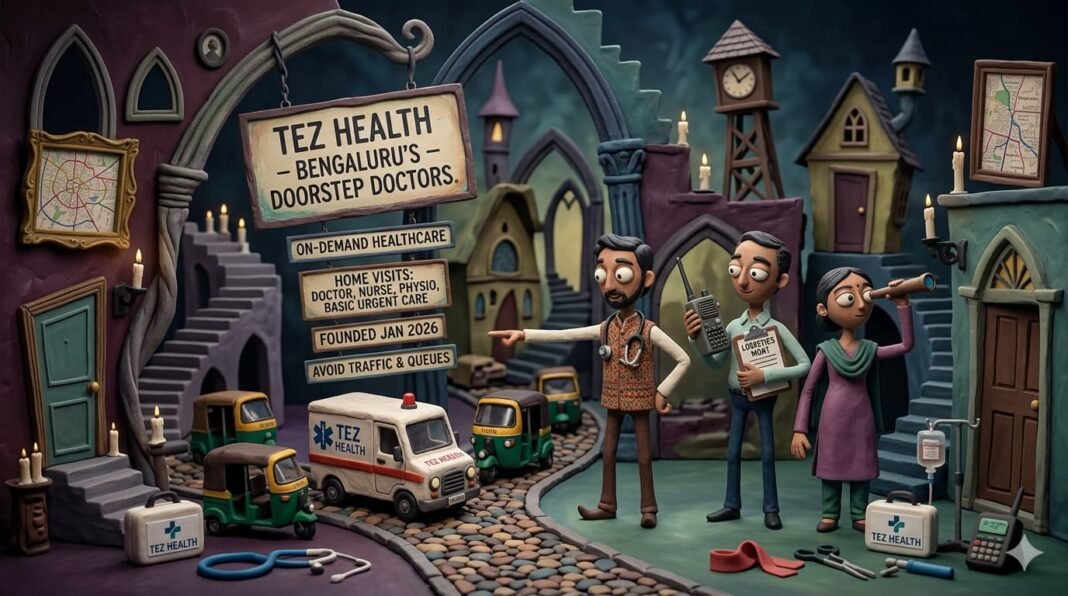
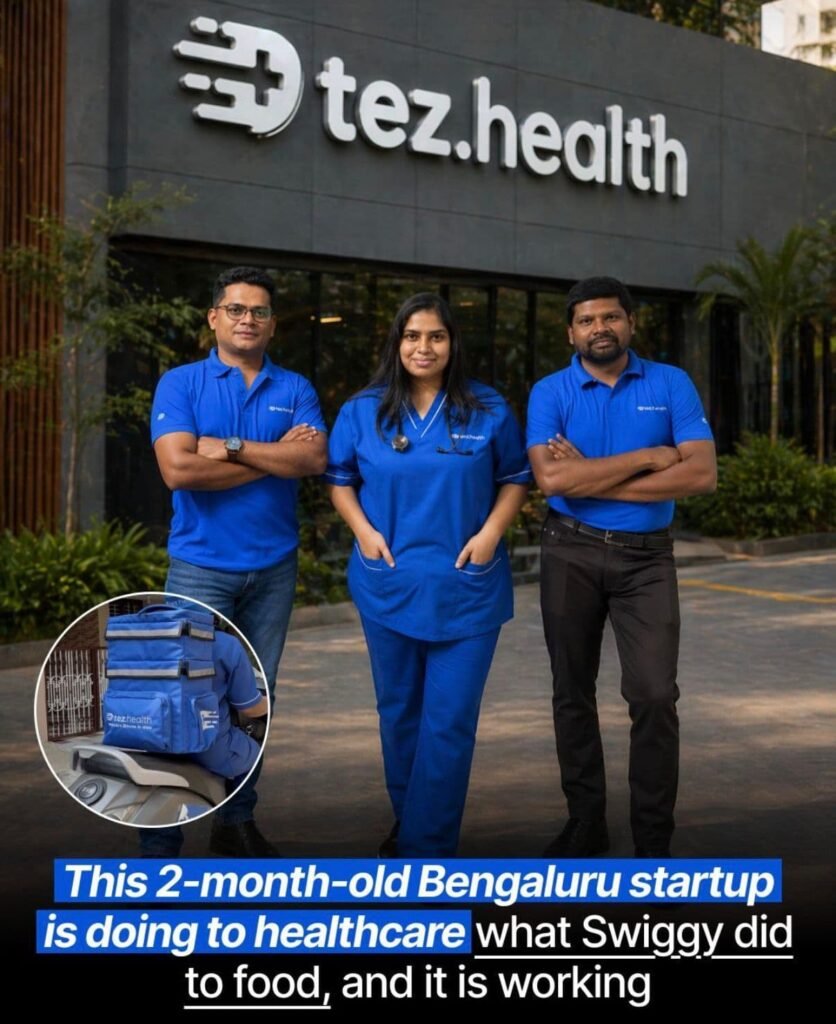
Bengaluru-based Tez Health is attempting to build a distinctly Indian version of on-demand healthcare by bringing doctors, nurses, physiotherapy, ambulance support, and basic urgent care directly to patients’ homes rather than requiring them to navigate traffic, queues, and overloaded facilities. Founded in January 2026 by Praveen Gowdru, Ramesh Chandra Yadav, and Dr Haripriya, the startup is positioning itself around speed, doorstep convenience, and a tightly monitored delivery model.[1][2][3]


That positioning matters because India’s access problem in healthcare is often logistical before it is clinical: the delay is not always in diagnosis or treatment quality, but in reaching care quickly and predictably enough for it to matter. Tez Health’s wager is that the next moat in urban healthcare may lie in orchestration—coordinating people, vehicles, diagnostics, and follow-up with the discipline of a logistics network, while still preserving medical quality.[3][4][1]

What Tez Health Is Building

Tez Health currently operates in Bengaluru and offers doctor consultations, basic nursing care, physiotherapy, ambulance support, emergency response, and, in some cases, doorstep X-ray access through a coordinated, partner-led model. According to public descriptions of the business, its operating spine is a 20-member core team, 10 full-time dedicated partners, and an extended network of more than 500 doctors, nurses, physiotherapists, and ambulance service providers.[5][6][7][1]

The company says it actively monitors each care journey from booking through service delivery and post-care follow-up, an important detail because home healthcare quality often depends less on the app interface than on handoffs, protocol adherence, and escalation discipline in the field. That emphasis on monitored execution is what separates serious home-care operators from mere lead-generation platforms.[4][7][1]

Why the Model Resonates

For patients and caregivers, the appeal is obvious. A home visit collapses multiple pain points at once: travel, waiting, stress, uncertainty, and the physical burden of moving elderly or unwell family members across the city for relatively routine interventions.[8][3][4]

India has seen this logic before. Portea, one of the country’s better-known home healthcare companies, began in 2013 and grew from fewer than 50 customers to operations across multiple cities, with more than 60,000 home visits a month reported at one stage and a history of large funding rounds that helped validate the category. Tez Health enters that same broad access problem, but with a more explicitly on-demand, rapid-response framing that is closer to urban consumer logistics than to traditional scheduled home care.[9][1][3][4][8]

The Tez Health Playbook

What makes Tez Health interesting is not only that it brings healthcare home, but that it is trying to standardise that experience like a managed network business. Publicly available startup profiles say the company has standardised pricing for at least some services, including ₹499 for an injection at home, while also promising a minimum booking flow to partners such as nurses, who are reported to earn at least ₹60,000 a month on the platform.[7][1]

This reveals a deliberate two-sided marketplace strategy. On one side, the startup reduces unpredictability for patients through transparent access and monitored service completion; on the other, it reduces income volatility for providers through volume assurance and workflow coordination. In theory, that structure could improve both responsiveness and partner retention, provided utilisation becomes dense enough across neighbourhood clusters.[1][4]

Why Investors and Operators Will Watch It Closely

Tez Health is still very early. Public accounts describe the company as serving around 30 patients a day, bootstrapped with ₹1.5 crore from the founders and an additional ₹1 crore from angel investors, while aiming to scale to 10,000 patients a day across five to six metro cities over the next three to five years. Those are ambitious expansion targets, especially in a category where unit economics and quality assurance can weaken quickly when geographic coverage expands faster than operational discipline.[4][5][9][1]

The broader sector context makes the story worth watching. Even Healthcare, for example, has attracted fresh capital for a managed-care and payvider-style model, reporting $20 million in new funding in early 2026 and highlighting coordinated care, hospital integration, and strong post-operative outcomes such as zero unplanned 30-day readmissions across more than 350 surgeries. That contrast is instructive: if Tez Health represents the logistics layer of healthcare innovation, companies like Even represent the outcome-accountability layer that could eventually define the sector’s long-term winners.[10][11][12]

The Operational Challenge

The biggest risk in on-demand healthcare is assuming that speed alone creates defensibility. It does not. In healthcare, rapid fulfilment is only valuable if it is paired with triage quality, provider competence, clinical protocols, escalation pathways, documentation, and reliable follow-up.[3][1][4]

That is why Tez Health’s real test will not be whether it can dispatch care quickly in Bengaluru. The real test is whether it can reproduce the same experience safely across multiple teams, partners, neighbourhoods, and cities without turning quality variation into a structural weakness.[5][7][1]

This challenge becomes sharper in a partner-heavy model. A distributed network can help a young startup scale supply faster than a fully employed workforce would allow, but it also creates more points of failure in training, accountability, and consistency in patient experience. The startups that survive this category will be those that build dense supervision systems, measurable protocols, and credible clinical governance—not just fast routing engines.[1][3][4][5]

The Compliance Burden Ahead

As healthcare delivery becomes more decentralised, compliance becomes more central. India’s DPDP framework and the 2025 rules have moved data protection from policy language to operational accountability, with expectations around consent logs, access controls, security audits, bilingual notices, and structured breach handling. Sector-specific guidance for healthcare also stresses breach notification to affected patients and the Data Protection Board, with detailed reporting expected within 72 hours in many scenarios.[13][14][15]

For a startup that coordinates home visits, patient histories, emergency responses, and potentially sensitive diagnostic or treatment information, this is not a peripheral issue. Trust in healthcare is built not only through bedside behaviour but also through invisible systems—how securely data is handled, how clearly consent is captured, and how quickly something goes right or wrong inside the operating stack.[14][15][13]

What Tez Health Could Become

If Tez Health executes well, it could evolve from a convenience-led doorstep service into an important urban healthcare access layer. Its model is especially relevant in dense metros where time-to-care often determines whether a problem stays manageable at home or escalates into a hospital visit.[3][4][1]

But the more consequential opportunity lies beyond convenience. The strongest version of Tez Health would deliver a professional to the patient’s home quickly and integrate dispatch, diagnostic support, care protocols, escalation rules, follow-up, and digital records into a dependable system of distributed care. That is the difference between an app that arranges visits and a platform that genuinely changes healthcare behaviour.[10][13][1][3]

The Bottom Line

Tez Health captures an important truth about modern Indian healthcare: for millions of patients, access is the first clinical problem. Its early model—fast, coordinated, partner-enabled, and home-first—fits the rhythms of urban India and addresses a category of friction that hospitals alone are poorly designed to solve.[4][5][1][3]

Whether it becomes a durable company, however, will depend on what it builds behind the promise of speed: governance, trust, consistency, compliance, and outcomes. In healthcare, the distance between a promising service and a scalable institution is measured not in kilometres, but in protocols.[15][13][1][3][4]

Sources
[1] Startup Pedia’s Post – LinkedIn https://www.linkedin.com/posts/startup-pedia_startuppedia-startupjourney-startupbusiness-activity-7450513454731526144-oOzC
[2] Unnati Bagga’s Post – LinkedIn https://www.linkedin.com/posts/unnatibagga_theres-a-2-month-old-startup-in-my-city-activity-7453402901198307329-sumJ
[3] Tez Health Brings Hospital-Grade Care to Homes in Bengaluru https://www.linkedin.com/posts/quick-scope_healthtech-startupindia-innovation-activity-7450767595470868480-xopF
[4] Portea brings convenience in healthcare for home-bound patients and their families https://yourstory.com/2015/12/portea
[5] India’s healthcare system is evolving, but access, speed … – Facebook https://www.facebook.com/startup.pedia7/posts/indias-healthcare-system-is-evolving-but-access-speed-and-reliability-still-rema/1432446655563159/
[6] In a recent interview, co-founder Praveen Gowdru shared how Tez … https://www.instagram.com/reel/DXbWWr1ybDP/
[7] Praveen Gowdru’s Post – LinkedIn https://www.linkedin.com/posts/praveengarera_thank-you-so-much-startup-pedia-for-featuring-activity-7450520811590926336-gURb
[8] Home healthcare provider Portea raises $37.5-mn funding https://www.thehindubusinessline.com/info-tech/portea-medical-raises-375-m-in-series-b-funding/article21169064.ece
[9] Indian home healthcare platform Portea Medical raises $26 … https://techcrunch.com/2017/11/22/indian-home-healthcare-platform-portea-medical-raises-26m-series-c/
[10] Even Healthcare Secures $20m in Funding for Bengaluru … https://www.linkedin.com/posts/adlin-pertishya-7114a7221_indian-healthcare-firm-even-raises-20m-in-activity-7414230669725204480-gqcC
[11] Even Healthcare raises $20 million from Lachy Groom, Alpha Wave, Sharp Ventures https://economictimes.com/tech/funding/even-healthcare-raises-20-million-from-lachy-groom-alpha-wave-sharp-ventures/articleshow/126357267.cms
[12] Even Healthcare raises $20M, claims early break-even at first … https://yourstory.com/2026/01/funding-even-healthcare-20-m-early-break-even-bengaluru-hospital
[13] India DPDP Act 2025, Compliance Handbook and Key Requirements https://kalpsystems.com/dpdp/dpdp-compliance-handbook-2025/
[14] India’s DPDP Rules 2025: Stricter Data Protection for Healthcare https://www.linkedin.com/posts/rishsood_boilerplates-activity-7413984235910377472-7Bn_
[15] DPDP Rules 2025 Guide for India’s Healthcare Sector – Elets eHealth https://ehealth.eletsonline.com/2025/11/the-healthcare-centric-guide-to-dpdp-rules-2025-what-indias-healthcare-providers-companies-must-know/
[16] Tez Health Revolutionizes India’s Healthcare with On-Demand Model https://www.linkedin.com/posts/vedanti-kohli-03225b199_startupindia-startupjourney-startupbusiness-activity-7450890861061611520-qUs-
[17] Healthcare, now at your doorstep Tez Health is transforming patient … https://www.instagram.com/p/DXSKL0SE_2g/
[18] Scoopearth – Facebook https://www.facebook.com/scoopearth/posts/-from-hospital-corridors-to-your-doorstepbengaluru-based-healthcare-startup-tez-/1376536504509066/
[19] Tez Health Revolutionises Home Healthcare in India – LinkedIn https://www.linkedin.com/posts/tez-health_tezhealth-healthcareinnovation-homehealthcare-activity-7418994818921668608-ysuf
[20] Portea Medical Announces Rs. 48 crores funding from Accel Partners and Ventureast https://www.biospectrumindia.com/news/18/503/portea-medical-announces-rs-48-crores-funding-from-accel-partners-and-ventureast.html

Hot this week

Is Pharma M&A Slowing Down Amidst Geopolitical Friction?

The pharmaceutical industry stands at a critical juncture in...

Will the GLP Battle Now Shift from Injectable to Oral?

In India’s million-strong retail pharmacy universe, oral weight-loss pills...

The Semaglutide Paradox: Anatomy of a High-Stakes Commodity Trap

The Semaglutide Shift: From Blockbuster to Commodity Why the $50...

Cytotoxics to Cell Therapy: A 40-Year Review of Indian Oncology Strategy

In 1989, oncology in India was not a business...

Ritesh Desai has joined Standard Chartered India as Executive Director

Ritesh Desai has joined Standard Chartered India as Executive...

Topics

Is Pharma M&A Slowing Down Amidst Geopolitical Friction?

The pharmaceutical industry stands at a critical juncture in...

Will the GLP Battle Now Shift from Injectable to Oral?

In India’s million-strong retail pharmacy universe, oral weight-loss pills...

The Semaglutide Paradox: Anatomy of a High-Stakes Commodity Trap

The Semaglutide Shift: From Blockbuster to Commodity Why the $50...

Ritesh Desai has joined Standard Chartered India as Executive Director

Ritesh Desai has joined Standard Chartered India as Executive...

A Tale of Two Companies – Sun Pharma’s Odyssey and Organon’s Second Act

Sun Pharma’s Odyssey and Organon’s Second Act – And...
spot_img

Related Articles

spot_imgspot_img