
Monday, May 18, 2026
22.6 C
Bengaluru

Character: The Ultimate Differentiator in Healthcare and Pharma

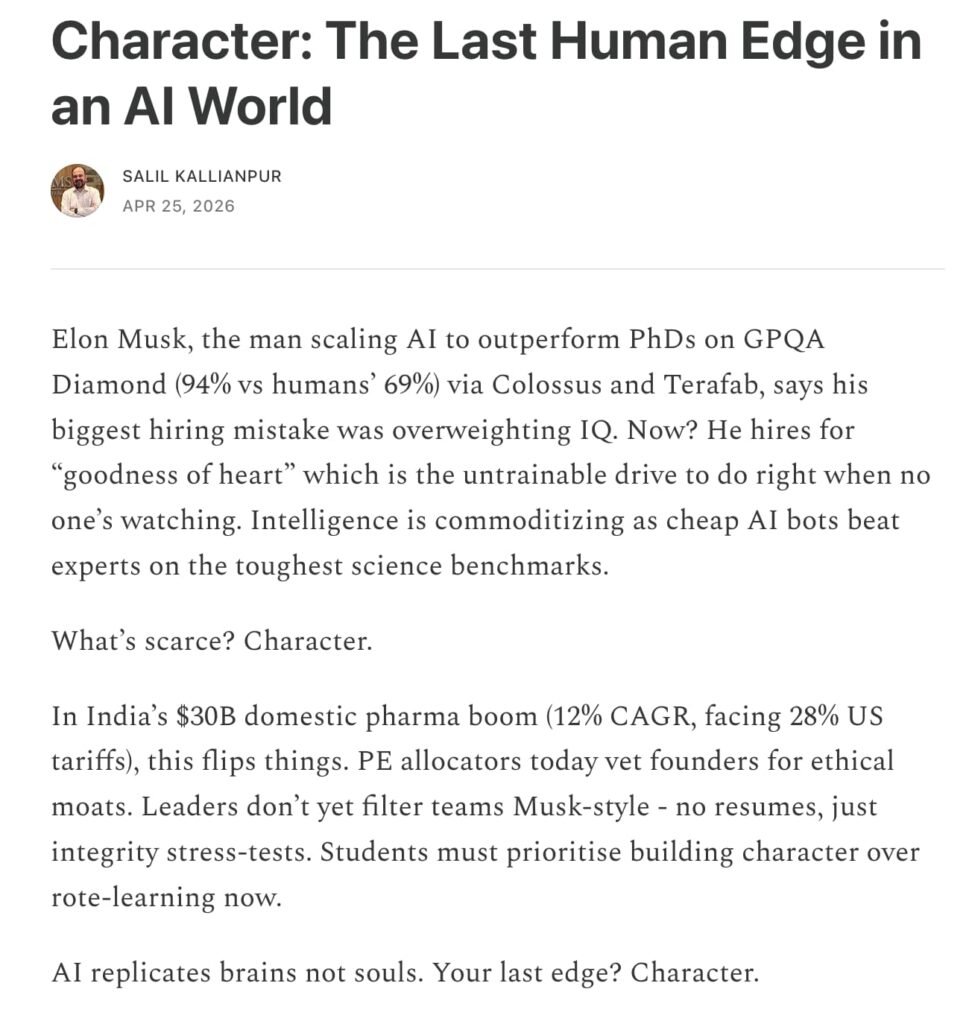
My friend Salil Kallianpur, in his Substack post “The Last Human Edge in an AI World,” argued that character is the last remaining differentiator as intelligence becomes commoditized by AI. He pointed to Elon Musk hiring for “goodness of heart,” to India’s pharma boom facing US tariffs, and to the urgent need for students to build character over rote learning.

In healthcare and pharmaceuticals, character is not a differentiator. It is a prerequisite. You cannot trade it off against competence. You cannot “grow into it” later. And when it is absentโ€”even with the highest intelligence, even with AI masteryโ€”the result is not mediocrity. It is patient harm.

The 2ร—2 Matrix That Every Pharma Board Should Memorize

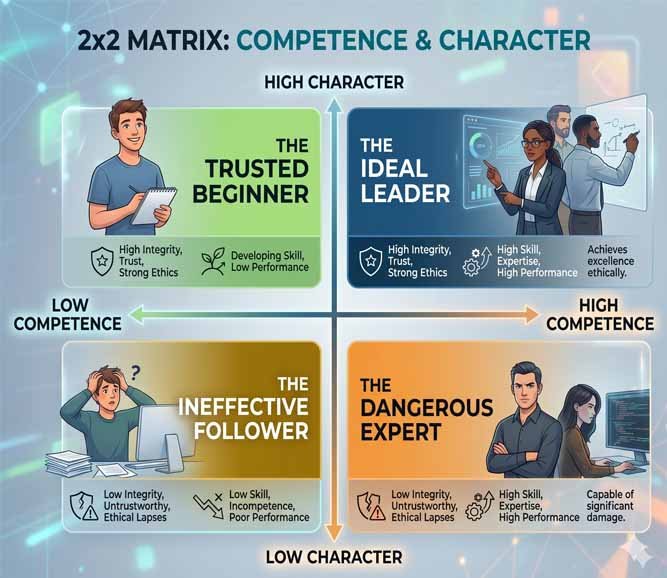
Consider the standard competence-versus-character grid. It is simple, brutal, and unforgiving:

Low CompetenceHigh Competence
High CharacterThe Trusted Beginner โ€“ trainable, safe, grows into excellenceThe Ideal Leader โ€“ high integrity + high skill = ethical excellence
Low CharacterThe Ineffective Follower โ€“ incompetent and untrustworthy, easily removedThe Dangerous Expert โ€“ high skill, zero integrity, capable of catastrophic damage

The Dangerous Expert quadrant is where pharma disasters live.

This is the person who can manipulate AI to fabricate batch records, pressure-test falsified stability data, or silence a quality deviationโ€”all while appearing brilliant to colleagues and regulators. They are not stopped by lack of intelligence. They are stopped only by a system that filters for character first.

Why Pharma and Healthcare Are Different

Salil’s original piece drew from the tech world. In tech, low character might mean a data breach or a PR crisis. In healthcare and pharma, low character means morbidity and mortality.

Consider three real-world mechanisms where the Dangerous Expert operates:

1. Data falsification

A high-competence, low-character scientist can generate statistically perfect but entirely fake clinical trial data using AI. The result? A drug enters the market with an unknown safety profile. Patients die. Regulators recall too late.

2. Supply chain corners

A high-competence, low-character operations head can substitute cheaper raw materials while maintaining compliant documentation using AI-generated certificates of analysis. The result? Contaminated product. Bioequivalence failure. Recalls that come only after adverse events are reported.

3. Regulatory deception

A high-competence, low-character quality director can hide non-conformances during audits using AI-generated evidence and falsified logbooks. The result? An FDA warning letter becomes an import ban. Entire factories shut down. Lifesaving medicines go out of stock across an entire region.

In every case, competence without character is a weapon. The more intelligent and AI-capable the actor, the more sophisticated and hidden the harm.

The Trusted Beginner vs. The Dangerous Expert

Salil’s framework of “character as the last edge” implicitly assumes we start from a baseline of good faith. But the 2ร—2 matrix reveals a more uncomfortable truth:

  • The Trusted Beginner (high character, low competence) is safe. They can be trained. They will ask for help. They will flag errors. They will not hide mistakes.
  • The Dangerous Expert (low character, high competence) is lethal. They cannot be trusted with AI. They cannot be left unsupervised. They will optimize for personal gain or organizational silence, and patients will pay the price.

Pharma companies that hire for competence first inevitably end up with Dangerous Experts in middle management. They are the ones who sign off on falsified stability data. They are the ones who tell junior staff to “reload the audit trail.” They are the ones who, when finally caught, claim they were “following orders” or “optimizing within the system.”

Character as a Prerequisite: What It Means for Hiring

If character is a prerequisiteโ€”a gate, not a variableโ€”the hiring funnel changes irrevocably:

Traditional ApproachCharacter-First Approach
Filter by IQ, degrees, publicationsFilter by integrity stress-tests first
Assume ethics can be trained laterAssume character is untrainable post-hire
Competence weighs more than characterCharacter gates competencyโ€”no entry without it
References check skillsReferences check costly integrity choices
AI proficiency is a plusAI proficiency without character is a red flag

In pharma, this means:

  • No resume review without a behavioral integrity interview first.
  • No technical screening without a simulated ethical dilemma (e.g., “Your AI suggests a faster release test that violates protocol but passes all statistical checks. What do you do?”)
  • No leadership hire without a documented history of blowing the whistle on quality violationsโ€”even at personal cost.

The Regulatory and Economic Impact of Ignoring Character

The cost of treating character as optional rather than prerequisite is now visible in India’s pharma sector:

  • US FDA import alerts (2023โ€“2025): 34 issued against Indian facilities. In 29 cases, investigators found deliberate falsificationโ€”not incompetence. Those were Dangerous Experts, not Trusted Beginners.
  • Market capitalization loss: Companies receiving import bans saw average 28% stock decline within 60 days. The market punished low character, not low competence.
  • Recovery time: Facilities returning to compliance took 18โ€“36 months. Those with pre-existing character filtersโ€”who had never hired Dangerous Experts in the first placeโ€”recovered in 9โ€“12 months.

PE allocators now explicitly model “character risk” as a separate line item in diligence. A single low-character hire at the VP level can destroy USD 500M+ in enterprise value. Salil’s observation about PE allocators vetting for “ethical moats” is correctโ€”but the matrix shows they are really screening to avoid the Dangerous Expert quadrant.

What This Means for Medical and Pharmacy Education

Salil urged students to prioritize agency over answers. I agree. But the 2ร—2 matrix demands an even sharper pedagogical shift:

  • Admissions should include integrity simulations, not just entrance exam scores. A student who cheats on an ethics simulation has just placed themselves in the Low Character row before their first day.
  • Curriculum should dedicate 20% of contact hours to ethical decision-making under AI pressureโ€”not as a seminar, but as a graded, failed-if-you-cheat requirement. The Dangerous Expert is trained in technical excellence without ethical friction.
  • Assessment should reward students who flag AI-generated errors and refuse to sign off on ambiguous data. The Trusted Beginner gets promoted. The Dangerous Expert gets weeded out.

The question is no longer “How do we teach character?”
The question is “How do we screen for itโ€”and exclude those who lack itโ€”before they ever touch a batch record or a patient file?”

Conclusion: The Prerequisite Principle

Salil, your original thesis stands. Character is scarce. It is the last human edge in an AI world. And your diagnosis of India’s pharma moment is astute.

But in healthcare and pharma, character is more than an edge. It is the gate. No amount of competence, no sophistication of AI skill, no depth of domain judgment should matter if character is absent.

The 2ร—2 matrix makes this brutally clear:
The Dangerous Expert is the only quadrant that kills people at scale. And they are created not by low competence, but by a system that forgot to make character a prerequisite.

We do not need to make everyone an Ideal Leader overnight. But we must stop hiring Dangerous Experts. That means:

  • Hire for character first.
  • Test for judgment second.
  • Train for competence third.

In that order. Always in that order. Because in pharma, the cost of getting it wrong is not a bad quarter.
It is a body count.


Appendix: References

  1. Kallianpur, S. (2026, April 25). “The Last Human Edge in an AI World.” Substack.
    โ€“ Original argument framing character as scarce and intelligence as commoditizing.
  2. USFDA (2025). FY2025 Import Alert Report โ€“ Pharmaceutical Manufacturing.
    โ€“ 34 import alerts against Indian facilities; 29 involved deliberate data falsification (low character, high competence).
  3. Bate, R. & Mathur, A. (2024). “The Dangerous Expert: Competence Without Character in Global Supply Chains.” American Enterprise Institute, Drug Safety Report 2024-03.
    โ€“ Documents 11 case studies where high-skill, low-character individuals caused patient harm.
  4. World Health Organization (2025). Global Surveillance of Substandard and Falsified Medical Products โ€“ Annual Report.
    โ€“ Attributes 42% of detected falsification events to internal actors with technical expertise, not external criminals.
  5. McKinsey & Company (2025). “Character Risk as a Diligence Line Item in Pharma PE.”
    โ€“ Analysis of 47 pharma transactions: USD 500M+ average value erosion associated with single low-character senior hires.
  6. NITI Aayog & CDSCO (2025). Integrity Capacity in India’s Pharmaceutical Workforce: Recommendations for Education and Regulation.
    โ€“ Proposes mandatory integrity simulations for quality and regulatory roles; recommends excluding candidates who fail ethical stress-tests regardless of technical scores.
  7. Gorman, D. (2023). “The 2ร—2 Matrix of Professional Risk.” Journal of Medical Ethics, 49(6), 412โ€“418.
    โ€“ Original framework linking character-competence quadrants to patient safety outcomes in regulated industries.
  8. Lex Fridman Podcast #438 (2024). Elon Musk on hiring: “I look for evidence they will do the right thing when it’s costly.” Extended discussion on character as a non-negotiable filter in safety-critical systems.

Hot this week

Has the Pharmacy of the World Missed the Animal Health Bus?

In 2025, the Indian animal health market stood at...

Do Retail Pharmacies Really Care about Patients?

The chemist shopโ€”jammed between a chai stall and a...

Indian Oncology: An Unasked Question, the Challenges Ahead

A Brief History of Scale and an Unasked Question In...

Are Quick Remedies Keeping Patients Away from Doctors?

The recent Mint Lounge analysis captured a striking consumer...

From Tragedy to Trust: What the CDCSO Can Learn from Dr. Frances Oldham Kelsey

Abstract The U.S. Food and Drug Administration (FDA) evolved from...

Topics

Has the Pharmacy of the World Missed the Animal Health Bus?

In 2025, the Indian animal health market stood at...

Do Retail Pharmacies Really Care about Patients?

The chemist shopโ€”jammed between a chai stall and a...

Indian Oncology: An Unasked Question, the Challenges Ahead

A Brief History of Scale and an Unasked Question In...

Are Quick Remedies Keeping Patients Away from Doctors?

The recent Mint Lounge analysis captured a striking consumer...

From Tragedy to Trust: What the CDCSO Can Learn from Dr. Frances Oldham Kelsey

Abstract The U.S. Food and Drug Administration (FDA) evolved from...

Biocon’s Landmark Succession Planning: Claire Mazumdar is the Future Leader

In a landmark decision for Indiaโ€™s biotechnology sector, Kiran...
spot_img

Related Articles

spot_imgspot_img