
Thursday, July 30, 2026
26.3 C
Bengaluru

What ChrysCapital’s Takeover Of Novartis India Really Means

When ChrysCapital, one of India’s oldest and largest homegrown private equity firms, finalized its 1,446 crore rupee acquisition of a controlling 70.68 percent stake in Novartis India Limited in July 2026, the transaction represented more than just another deal it marked a symbolic culmination of the firm’s 27-year journey in Indian pharmaceuticals.

Founded in 1999 as Chrysalis Capital by Ashish Dhawan and Raj Kondur, the firm pivoted from venture capital to private equity after the dot-com bust and has since raised over 8.5 billion dollars across ten funds, delivering three-fold returns on 7.8 billion dollars returned to investors through more than 80 exits. Its pharmaceutical track record is widely considered the strongest in Indian private equity by a considerable margin.
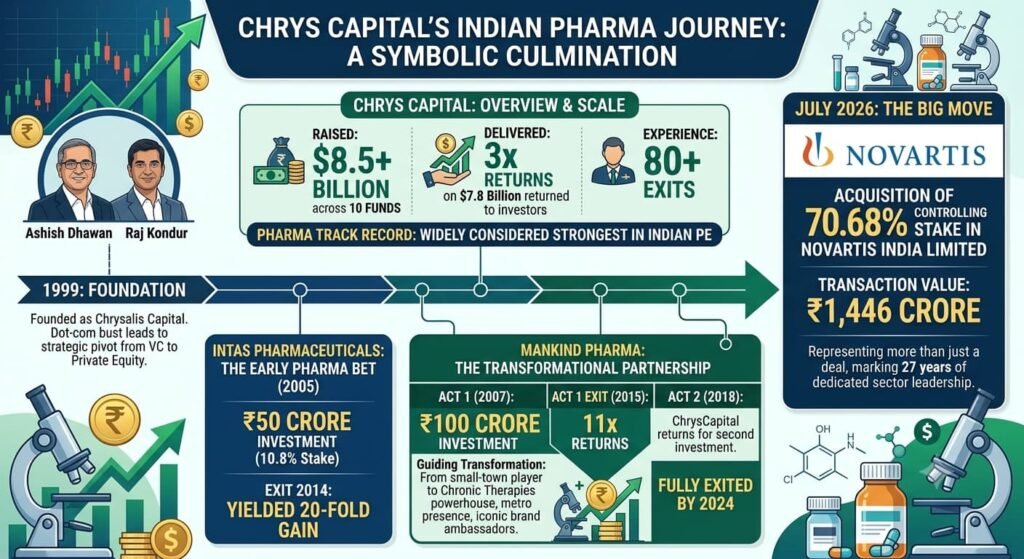

The firm’s pharma playbook began taking shape in 2005 with a 50 crore rupee investment in Intas Pharmaceuticals for a 10.8 percent stake a bet that yielded a 20-fold gain by 2014. But the defining moment came in 2007 when ChrysCapital first backed Mankind Pharma with a 100 crore rupee investment. Over eight years of partnership, it guided the company’s transformation from a small-town player best known for its Manforce condom brand into a formidable chronic therapies player with metro presence and iconic brand ambassadors. The exit in 2015 yielded 11 times returns. ChrysCapital returned for a second act in 2018 before fully exiting by 2024.

Beyond these flagship investments, the firm built a comprehensive healthcare portfolio spanning Intas, Eris Lifesciences, Torrent Pharma, Ipca Labs, Zydus Cadila, Corona Remedies, and more recently, La Renon Healthcare. Its approach combines deep domain expertise with aggressive inorganic growth orchestrating over 50 M&A transactions across portfolio companies, including pushing Intas to acquire Actavis’s UK assets for over 5,000 crore rupees.

Yet until the Novartis India acquisition, ChrysCapital had never taken majority control of a pharmaceutical company. Its investments were predominantly minority stakes with board influence but not operational command. The Novartis deal changes that calculus fundamentally, giving the firm a clean, debt-free listed platform with trusted legacy brands like Voveran, Calcium Sandoz, and Tegrital and a mandate to build a domestic branded-generics consolidator.

This is the culmination of a strategic pivot that has seen buyouts rise from near-zero in Indian private equity in 1999 to 30 to 45 percent of the market today. For ChrysCapital, which raised its record 2.2 billion dollar Fund X in November 2025 and expects buyouts to comprise over half the portfolio, Novartis India represents the template for its next chapter moving from passive financial partner to active platform-builder in Indian healthcare.

The stage is set for a new playbook one that will test whether the firm can translate its legendary minority-investment magic into operational control and consolidation leadership.

What Pharma Veterans Think

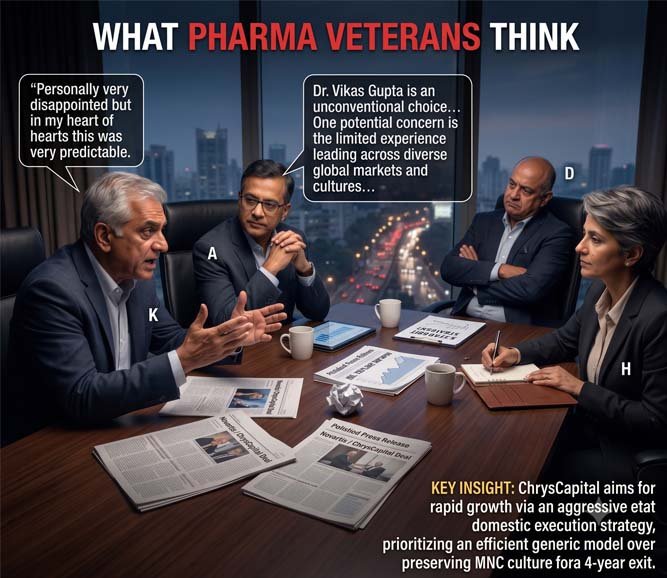
Behind the polished press releases and carefully worded corporate announcements, a very different conversation is unfolding among seasoned pharmaceutical industry observers. A candid exchange among four veteran industry watchers referred to here as Veteran A, Veteran K, Veteran H, and Veteran D reveals the skepticism, disappointment, and sharp analysis that industry insiders bring to this transaction. Their perspectives add a crucial layer of understanding that formal financial analysis alone cannot provide.

The news of Dr. Vikas Gupta’s appointment as Managing Director and Chief Executive Officer drew immediate and pointed reactions. Veteran K, a well-known pharmaceutical industry commentator, expressed views without reservation: “Personally very disappointed but in my heart of hearts this was very predictable.”

This disappointment is not about Dr. Gupta’s capabilities he is widely respected as a seasoned executive with two decades of experience across Alkem, Cipla, and other top domestic pharma companies. The concern lies in what his appointment signals about ChrysCapital’s strategic intent.

Veteran A, a senior industry observer, articulated the underlying concern: “Dr. Vikas Gupta is an unconventional choice not just for Novartis, but for any global MNC. One potential concern is the limited experience leading across diverse global markets and cultures, which is often considered an important criterion for such leadership roles.”

To this, Veteran K offered a blunt rejoinder: “That is the point. It tells you that ChrysCapital doesn’t think of Novartis India Limited as an MNC and wants to reverse the ways of working into an efficient generic player with focus on topline growth for a 4 year exit.”

This is a critical insight. ChrysCapital has not appointed a leader who will preserve Novartis India’s multinational culture, governance standards, and long-term brand stewardship. Instead, it has chosen an executive known for domestic market execution and aggressive growth exactly the skill set needed to prepare the company for a rapid exit.

Veteran H, another core team member, added important context: “That is their approach always. The only place where it did not work the way they wanted it was Curatio. The founder and the CEO were clear about their business model.”

This reference to Curatio Healthcare is revealing. ChrysCapital had invested in Curatio but was unable to impose its preferred operational playbook because the founder and management team resisted. The Novartis India situation is different. With majority control and a newly installed leadership team, ChrysCapital faces no such resistance. There is no founder or legacy management to protect the company’s historical identity.

The implications are stark. Veteran K painted a vivid picture of what lies ahead: “Will drive growth at reckless speed, sell to highest bidder and pocket 100 to 150 crores by 2030. All before the age of 55. Ruthless Reorganisation plus Relentless Rate of Growth seems to be the near future for Novartis India Limited.”

This characterization ruthless reorganization combined with relentless rate of growth captures the private equity playbook in its purest form. Cost optimization, portfolio rationalization, aggressive sales expansion, and a laser focus on topline growth. All directed toward a specific goal maximizing valuation for a sale within four to five years.

The conversation then turned to broader implications for the Indian pharmaceutical landscape. Veteran K asked pointedly: “Should I be so bold as to ask if Pfizer will be next since this doesn’t upset the government. Or will this be like the Abbott plus Piramal playbook never to be repeated thanks to government of India panic.”

This reference to the Abbott-Piramal transaction is significant. In 2010, Piramal Healthcare acquired Abbott’s domestic formulations business for approximately 17,000 crore rupees. The deal was seen as a template for MNC divestitures in India. However, subsequent regulatory and political reactions made similar large-scale transactions more difficult. The question of whether the government would permit a wave of MNC pharma exits without intervention remains open.

Veteran K concluded with a telling observation about market sentiment: “The reaction of Novartis India Limited shareholders should have led me on. They’re hoping that ChrysCapital will drive everything that Novartis India Limited didn’t. Hence refused to exit the asset.”

This is a crucial insight into the open offer dynamics discussed earlier. Public shareholders chose not to tender their shares because they believe ChrysCapital will create value that Novartis, as a multinational parent, could not or would not pursue. They are betting on private equity aggression over multinational caution.

Veteran D, a veteran industry leader, offered a lighter take but one that underscores the gossip and speculation swirling around the deal: “Lots of masala for your breakfast gossip blog. Yes, I’m busy cooking Masala Vad Paav with extra chilly.”

Behind the humor lies a serious point. The industry is abuzz with speculation about ChrysCapital’s real intentions, the sustainability of the growth strategy, and the long-term consequences for employees, patients, and the broader pharmaceutical ecosystem.

What The Veteran Perspectives Reveal

The exchange among the four veteran industry watchers provides several important analytical insights that formal financial coverage often misses.

First, the appointment of Dr. Vikas Gupta is not simply a routine executive change. It is a deliberate strategic signal. ChrysCapital is not trying to run Novartis India as a multinational subsidiary. It is converting it into a domestic generics platform optimized for a short-term exit. The choice of a domestic-market specialist over a globally experienced executive confirms this intent.

Second, ChrysCapital’s track record, while impressive, has one notable exception Curatio Healthcare where the firm could not fully impose its playbook. In Novartis India, with majority control and a compliant management team, there is no such constraint. The firm has complete freedom to execute its strategy without resistance.

Third, the shareholder response to the open offer is a real-time vote of confidence in the private equity model. Public shareholders are betting that ChrysCapital will deliver growth and value that Novartis could not. Whether this optimism is justified depends entirely on execution.

Fourth, the broader implications for the Indian pharmaceutical industry are profound. If ChrysCapital succeeds, it will likely trigger a wave of similar transactions as other MNCs seek to exit legacy retail businesses. If it fails, it will serve as a cautionary tale about the limits of private equity in healthcare. The Abbott-Piramal precedent and the government’s potential response add further layers of complexity.

Finally, the veteran perspectives highlight the human dimension that gets lost in financial analysis. Employees face uncertainty. Patients may see price increases or reduced availability of trusted brands. The cultural shift from a multinational governance model to a private equity cost-optimization model will be jarring. These are not abstract concerns they are the lived reality of the transaction.

What It Means For Novartis India Limited

From a Stable Subsidiary to an Aggressive Acquisition Platform

Historically, Novartis India Limited operated as a typical multinational subsidiary. It maintained a stable, profitable portfolio of established brands but operated within the risk parameters and growth constraints set by its Swiss parent. Growth targets tended to be conservative, and the company functioned primarily as a vehicle for legacy brands rather than an engine for aggressive market expansion.

Under ChrysCapital, which now manages close to 8 billion dollars in assets, the newly rebranded entity is positioned to transition into a more aggressive domestic branded generics platform. Backed by ChrysCapital Fund X, the company appears poised to pursue a consolidation strategy using its clean, debt-free balance sheet to acquire under-managed or non-core mature brands from other multinational companies looking to streamline their local operations.

However, the veteran perspectives underscore a critical reality private equity ownership is not about building a lasting institution. It is about creating value within a defined timeframe and exiting. This is not inherently good or bad it is simply the nature of the asset class. But it has profound implications for employees, patients, and the company’s long-term trajectory.

Financial Benchmarks and Valuation Context

The transaction was executed at a price of 860.64 rupees per share. At the time of announcement, this represented approximately a 3.6 percent premium over prevailing trading prices. While this premium appears modest relative to typical control transactions, it must be evaluated in the context of the company’s historical trading range and financial performance. Notably, the offer price represented a 13.6 percent discount to the 996.50 rupee closing price on the announcement day, when shares rallied nearly 20 percent on the news.

For context, comparable Indian pharmaceutical companies have historically traded at enterprise value to earnings before interest, taxes, depreciation, and amortization multiples in the range of 12 to 16 times. Novartis India Limited’s transaction multiple appears broadly in line with these benchmarks, though the company had reported a 33.6 percent sequential decline in net profits to 16.09 crore rupees in the third quarter of fiscal year 2026 and a 5.1 percent revenue drop, suggesting operational headwinds.

A critical reading suggests that the modest premium may indicate that ChrysCapital secured the asset at a reasonable price. However, the subdued premium could also reflect limited buyer interest, concerns about the brands’ growth prospects, or the challenges of transitioning a multinational subsidiary to private equity ownership. The veteran observation that public shareholders refused to exit suggests they believe ChrysCapital will unlock substantial value that justifies the risks.

Strategic Leadership Built for Domestic Execution

The appointment of Dr. Vikas Gupta as Managing Director and Chief Executive Officer, alongside Bhagwat Singh Deora as Chief Financial Officer and Jason D’Souza as President of Mergers and Acquisitions, signals a deliberate operational shift. The new executive team brings decades of combined leadership from top domestic pharmaceutical companies including Alkem, Cipla, JB Pharma, Intas, and Glenmark.

Dr. Gupta, most recently CEO of Alkem Laboratories and a medical graduate from Delhi University, has two decades of experience across acute care, chronic diseases, metabolic disorders, and respiratory therapies. He is known for leading business transformation initiatives and driving growth across multiple markets.

These leaders understand how to expand medical representative networks, penetrate semi-urban tier two and tier three markets, and compete aggressively for prescriber mind share tactics a European parent company, focused on global portfolio management, rarely prioritized for a single market subsidiary.

Yet the veteran perspectives highlight significant integration risks and cultural tensions. The shift from a multinational governance framework to a private equity cost-optimization model will be jarring. Talent retention is not guaranteed. Key employees who valued the stability and global connections of Novartis ownership may depart. Supply chain resilience beyond the initial five-year transition period remains uncertain.

Immediate Revenue Safety Net

A common risk in buyout deals is losing access to core assets. ChrysCapital appears to have mitigated this through strategic agreements at closing.

The company secured full ownership of marquee brands including Voveran, Macalvit, and Citromacalvit, as well as an exclusive, royalty-free license for Tegrital. A five-year exclusive distribution agreement with Novartis Pharma Services AG aims to ensure zero disruption to product imports and supply chain continuity while the company transitions its identity.

These agreements provide genuine stability and reduce execution risk in the critical first years of new ownership. However, the five-year timeline also creates a natural deadline for the company to develop alternative supply arrangements or negotiate extensions. The veteran prediction of a ruthless reorganization suggests that ChrysCapital will use this stability window aggressively to restructure operations and drive growth before the agreements expire.

The Open Offer Mechanism And Market Sentiment

Under the Securities and Exchange Board of India Substantial Acquisition of Shares and Takeovers Regulations, ChrysCapital’s acquisition of a 70.68 percent stake triggered a mandatory open offer to public minority shareholders. This offer was made at the same price of 860.64 rupees per share, allowing remaining shareholders the option to exit alongside the controlling stake transfer.

The consortium, which includes WaveRise Investments, ChrysCapital Fund X, and Two Infinity Partners, has clarified it does not intend to delist the company and will ensure compliance with minimum public shareholding requirements. If the open offer succeeds fully, the consortium would hold more than 96 percent of Novartis India.

The response to the open offer is a crucial signal of market sentiment. As Veteran K observed, shareholders refused to exit because they are betting on ChrysCapital’s ability to drive growth that Novartis could not achieve. This is not simply a vote of confidence in the new owners it is a bet that the private equity model will unlock value that the multinational model left untapped.

Analysts tracking the deal should monitor the final tender rates closely. If most shareholders choose to remain invested despite the offer, it would indicate widespread belief in the value creation potential under ChrysCapital management. This would be a powerful endorsement of the private equity thesis and validate the optimistic projections circulating in financial circles.

What It Means For India And Indian Pharma

The Rise of Private Equity Led Consolidation of Non-Core Multinational Brands

For decades, global pharmaceutical giants built deep trust in India through iconic brands like Voveran and Calcium Sandoz. However, as multinational parents pivot to high-margin, single-molecule biologics and specialty therapies, these mature legacy brands become strategic misfits inside multinational balance sheets.

This deal validates a growing trend in Indian healthcare private equity acting as the bridge that captures value in multinational legacy assets. By applying domestic commercial agility and stripping away corporate overhead, private equity firms aim to turn steady legacy cash flows into engines for domestic expansion. Under ChrysCapital’s ownership, the company is expected to adopt a String of Pearls M&A strategy, using its platform to acquire bolt-on brands and build a 3,000 to 5,000 crore rupee domestic specialty platform.

A critical perspective, however, raises questions about the broader impact on Indian healthcare. Private equity consolidation often leads to reduced competition, higher drug prices for consumers, and less investment in research and development. In a country where out-of-pocket healthcare expenditure remains high and price sensitivity is extreme, these considerations are not peripheral they are central to any responsible analysis.

The veteran concerns about ruthless reorganization and relentless growth suggest that ChrysCapital will prioritize financial returns over patient access or long-term brand investment. Whether this leads to a more efficient sector or to concentration of market power and reduced innovation remains to be seen.

A Shift from Brand Prestige to Volume Penetration

Under multinational ownership, legacy portfolios often rely on established brand equity rather than aggressive ground-level expansion. Under private equity management, industry observers expect several shifts.

These include expansion of trade channels and pharmacy-level push, deeper geographic reach into tier two to tier four towns, and dynamic pricing strategies to combat local generic competition.

While these strategies make commercial sense, they also carry risks. Aggressive pricing and distribution expansion can dilute brand equity built over decades. Conflicts may arise between volume targets and quality standards. The domestic pharmaceutical market in India is already intensely competitive, and achieving meaningful market share gains will require significant investment and executional excellence.

The veteran prediction of a relentless rate of growth suggests that ChrysCapital will push the organization hard. Whether this leads to sustainable expansion or burnout and quality compromises depends on execution and leadership.

What It Means For Novartis Global Strategy

Completing the Pure-Play Innovator Transformation

Under Chief Executive Officer Vas Narasimhan, Novartis AG has spent the past several years aggressively restructuring its business. This has included spinning off Alcon in eye care, spinning off Sandoz in generics and biosimilars, and divesting mature retail entities such as Novartis India Limited.

Divesting its 70.68 percent stake completes an important phase of Novartis structural transformation into a pure-play innovative medicines company. Holding a majority stake in a listed branded generics distribution vehicle created a capital and operational drag that no longer aligned with its focus on novel gene therapies, oncology, and cardio-renal breakthroughs.

From Novartis perspective, this transaction makes clear strategic sense. The Indian subsidiary represented a very small fraction of global revenue and consumed management attention disproportionate to its financial contribution. Divesting it allows the company to streamline its portfolio and focus resources on higher-growth, higher-margin opportunities.

However, the significance of this transaction to Novartis global strategy should not be overstated. The deal represents approximately 0.3 percent of Novartis annual revenue. While symbolically important for completing the restructuring narrative, it is financially immaterial to a company of Novartis size.

Decoupling Commercial Retail from Global Capability

Crucially, selling Novartis India Limited is not an exit from India. Novartis maintains a large and expanding operational footprint in India through its wholly-owned, unlisted subsidiary Novartis Healthcare Private Limited.

The Novartis Corporate Center in Hyderabad houses over 9,000 associates driving global research and development, data science, regulatory affairs, and commercial operations. The company also manages clinical trial programs across more than 300 active sites in India. Additionally, Novartis Healthcare Private Limited will directly market Novartis next-generation pipeline products including oncology, rare diseases, and cardio-renal metabolic treatments to Indian hospitals and specialists.

By separating its high-volume legacy retail arm from its high-innovation global capability arm, Novartis achieves a clean structural division. The company maintains its access to Indian talent and research capabilities while shedding a low-growth retail business that no longer fits its strategic profile.

This dual structure is clever and reflects clear strategic thinking. However, it is worth examining whether the Hyderabad center is genuinely strategic or primarily a cost-saving measure. Global capability centers in India often handle routine back-office functions while strategic decisions remain in headquarters.


Private Equity Investment Horizons And Exit Strategies

ChrysCapital Fund X, like most private equity vehicles, operates on a defined lifecycle typically five to seven years from fund close to final exit. This temporal constraint has important implications for Novartis India Limited’s strategic direction and the timeline for value creation.

Understanding the fund lifecycle is essential to evaluating the transaction’s long-term implications. Private equity firms are not permanent owners they acquire assets with the explicit intention of exiting at a profit within a finite period. This creates inherent tension between long-term brand building and the pressure to deliver returns within the fund horizon.

Several exit routes are plausible for ChrysCapital, and each carries different implications for the company, its employees, and its stakeholders.

The most likely near-term scenario is continued operational improvement followed by a secondary buyout. In this scenario, ChrysCapital invests in expanding the platform, acquiring additional brands, and building scale. After three to five years, the company could be sold to another private equity firm, either a larger global player seeking entry into the Indian branded generics market or a domestic fund looking for a scaled platform.

Alternatively, ChrysCapital could pursue a strategic sale to a domestic pharmaceutical company. Indian drugmakers such as Sun Pharma, Cipla, or Torrent Pharmaceuticals have historically acquired legacy multinational brands to complement their existing portfolios. A sale to a strategic buyer could command a premium if the acquired assets are well-integrated and demonstrate growth.

A third possibility is an initial public offering or a reverse merger with a listed entity. If ChrysCapital successfully grows the platform and improves profitability, taking the company public could provide an attractive exit. However, public market valuations for pharmaceutical companies in India have been volatile, and market conditions at the time of exit would significantly influence this outcome.

A fourth and more aggressive scenario involves merger with another ChrysCapital portfolio company. Private equity firms often consolidate complementary assets within their portfolios to create larger, more competitive entities. If ChrysCapital holds other pharmaceutical investments in India, a merger could create synergies and enhance exit value.

Veteran K’s prediction “Will drive growth at reckless speed, sell to highest bidder and pocket 100 to 150 crores by 2030” captures the essence of the private equity playbook. The timeline of approximately four years aligns with the typical fund horizon. The profit estimate of 100 to 150 crore rupees for the CEO suggests generous performance incentives tied directly to exit value.

The existence of these potential exit strategies does not guarantee success. Execution risk is substantial. The branded generics market in India is highly competitive, regulatory scrutiny is increasing, and pricing pressures are intensifying. ChrysCapital must navigate these challenges while simultaneously integrating a legacy multinational subsidiary, retaining talent, and delivering returns within a fixed timeline. The firm’s track record in pharmaceutical investments will be tested.

The Big Picture A Critical Reassessment

This transaction is clearly a win for Novartis AG, which sheds a non-core asset and completes its strategic restructuring. It may also prove beneficial for ChrysCapital and Novartis India Limited if the private equity firm executes its consolidation strategy effectively and exits at a profit.

However, the broader implications for Indian healthcare, patients, and competition deserve more critical attention than the promotional framing of this transaction typically provides.

For patients, the outcome remains uncertain. Private equity ownership could lead to better availability of trusted brands in underserved markets, which would be a positive development. Alternatively, it could lead to price increases, reduced service quality, and a focus on profitable products at the expense of less profitable but medically necessary ones. The optimistic scenario is assumed without acknowledging the risks.

For the Indian pharmaceutical industry, this deal reinforces a trend of private equity consolidation. Whether this leads to a more efficient and competitive sector or to concentration of market power and reduced innovation remains to be seen. The veteran concerns about ruthless reorganization suggest that the transition will be jarring and potentially disruptive.

For Novartis India Limited employees, the transaction introduces significant uncertainty. Will the new private equity owners invest in workforce development or pursue cost-cutting measures? Will the company maintain its existing compensation and benefits structures or seek to reduce costs? Will the corporate culture shift toward short-term financial targets over long-term brand building? These are not peripheral concerns they are central to the human impact of the transaction.

The veteran perspectives make clear that ChrysCapital is not interested in preserving Novartis India’s multinational culture. The goal is to transform it into an efficient generic player with focus on topline growth for a 4 year exit. This is not a judgment it is a statement of strategic intent. The consequences for employees, patients, and the broader healthcare ecosystem will unfold over the coming years.

The modest premium paid by ChrysCapital, the response of public shareholders to the open offer, and the firm’s eventual exit strategy will collectively determine whether this transaction is remembered as a successful value creation story or a cautionary tale about private equity ownership in Indian healthcare.

Readers should approach optimistic projections with healthy skepticism and recognize that private equity ownership brings both opportunities and risks. The transaction makes strategic sense for all parties involved, but the outcome depends on execution, market conditions, regulatory developments, and the choices ChrysCapital makes in the coming years.


APPENDIX: SOURCES AND REFERENCES

The following sources were consulted in preparing this analysis. Primary sources include regulatory filings and stock exchange disclosures, which provide the most reliable information on the transaction structure and terms. Secondary sources include financial news coverage and market analysis, which offer context and interpretation. Additional financial benchmarks and peer comparisons are based on publicly available data and industry analysis.

Statutory and Regulatory Disclosures

Securities and Exchange Board of India and Stock Exchange Filings

Novartis India Limited is listed on the Bombay Stock Exchange under scrip code 500672 and on the National Stock Exchange under symbol NOVARTIND.

Outcome of Board Meetings 245th, 246th, and 247th

Filing Date July 29, 2026

These disclosures detailed the execution of the Share Purchase Agreement resulting in ChrysCapital, through WaveRise Investments and consortium vehicles, acquiring 1,74,50,680 shares representing 70.68 percent of the company from Novartis AG. The filings also documented the resignation of outgoing directors representing Novartis AG, the reconstitution of Board Committees, and formal appointments under SEBI Regulation 30 of the Listing Obligations and Disclosure Requirements.

Management Appointments and Commercial Execution Announcement

Filing Date July 29 to 30, 2026

These disclosures confirmed the appointment of Dr. Vikas Gupta as Managing Director and Chief Executive Officer, Bhagwat Singh Deora as Chief Financial Officer, and Ramesh Ramadurai as Chairperson. The filings also disclosed the execution of commercial brand licensing agreements for Tegrital, transfer of ownership for Voveran, Macalvit, and Citromacalvit, and the five-year exclusive distribution contract with Novartis Pharma Services AG.

Open Offer Disclosure under SEBI SAST Regulations

Filing Date July 2026

These filings detailed the mandatory open offer triggered by ChrysCapital’s acquisition of a controlling stake. The offer was made to public minority shareholders at 860.64 rupees per share, consistent with the acquisition price. Disclosure of tender rates and acceptance levels provides insight into market sentiment regarding the transaction.

Market Data and Financial News Coverage

ScanX Market Analysis

Published July 29, 2026

ScanX reported on the completion of ChrysCapital’s acquisition of a 70.68 percent stake in Novartis India Limited for 1,376.8 crore rupees, noting the appointment of Dr. Vikas Gupta as Managing Director and Chief Executive Officer. The analysis detailed the deal execution, acquisition sizing, equity structure, and strategic goal of building Novartis India Limited into a domestic branded generics platform.

The Hindu BusinessLine

Published July 30, 2026

Coverage confirmed the acquisition marked ChrysCapital’s first majority-controlled investment in the Indian pharmaceutical sector and noted Novartis India Limited would adopt a new name and corporate identity.

Moneycontrol

Published July 30, 2026

Reported on ChrysCapital’s plans to leverage its healthcare investment experience and operating network to build a domestic branded formulation growth platform around the company rather than operate it as a carve-out asset.

The Financial Express

Published February 19, 2026

Detailed the deal agreement, open offer mechanism, and noted Novartis would continue its India presence through Novartis Healthcare Private Limited.

VCCircle

Published February 19, 2026 and April 2026

Provided detailed analysis of the deal structure, open offer mechanics, and ChrysCapital’s existing pharma portfolio, including the 70 million dollar investment in La Renon Healthcare.

Financial Benchmarks and Peer Comparison

Publicly available trading data for comparable Indian pharmaceutical companies including JB Pharma and Mankind Pharma provided context for evaluating the transaction multiple. Enterprise value to earnings before interest, taxes, depreciation, and amortization multiples for peer companies were derived from market data as of July 2026. The 860.64 rupee per share transaction price represented an approximate 3.6 percent premium over prevailing trading prices at the time of announcement and a 13.6 percent discount to the announcement day closing price.

Corporate and Strategic Context

Novartis AG Global Restructuring Disclosures

Official corporate releases from Novartis AG detailed the strategic focus on pure-play innovative medicines following the previous spin-offs of Alcon and Sandoz. These releases also described the operational framework of Novartis Healthcare Private Limited in Hyderabad as a research and development and capability hub. Readers should note that corporate releases are inherently promotional and should be treated as statements of intent rather than independent assessments.

ChrysCapital Portfolio and Asset Footprint

Forbes India December 2025

Provided comprehensive coverage of ChrysCapital’s 27-year journey, its transformation from VC to PE, the Mankind Pharma partnership, and the firm’s evolution toward specialization in pharmaceuticals and healthcare.

The Hindu BusinessLine November 2025

Reported on the final close of ChrysCapital’s Fund X at 2.2 billion dollars and the firm’s intention to allocate 20 to 25 percent of the corpus to healthcare, with buyouts expected to account for over half of the portfolio.

ChrysCapital Fund Lifecycle and Exit Strategy Context

Industry standard practice and publicly available information about ChrysCapital investment history informed the discussion of potential outcomes. ChrysCapital Fund X operates on a typical five to seven year fund lifecycle, consistent with industry practice for mid-market private equity vehicles in India.

Industry Veteran Perspectives

A candid group discussion among four pharmaceutical industry veterans provided critical analysis of the transaction. The perspectives shared in this exchange offered insights into the strategic implications of the CEO appointment, the private equity playbook, and the broader industry trends that this deal represents. These veterans are referred to in this analysis as Veteran A, Veteran K, Veteran H, and Veteran D.

Limitations of Available Sources

This analysis relies primarily on publicly available regulatory filings and secondary news sources. No direct interviews were conducted with ChrysCapital, Novartis, or industry analysts for this article. Independent financial analysis of Novartis India Limited’s historical performance beyond publicly available disclosures was not available at the time of writing. Readers seeking deeper due diligence should consult primary financial statements, conduct independent market research, and consider seeking professional financial advice before making any investment decisions.


Hot this week

Biological E. Limited appointments Manishkumar Munot as Chief Business Officer—Vaccines.

Manishkumar Munot has joined Biological E. Limited as Chief...

Big Pharma and the Obesity War – Science to Subpoenas

Two pharmaceutical giants are currently locked in a high-stakes...

Lifetime Value of a Patient: Why Indian Pharma must Transition from Product-centric Selling to Patient-centric Healthcare

Introduction For decades, the Indian pharmaceutical industry has measured success...

Simon Rosof has been appointed Head of Asia Pacific for Bayer Pharmaceuticals

Simon Rosof has been appointed Head of Asia Pacific...

The Wealth of Pharma Nations: Top 25 Pharma Blockbusters

The economic footprint of a truly historic pharmaceutical blockbuster...

Topics

Big Pharma and the Obesity War – Science to Subpoenas

Two pharmaceutical giants are currently locked in a high-stakes...

The Wealth of Pharma Nations: Top 25 Pharma Blockbusters

The economic footprint of a truly historic pharmaceutical blockbuster...

Oxytocin Maternal Deaths in Kota: Death in a Vial

When a vial contains only water, the failure is...

Innovation Without Access to Millions of Poor People is Unethical

What the Trikafta Stand-Off Teaches Us About the Future...
spot_img

Related Articles

spot_imgspot_img