
Tuesday, August 11, 2026
27.6 C
Bengaluru

Does India Need to Reinvent the Wheel on Junk Foods?

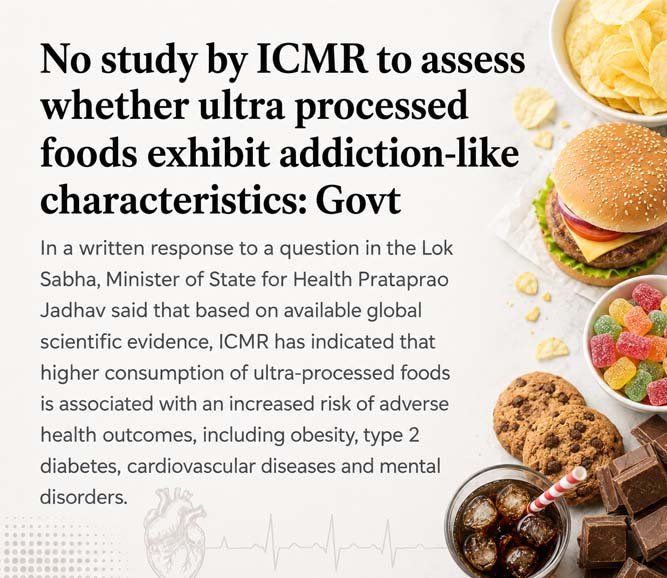
In a written reply in the Lok Sabha in early August 2026, Minister of State for Health Prataprao Jadhav stated that the Indian Council of Medical Research (ICMR) has not conducted any study to assess whether ultra-processed foods (UPFs) exhibit addiction-like behavioural characteristics comparable to tobacco products or other habit-forming substances.

At the same time, the Minister noted that, based on available global scientific evidence, ICMR has indicated that higher consumption of UPFs is associated with an increased risk of adverse health outcomes, including obesity, type 2 diabetes, cardiovascular diseases and mental disorders. These conditions are multifactorial in origin, and high UPF intake is considered one of several modifiable risk factors. The available evidence is largely observational and does not, by itself, establish causality.


ICMR and the National Institute of Nutrition have already responded to the broader risks. The Dietary Guidelines for Indians, 2024 explicitly recommend minimising intake of UPFs and high-fat, sugar and salt (HFSS) foods, limiting free sugars, avoiding frequent consumption of sugar-sweetened beverages, and carefully reading food labels. The guidelines also provide practical guidance on identifying UPFs. Complementary efforts include the “Let’s Fix Our Food” initiative, FSSAI’s Eat Right India movement and the “Aaj Se Thoda Kam” campaign.

The sharper question is this: Does India need to wait for its own definitive studies on every mechanism—including addiction-like properties—before treating UPFs as a public-health priority? Or does the existing international evidence already provide a sufficiently robust foundation that India can adapt and accelerate?

What Global Evidence Shows on Health Outcomes

The NOVA classification system defines UPFs as industrial formulations that typically contain little or no whole foods and high levels of additives, refined carbohydrates, sugars, fats and salt. These products are engineered for long shelf life, convenience and hyper-palatability.

A major 2024 umbrella review published in The BMJ synthesised 45 meta-analyses involving nearly 10 million participants. It found direct associations between higher UPF exposure and 32 of 45 health parameters examined. Convincing evidence linked greater UPF intake to higher risk of cardiovascular disease-related mortality (risk ratio 1.50) and type 2 diabetes (dose-response risk ratio 1.12). Highly suggestive evidence covered all-cause mortality, heart-disease mortality, obesity, depression and common mental disorders.

Multiple independent meta-analyses report elevated risks for obesity (odds ratios around 1.55 comparing highest versus lowest intake groups), type 2 diabetes (commonly 12–40% higher risk), hypertension, dyslipidaemia and depression. No beneficial associations with high UPF consumption appear in the literature. While the evidence base is observational and residual confounding cannot be fully excluded, the consistency across large prospective cohorts, the presence of dose-response relationships, and biological plausibility (high energy density, rapid nutrient absorption, displacement of nutrient-dense foods, effects on gut microbiota and low-grade inflammation) are substantial.

The Addiction Question: International Findings

The specific issue raised in the Lok Sabha—whether UPFs display addiction-like characteristics—has been examined in depth outside India. In a 2023 paper in the journal Addiction, Ashley Gearhardt and colleagues argued that highly processed foods meet the scientific criteria used in the 1988 U.S. Surgeon General’s report to classify tobacco as addictive: they are highly reinforcing, produce craving and loss of control, and drive continued use despite negative consequences.

Prevalence estimates using the Yale Food Addiction Scale place ultra-processed food addiction at approximately 14% of adults and 12–15% of youths across studies from dozens of countries—rates comparable to those of alcohol or tobacco use disorders. Neuroimaging research shows overlapping activation in reward circuits (including dopaminergic pathways), reduced inhibitory control, and patterns resembling those seen in substance-use disorders. Preclinical and human studies indicate that the combination of refined carbohydrates and fats, rapid delivery into the bloodstream, and intense sensory enhancements can promote compulsive intake more strongly than whole or minimally processed foods.

Scientific debate continues. Some imaging studies report more modest dopamine responses than those seen with classic drugs of abuse, and not every individual who consumes UPFs develops addiction-like behaviour. Nevertheless, the cumulative evidence from nearly 300 studies across 36 countries supports the conclusion that certain industrial food products can engage reward systems in ways that traditional foods do not. Leading voices in addiction science and nutrition have described this as a public-health issue that diagnostic systems and policy have been slow to address fully.

India’s Context: Rapid Growth Meets High Metabolic Vulnerability

India does not need to rediscover the biological mechanisms. What it requires is context-specific data and faster policy translation. Retail sales of UPFs in India rose from approximately $0.9 billion in 2006 to nearly $38 billion in 2019—a roughly 40-fold increase, among the fastest rates recorded globally (Lancet series, 2025). Over a comparable period, the prevalence of obesity roughly doubled in both men and women. ICMR-INDIAB data show that roughly one in four adults is overweight or obese, one in ten has diabetes, abdominal obesity is widespread, and childhood overweight is rising.

South Asian populations already carry elevated genetic and metabolic predisposition to visceral adiposity and type 2 diabetes at lower body-mass-index thresholds than many Western populations. Traditional diets centred on whole grains, pulses, vegetables and home-cooked meals are being displaced by packaged snacks, biscuits, instant noodles, sugary drinks and ready-to-eat products—first in urban centres and increasingly in smaller towns and rural areas. Aggressive marketing, convenience and rising disposable incomes accelerate the shift.

The 2024 Dietary Guidelines correctly identify the problem. Implementation gaps remain: front-of-pack warning labels are still under active development, restrictions on marketing (especially to children) remain limited, and fiscal measures targeting the most harmful products lag behind those of several countries that moved earlier.

Reinvent or Accelerate?

India does not need to reinvent the wheel of nutrition. The global evidence on health risks is already robust enough to justify decisive action: reducing UPF availability and marketing in and around schools, strengthening clear front-of-pack labelling, restricting advertising of HFSS and UPF products directed at children, and actively promoting traditional and minimally processed foods through public procurement, targeted subsidies and sustained education.

Local research remains essential—precise national consumption data using validated tools (such as the Nova-UPF screener developed for India), longitudinal studies in Indian cohorts, mechanistic work on metabolic responses specific to South Asian genetics, and rigorous evaluation of policy interventions. Waiting for perfect local evidence on every pathway, including addiction-like characteristics, would delay protection of a generation already showing rising rates of obesity and diabetes.

The scientific wheel exists. The practical task is to adapt it to Indian roads—cultural food patterns, federal governance, industry realities and the double burden of malnutrition—and to start moving it with urgency. Public-health history repeatedly shows that demanding absolute proof of every mechanism before acting on strong observational and biological evidence has proven costly. Ultra-processed foods present a clear case for informed, evidence-based acceleration rather than reinvention.

Appendix: Selected Sources

  1. Government of India, Lok Sabha reply by Minister of State for Health Prataprao Jadhav (August 2026). Reported in CNBC-TV18, The Hindu and Economic Times Health.
  2. ICMR-National Institute of Nutrition. Dietary Guidelines for Indians, 2024. Hyderabad: ICMR-NIN.
  3. Lane MM et al. Ultra-processed food exposure and adverse health outcomes: umbrella review of epidemiological meta-analyses. The BMJ 2024;384:e077310. doi:10.1136/bmj-2023-077310.
  4. Gearhardt AN et al. Highly processed foods can be considered addictive substances based on established scientific criteria. Addiction 2023. doi:10.1111/add.16065.
  5. Monteiro CA et al. Ultra-processed foods: what they are and how to identify them. Public Health Nutrition (NOVA classification foundational papers).
  6. Lancet Series on Ultra-Processed Foods and Human Health (2025). Multiple papers document global and India-specific sales growth, dietary transition, and health impacts (including the reported ~40-fold rise in Indian UPF retail sales from 2006 to 2019).
  7. ICMR-INDIAB studies (various phases) on prevalence of obesity, diabetes and related metabolic disorders in India.
  8. Schulte EM, Gearhardt AN and related work on the Yale Food Addiction Scale and prevalence estimates of ultra-processed food addiction (~14% adults).
  9. Additional supporting meta-analyses and reviews in Clinical Nutrition, Advances in Nutrition, Current Obesity Reports and Nature Medicine (2023–2025) on cardiometabolic, mental-health and mortality associations with UPF intake.

Hot this week

Platforms Are Owning the Patient While Pharma Waits

The future of experimental medicine is not simply a...

Samit Mehta has been appointed Chief Operating Officer (COO) of Emcure Pharmaceuticals Ltd.

Samit Mehta brings extensive experience in healthcare leadership, business...

Indian Hospitals and Private Equity: Healthy for Patients?

If healthcare is so lucrative that global private equity...

Topics

spot_img

Related Articles

spot_imgspot_img