
Saturday, August 8, 2026
22.2 C
Bengaluru

Platforms Are Owning the Patient While Pharma Waits

The future of experimental medicine is not simply a regulatory question. It is a question about who controls access, who pays for treatment, who generates evidence, and who bears the risk.

We spend too much time debating what will happen in healthcare.

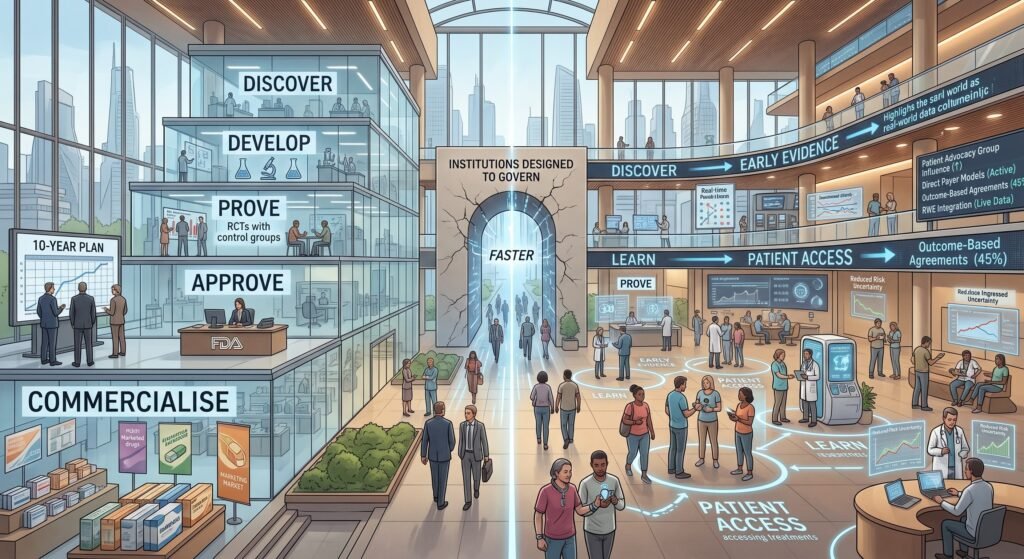
We hold conferences on “future-proofing” pharma. We run scenario-planning exercises on the FDA of 2030. We build 10-year development strategies around the assumption that the healthcare system will continue to progress in a predictable sequence: discovery, development, proof, approval, and commercialisation.

But the more important question is whether the market is already moving faster than the institutions designed to govern it.

In his recent Substack post, “When the Patient Becomes the Customer“, Salil Kallianpur describes the early consumerisation of drug development. He contrasts the traditional model—“Discover → Develop → Prove → Approve → Commercialise”—with an emerging possibility: “Discover → Early evidence → Patient access → Learn → Prove.”[1]

That distinction matters. It suggests that the conventional patient is increasingly becoming an active market participant: searching for information, comparing providers, seeking earlier access, paying directly and influencing the development pathway.

The future, in other words, may not be approaching. It may already be reshaping the market.

1. The competitor is no longer only pharma

The classic pharmaceutical competitor was another company developing a therapy with a similar mechanism of action. That remains true, but it is no longer the complete competitive picture.

Healthcare companies now compete with platforms that control parts of the patient journey before conventional pharmaceutical companies enter the conversation. Digital-health businesses can combine symptom discovery, teleconsultation, prescription support, pharmacy fulfilment, payment options and follow-up care within a single consumer-facing experience.

Ro’s 2026 expansion illustrates this model. The company describes itself as a vertically integrated, direct-to-patient healthcare platform spanning Telehealth, laboratory services, pharmacy access and ongoing care. Its April 2026 announcement concerning Foundayo, an oral GLP-1 product from Eli Lilly, positioned Ro as a channel for access to FDA-approved therapies—not simply as a marketing intermediary.[2]

That distinction is important. The competitive threat is not necessarily that digital-health companies are bypassing regulation. It is that they are becoming better at controlling the patient relationship, the data trail, the purchase decision and the treatment experience.

The competitor may therefore be:

– A telehealth platform with a large patient database.
– A pharmacy or fulfilment network that controls access and convenience.
– A cash-pay clinic selling speed, personalisation and continuity.
– A wellness brand that shapes consumer expectations before diagnosis.
– A technology company that helps patients interpret data and select care options.

For pharma companies, the strategic issue is not merely whether a digital platform will replace the sales force. It is whether the platform will own the context in which a treatment is discovered, discussed, prescribed and judged.

2. The company model is becoming more integrated

The traditional company structure—research and development, regulatory, medical affairs, market access and commercialisation—was built around a relatively linear process.

The emerging model is more integrated. Companies increasingly need to combine:

– Biology and technology.
– Manufacturing and supply-chain capability.
– Regulatory strategy and evidence generation.
– Physician access and patient engagement.
– Real-world data and post-market learning.
– Affordability, reimbursement and direct payment options.

This does not mean that regulatory approval is becoming irrelevant. It means that commercial, clinical and regulatory decisions are becoming harder to separate.

Cellularity provides a useful, documented example—not because it has created a legislative-navigation business, but because its restructuring illustrates how a biotechnology company can operate across multiple commercial and development units. In 2025, the company created separate operating subsidiaries for biomaterials, longevity-focused cellular therapies, biobanking, contract development and manufacturing, and internal discovery and development. It also restructured its balance sheet and retired senior secured debt.[3]

The lesson is broader than Cellularity’s specific strategy. Biotech companies are under pressure to create value before a single product reaches conventional commercial scale. That may encourage business models built around multiple assets, manufacturing capabilities, service revenues, partnerships and data—not just a single eventual approval.

However, the industry should be cautious about calling every alternative funding or access model a breakthrough. Claims about “patient crowdfunding,” “tokenised trials” or community-owned drug development require verifiable evidence. Without primary filings, named investors, identifiable trial sponsors and clear legal structures, they should not be presented as established market trends.

3. Access is changing—but not every pathway is equivalent

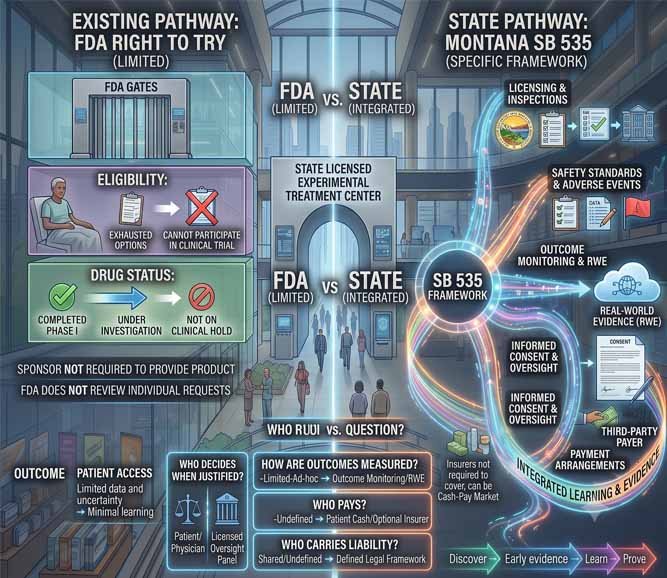
The debate around experimental medicine is often weakened by imprecise language. Off-label use of an approved medicine is not the same as access to an unapproved investigational product. A compounded preparation is not automatically equivalent to an FDA-approved product. A wellness intervention is not necessarily a treatment supported by clinical evidence. Regulatory flexibility is not regulatory abandonment. The FDA’s Right to Try pathway is limited. It applies to eligible patients with life-threatening diseases or conditions who have exhausted approved treatment options and cannot participate in a clinical trial. The investigational drug must have completed Phase I, remain under investigation or have a qualifying FDA application, and not be on clinical hold. The sponsor is not required to provide the product, and FDA does not review or approve each individual request.[4]

Montana has created a more specific state-level framework through SB 535. The law provides for licensed experimental treatment centres. It defines an experimental treatment as an investigational drug, biological product, device, or other intervention that has completed Phase I but has not been approved for general use, and is subject to additional conditions. The framework includes licensing, inspections, safety standards, outcome monitoring, adverse-event reporting and informed-consent requirements.[5]

It also allows payment arrangements with patients and third-party payers, while making clear that insurers and government programmes are not required to cover the treatment.[5]

This is significant because it introduces a potential cash-pay market for experimental medicine. But it does not create a general licence to commercialise any promising therapy, nor does it eliminate the need for clinical evidence, informed consent, safety monitoring or manufacturer participation.

The critical question is not simply whether patients should have earlier access. It is who decides when access is justified, how outcomes are measured, who pays, and who carries liability when the evidence later changes.

4. The customer is becoming more informed—and more exposed

The traditional patient was often imagined as a relatively passive participant in the healthcare system: symptoms led to a consultation, the physician made a recommendation, the payer determined coverage, and the patient followed the treatment plan.

And online communities have made patients. That model has never been completely accurate. But digital health, social media, wearable devices, telemedicine, and online communities have made patients more active and more commercially visible.

The emerging healthcare customer may:

– Monitor glucose, sleep, weight, heart rate or other health metrics.
– Compare providers and prices online.
– Seek multiple clinical opinions through telemedicine.
– Ask about therapies discussed in online communities.
– Pay cash when insurance coverage is unavailable.
– Expect rapid delivery, digital follow-up and transparent pricing.
– Evaluate treatment through personal experience as well as published evidence.

This does not mean that patients reject evidence. It means that evidence competes with other forms of influence: convenience, testimonials, online authority, personal urgency, affordability and perceived control.

McKinsey’s 2026 consumer research describes a technology-driven path to purchase, a health revolution and the rise of the “resourceful consumer.” Its healthcare research also reports significant dissatisfaction with the healthcare industry and links consumer empowerment with improved perceptions of healthcare brands.[6][7]

Those findings support the broader direction of the argument. Still, they do not support the previously cited claim that 44% of US adults under 50 would pay for a Phase II therapy recommended by an online specialist. That statistic should not be used without the original survey and methodology.

The commercial implication is clear: patients are not merely endpoints in a treatment pathway. They are increasingly participants in the selection, financing, monitoring and evaluation of care.

The ethical implication is equally clear: a customer can demand access, but demand is not proof of benefit.

5. Evidence may become a contested market

Kallianpur’s three-tier framework is useful for understanding the emerging landscape:

Approved medicine

This is the conventional market: stronger evidence, regulatory authorisation, established prescribing rules and conventional reimbursement.

Experimental medicine

This involves limited or evolving evidence, controlled access, informed consent and active evidence generation. It may be especially relevant to serious, rare or rapidly progressive diseases where conventional development pathways may not fit the clinical need.

Consumer optimisation

This is the cash-pay market for interventions driven by personal goals, perceived benefit, convenience and individual choice. It may include services that sit at the boundary between healthcare, wellness and performance enhancement.

The danger arises when these tiers are presented as interchangeable.

Phase I evidence is primarily designed to evaluate early safety, tolerability and dosing. It is not designed to establish definitive efficacy. A therapy that is biologically interesting may still fail in later development. A treatment that appears promising in a small group may produce limited benefit—or serious harm—when used more broadly.

The risk is therefore not only that experimental medicine becomes more accessible. It is that commercial demand begins to outrun evidence generation.

Once the patient becomes the customer, the commercial relationship introduces new questions:

– Who sets the price?
– Who pays when insurance does not?
– Who owns the patient-generated data?
– Who is responsible for long-term monitoring?
– Who bears liability if later evidence reveals harm?
– How are negative outcomes communicated?
– What prevents marketing from overstating uncertainty?
– How do regulators distinguish controlled access from premature commercialisation?

These questions cannot be answered by technology alone. They require governance, transparent evidence standards and clear accountability.

What this means for Indian healthcare decision-makers

For Indian healthcare decision-makers, the lesson is not to copy Montana or import the US Right to Try model. India already has a regulatory framework for new drugs, investigational new drugs, clinical trials and ethics committees under the New Drugs and Clinical Trials Rules, 2019. The framework also recognises post-trial access in defined circumstances, including cases where an investigational product has benefited a trial participant and the ethics committee approves continued access. At the same time, India’s telemedicine guidelines allow registered medical practitioners to provide consultations and prescriptions within defined requirements, including appropriate digital prescriptions and referral for emergencies. Indian pharma, hospital, and digital-health leaders should therefore focus on controlled access rather than regulatory shortcuts: transparent consent, pharmacovigilance, real-world evidence, affordability, data governance, physician accountability, and a clear separation among approved treatments, investigational use, and wellness claims. The strategic opportunity is to build trusted, evidence-generating patient pathways—not merely faster routes to market.[8][9][10][11]

The lag can become lethal

The consumerisation of healthcare is not simply an RFK Jr. phenomenon. Political shifts may accelerate the debate, but the underlying forces are larger:

– Patients are more informed and more impatient.
– Digital platforms are reducing friction between demand and treatment.
– Biotech companies need capital and faster learning.
– Longevity and optimisation have created new cash-pay categories.
– Telemedicine is changing how care is accessed.
– Patients increasingly expect choice, convenience and transparency.
– Regulators are being asked to manage technologies that do not fit old categories.

The pharmaceutical industry should not respond by abandoning evidence. It should respond by recognising that evidence, access, experience and trust are becoming part of the same competitive system.

The winning healthcare companies of the next decade may not be those that simply discover the next blockbuster. They may be the companies that can connect science, manufacturing, clinical care, patient engagement, affordability, data and responsible evidence generation.

The patient is not becoming less important. The patient is becoming more visible, more powerful and more commercially central.

That shift creates opportunity. It also creates a higher duty of care.

Experimental medicine may become more accessible. But the question that will define the next phase is not merely who gets access.

It is who decides when access is justified—and who bears the cost when the market arrives before the evidence.

Editorial note: This article is an analysis, not medical, legal, regulatory or investment advice.

Sources
[1] When the Patient Becomes the Customer – by Salil Kallianpur https://mypharmareviews.substack.com/p/when-the-patient-becomes-the-customer
[2] Ro Offers Eli Lilly’s Foundayo™, the Newest GLP-1 Innovation https://ro.co/press/foundayo/
[3] Celularity Completes Major Balance Sheet Restructuring, Retires All $41.6 Million in Senior Secured Debt https://celularity.com/celularity-completes-major-balance-sheet-restructuring-retires-all-41-6-million-in-senior-secured-debt/
[4] Right to Try https://www.fda.gov/patients/learn-about-expanded-access-and-other-treatment-options/right-try
[5] 1 – Authorised Print Version – SB 535 ENROLLED BILL AN … https://archive.legmt.gov/content/Sessions/69th/Contractor_index/CH0621.pdf
[6] State of the Consumer 2026: When tech acceleration and cost pressures collide https://www.mckinsey.com/industries/consumer-packaged-goods/our-insights/state-of-consumer
[7] Improving consumer trust and experience in healthcare | McKinsey https://www.mckinsey.com/industries/healthcare/our-insights/healing-consumer-confidence-through-ai-powered-human-centered-healthcare
[8] THE NEW DRUGS AND CLINICAL TRIALS RULES, 2019 https://cdsco.gov.in/opencms/resources/UploadCDSCOWeb/2022/new_DC_rules/NEW%20DRUGS%20ANDctrS%20RULE,%202019.pdf
[9] Frequently Asked Questions (FAQs) on New Drugs and … https://cdsco.gov.in/opencms/export/sites/CDSCO_WEB/Pdf-documents/New-Drugs/FAQs/faqonndandctRules24set25.pdf
[10] Telemedicine practice guidelines of India, 2020 – PMC – NIH https://pmc.ncbi.nlm.nih.gov/articles/PMC8106416/
[11] Telemedicine Regulations https://www.pib.gov.in/PressReleasePage.aspx?PRID=1740756
[12] SEC https://cdsco.gov.in/opencms/opencms/en/Committees/SEC/
[13] Search Filings – SEC.gov https://www.sec.gov/search-filings
[14] Form D Data Sets – SEC.gov https://www.sec.gov/data-research/sec-markets-data/form-d-data-sets
[15] FORM D – SEC.gov https://www.sec.gov/Archives/edgar/data/1347616/000131586322000529/xslFormDX01/primary_doc.xml
[16] Perspectives on consumer health and wellness https://www.mckinsey.com/industries/consumer-packaged-goods/our-insights/perspectives-on-consumer-health-and-wellness
[17] Health and wellness worldwide: Consumer insights from four countries https://www.mckinsey.com/industries/consumer-packaged-goods/our-insights/wellness-worldwide-consumer-insights-from-four-countries
[18] State of the Consumer 2026 https://www.theconsumergoodsforum.com/app/uploads/2026/06/The-Global-Consumer-Whats-Next.pdf
[19] The State of the 2026 Consumer – A Focus on Health … https://www.healthpopuli.com/2026/07/09/the-state-of-the-2026-consumer-a-focus-on-health-experience-and-diy-agency-mckinsey-observes/
[20] McKinsey 2026 consumer health across dimensions … https://www.healthpopuli.com/2026/07/09/the-state-of-the-2026-consumer-a-focus-on-health-experience-and-diy-agency-mckinsey-observes/mckinsey-2026-consumer-health-across-dimensions/
[21] McKinsey’s 2026 Consumer Report Signals a DC Health Policy … https://washingtondcmagazine.substack.com/p/mckinseys-2026-consumer-report-signals
[22] The Consumer Takeover – by Salil Kallianpur https://mypharmareviews.substack.com/p/the-consumer-takeover
[23] First look at McKinsey’s new Future of Wellness Report 2026 https://europeanspamagazine.com/first-look-at-mckinseys-future-of-wellness-report/
[24] New Drugs and Clinical Trials Rules, 2019 https://cdsco.gov.in/opencms/opencms/en/Acts-and-rules/New-Drugs/
[25] THE DIGITAL PERSONAL DATA PROTECTION ACT, 2023 … https://www.meity.gov.in/static/uploads/2024/06/2bf1f0e9f04e6fb4f8fef35e82c42aa5.pdf
[26] Digital Personal Data Protection Act, 2023. https://www.indiacode.nic.in/handle/123456789/22037?view_type=browse
[27] Telepsychiatry Operational Guidelines – 2020 https://www.lgbrimh.gov.in/resources/telemedicine/guidelines/op_guidelines.pdf
[28] Post-trial access to investigational drugs in India – Oxford Academic https://academic.oup.com/medlaw/article/32/1/20/7250237
[29] Understanding the Medico-Legal Aspects of Telemedicine in … https://pmc.ncbi.nlm.nih.gov/articles/PMC10448835/
[30] The Digital Personal Data Protection Act 2023 – PMC – NIH https://pmc.ncbi.nlm.nih.gov/articles/PMC12423081/
[31] BOARD OF GOVERNORS https://esanjeevani.mohfw.gov.in/assets/guidelines/Telemedicine_Practice_Guidelines.pdf
[32] Telehealth Practice Guidelines for AFMS https://sehatopd.gov.in/assets/guidelines/Telemedicines_reference.pdf
[33] Telemedicine practice guidelines in India https://lms.thsti.in/wp-content/uploads/2024/04/Telemedicine-practice-guidelines-in-India_-Global-implications-in-the-wake-of-the-COVID%E2%80%9019-pandemic.pdf
[34] India’s new Telemedicine Practice Guidelines – Analysis and Do’s and Don’ts for Doctors offering teleconsultation https://www.lexology.com/library/detail.aspx?g=a1d76ffa-1853-4c7a-84e8-f8ef37d44525

Hot this week

Samit Mehta has been appointed Chief Operating Officer (COO) of Emcure Pharmaceuticals Ltd.

Samit Mehta brings extensive experience in healthcare leadership, business...

Indian Hospitals and Private Equity: Healthy for Patients?

If healthcare is so lucrative that global private equity...

What ChrysCapital’s Takeover Of Novartis India Really Means

When ChrysCapital, one of India's oldest and largest homegrown...

Biological E. Limited appointments Manishkumar Munot as Chief Business Officer—Vaccines.

Manishkumar Munot has joined Biological E. Limited as Chief...

Big Pharma and the Obesity War – Science to Subpoenas

Two pharmaceutical giants are currently locked in a high-stakes...

Topics

Samit Mehta has been appointed Chief Operating Officer (COO) of Emcure Pharmaceuticals Ltd.

Samit Mehta brings extensive experience in healthcare leadership, business...

Indian Hospitals and Private Equity: Healthy for Patients?

If healthcare is so lucrative that global private equity...

What ChrysCapital’s Takeover Of Novartis India Really Means

When ChrysCapital, one of India's oldest and largest homegrown...

Big Pharma and the Obesity War – Science to Subpoenas

Two pharmaceutical giants are currently locked in a high-stakes...

The Wealth of Pharma Nations: Top 25 Pharma Blockbusters

The economic footprint of a truly historic pharmaceutical blockbuster...
spot_img

Related Articles

spot_imgspot_img