
Wednesday, April 22, 2026
29.4 C
Bengaluru

City Lungs Under Siege: Pigeon Droppings and Interstitial Lung Disease

Feeding pigeons may feel harmless — but for many urban Indians, it’s literally taking their breath away

🌆 Urban Compassion, Hidden Consequences

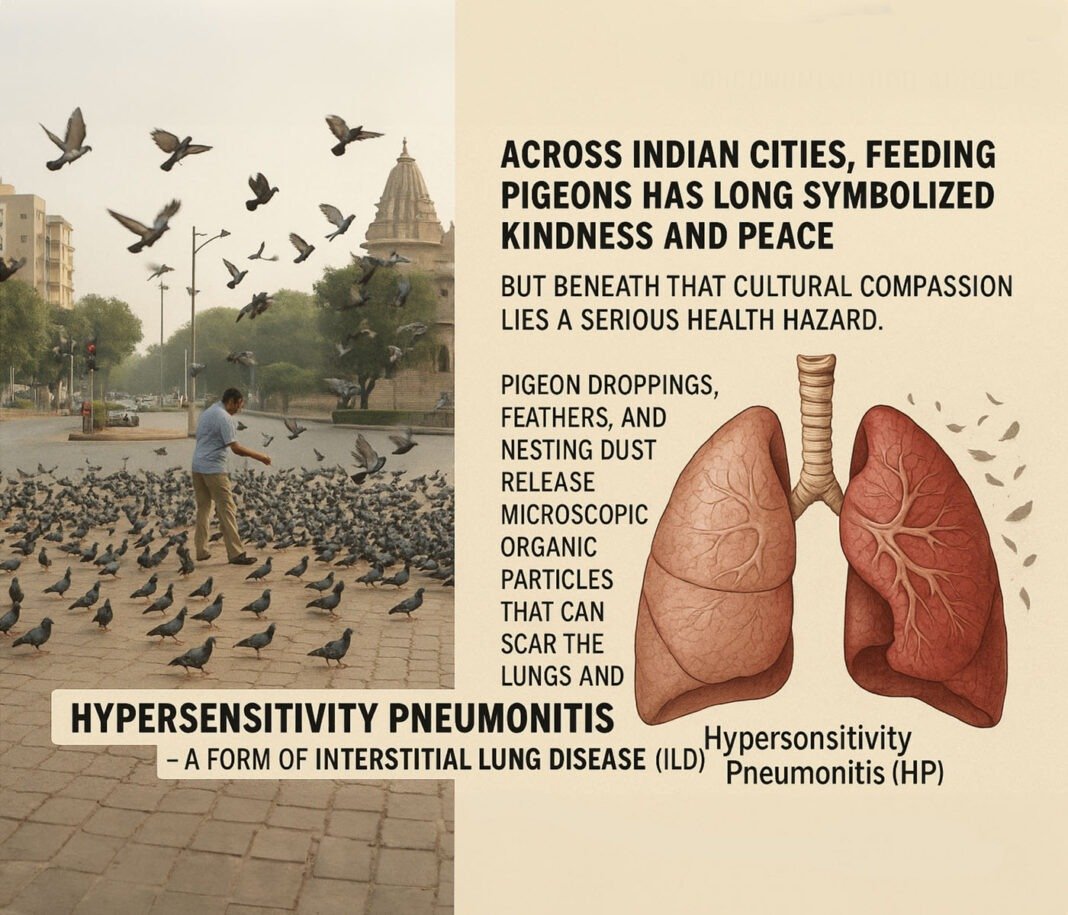
Across Indian cities, feeding pigeons has long symbolized kindness and peace. Flocks gather at traffic circles, temple courtyards, and apartment terraces — often fed by residents who see it as an act of care.

But beneath that cultural compassion lies a serious health hazard.
Pigeon droppings, feathers, and nesting dust release microscopic organic particles that can scar the lungs and cause a life-altering condition called Hypersensitivity Pneumonitis (HP) — a form of Interstitial Lung Disease (ILD).


The Science: When the Immune System Turns Against the Lungs

When inhaled repeatedly, avian proteins in pigeon droppings and feathers provoke a hypersensitive immune response.
Over time, this chronic inflammation leads to fibrosis — thickening and stiffening of lung tissue that impairs oxygen exchange.

It’s not an infection. It’s an immune overreaction — your body essentially attacking its own lungs.

“Many patients come to us with progressive breathlessness, thinking it’s asthma or pollution.
But the real culprit is often right on their balcony — pigeon exposure.”
— Pulmonologist, ILD Clinic, Mumbai

Clinical Reality: How It Shows Up

Stage Symptoms & Clues
Acute (hours after exposure) Fever, cough, chills, and breathlessness — often mistaken for flu or infection.
Subacute (weeks to months) Persistent cough, fatigue, and exertional breathlessness.
Chronic Progressive lung fibrosis → permanent ILD, low oxygen levels, and dependency on long-term therapy.

HRCT scans typically reveal ground-glass opacities, fibrosis, and air-trapping.
Serology may show antibodies to avian antigens, and BAL tests reveal lymphocytic inflammation.

⚠️ Epidemiology: India’s Emerging ILD Hotspot

A 2020 ILD India Registry estimated that up to one-third of ILD cases in urban centers are hypersensitivity pneumonitis linked to bird exposure — especially pigeons.
Dense housing, terrace feeding, and lack of awareness create a perfect storm.

Cities like Mumbai, Pune, Delhi, and Bengaluru have recorded rising cases — often misdiagnosed for years as tuberculosis or asthma.

💊 Diagnosis & Management
1. History — direct questioning about bird or pigeon exposure is critical.
2. Antigen avoidance — complete removal of pigeons, droppings, and contaminated dust.
3. Corticosteroids — to suppress acute inflammation.
4. Antifibrotics (pirfenidone, nintedanib) — for chronic, progressive disease.
5. Rehabilitation & oxygen support — for advanced cases.

Early identification and environmental control remain the strongest predictors of recovery.

  • Public Health Imperative
    • Awareness campaigns: feeding bans and health advisories in high-density pigeon zones.
    • Housing policies: discouraging pigeon nesting in public housing and terraces.
    • Community messaging: “Feeding pigeons harms people — not helps birds.”
    • Surveillance: inclusion of HP/ILD in municipal health data systems.
  • This is where public health meets behavioral change — compassion for birds must coexist with compassion for lungs.
  • MedicinMan Insight
  • In India’s healthcare narrative, pollution gets the headlines — but bioaerosols like pigeon dust quietly cause chronic disease in thousands.
    ILD from avian exposure is preventable — but only if recognized early.
  • For clinicians: always ask the pigeon question.
    For citizens: choose clean air over symbolic feeding.
    For policymakers: urban hygiene and public awareness are as vital as medical care.
  • Because every act of misplaced kindness shouldn’t come at the cost of someone else’s breath.

All Images Are AI Generated For Illustration Only. E&OE.

📚 Appendix: Key References
1. Raghu G, et al. “Hypersensitivity Pneumonitis: A Clinical Perspective.” Chest (2020).
2. Indian Chest Society – ILD India Registry Report (2020).
3. Times of India, Hindustan Times, and The Hindu reports on pigeon-related ILD cases, Mumbai & Delhi editions (2018–2024).
4. Cormier Y. “Bird Fancier’s Lung.” Clin Chest Med (2012).

Hot this week

Will the GLP Battle Now Shift from Injectable to Oral?

In India’s million-strong retail pharmacy universe, oral weight-loss pills...

The Semaglutide Paradox: Anatomy of a High-Stakes Commodity Trap

The Semaglutide Shift: From Blockbuster to Commodity Why the $50...

Cytotoxics to Cell Therapy: A 40-Year Review of Indian Oncology Strategy

In 1989, oncology in India was not a business...

Ritesh Desai has joined Standard Chartered India as Executive Director

Ritesh Desai has joined Standard Chartered India as Executive...

The Healthium Odyssey: From Sutures to Scalpel-Sharp Innovation

The story of Healthium is not just one of...

Topics

Will the GLP Battle Now Shift from Injectable to Oral?

In India’s million-strong retail pharmacy universe, oral weight-loss pills...

The Semaglutide Paradox: Anatomy of a High-Stakes Commodity Trap

The Semaglutide Shift: From Blockbuster to Commodity Why the $50...

Ritesh Desai has joined Standard Chartered India as Executive Director

Ritesh Desai has joined Standard Chartered India as Executive...

A Tale of Two Companies – Sun Pharma’s Odyssey and Organon’s Second Act

Sun Pharma’s Odyssey and Organon’s Second Act – And...

The Semaglutide Gold Rush: Miracle Cure or Market Mirage?

The Indian Pharmaceutical Market (IPM) has entered a definitive...
spot_img

Related Articles

spot_imgspot_img