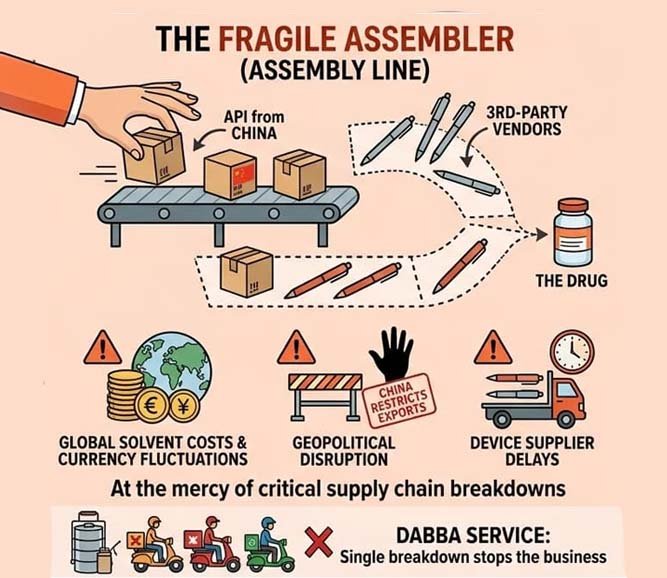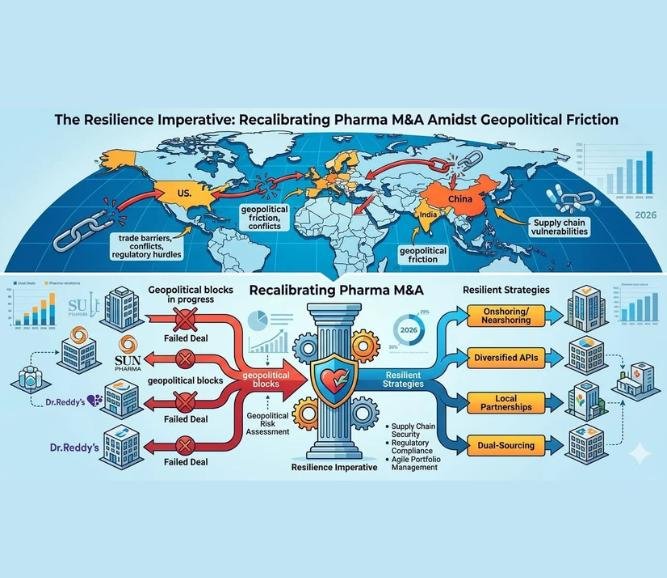

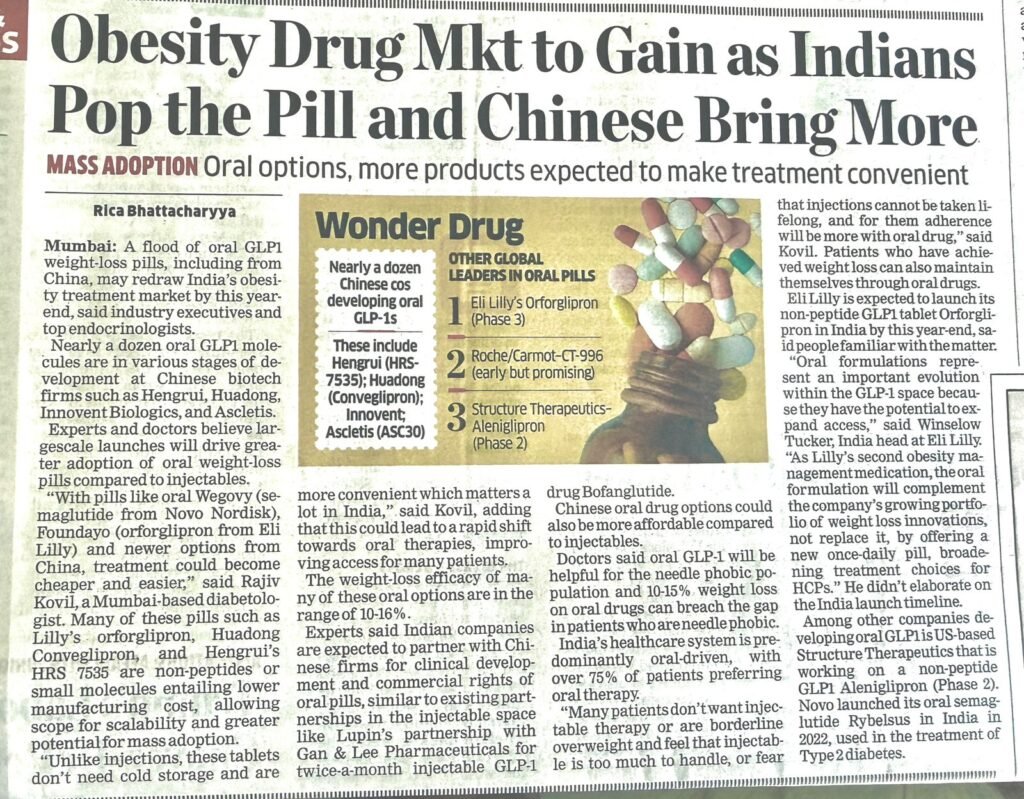
In Indiaโs million-strong retail pharmacy universe, oral weight-loss pills wonโt wait for prescriptionsโand the industry needs to prepare for that reality.
MedicinManAI Feature
Let us set aside the clinical ideal for a moment. No amount of regulatory advisory or media noise from the medical establishment will change the fundamental reality of Indian healthcare.

India is not a clinic-first country. It is a pharmacy-first country.
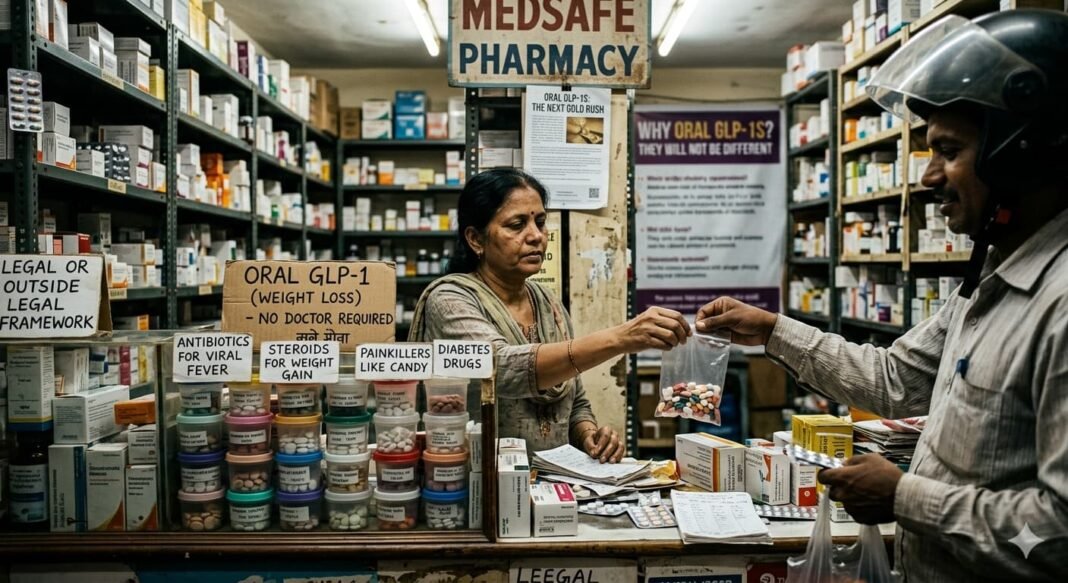
With over one million retail pharmacies serving as the de facto primary healthcare system, Indiaโs drug market functions as a parallel universe of affordable, accessible healthcare. For the average citizen, the pharmacy is cheaper, faster, and more approachable than a doctorโs clinic. It is the first point of access for everythingโfrom antibiotics for a fever to AYUSH remedies for joint pain to โgeneral productsโ for daily wellness.
This is a highly lucrative business for retail pharmacies. And it is virtually impossible to regulate one million outlets across 28 states and 8 union territories.

Now, add to this the existence of thousands of small drug companies that sell trade generics directly to retail pharmacies at mind-boggling margins. These are not the Sun Pharmas and Dr. Reddyโs of the world. These are regional, often unlisted manufacturers who bypass the standard distribution chain, offering pharmacists 70โ80% margins on certain products.
Into this ecosystem, oral GLP-1 weight-loss pills are about to arrive.
The question is not whether they will be accessed responsibly, with a prescription and clinical supervision. The question is: How quickly will they bypass the clinic and reach the pharmacy counterโand who will profit?
The Logistical Liberation
For years, the injectable GLP-1 market was self-regulating. The need for cold-chain infrastructure and the psychological hurdle of self-administration kept these drugs in a relatively narrow clinical channel. A patient could not casually buy a refrigerated injectable pen from a corner pharmacy.
Oral, non-peptide GLP-1 molecules change everything.
These small moleculesโpioneered by Eli Lilly (Orforglipron) and a cohort of Chinese biotech innovators including Hengrui (HRS-7535), Huadong (Conveglipron), Innovent Biologics, and Ascletis (ASC30) โdo not require refrigeration. They are small, shelf-stable pills. They look like any other tablet on the pharmacy shelf.

The weight-loss efficacy of these oral options ranges from 10โ16%, according to industry experts quoted in The Economic Times (April 2026). For the needle-phobic populationโand for the pharmacy-first patientโthis is more than sufficient.
Dr. Rajiv Kovil, a Mumbai-based diabetologist, told The Economic Times: โUnlike injections, these tablets donโt need cold storage and are more convenient which matters a lot in India.โ
Convenience is the mother of consumerisation.
The Oral Players: Who Is Coming to India?
| Company | Molecule | Type | Expected India Timeline |
|---|---|---|---|
| Eli Lilly | Orforglipron | Non-peptide small molecule | By end of 2026 |
| Novo Nordisk | Rybelsus (oral semaglutide) | Peptide (already launched) | Available since 2022 for Type 2 diabetes |
| Hengrui | HRS-7535 | Non-peptide | Development stage |
| Huadong | Conveglipron | Non-peptide | Development stage |
| Innovent Biologics | Oral GLP-1 candidate | Non-peptide | Development stage |
| Ascletis | ASC30 | Non-peptide | Development stage |
Indian companies are expected to partner with Chinese firms for clinical development and commercial rights, similar to existing partnerships in the injectable spaceโsuch as Lupinโs alliance with Gan & Lee Pharmaceuticals for a twice-a-month injectable GLP-1.
But the real action will not be at the branded generic level. The real action will be at the trade generic levelโthe thousands of small manufacturers who will reverse-engineer, reformulate, or simply copy these molecules once regulatory pathways become clear.

The Unspoken Reality: Indiaโs Consumerised Drug Market
Let us name what the industry whispers but rarely prints.
Indiaโs retail pharmacy network is not just a distribution channel. It is a parallel healthcare system:
| Feature | Reality |
|---|---|
| Number of retail pharmacies | Over 1 million |
| First point of healthcare access | For most Indians, yes |
| Prescription requirement | Routinely bypassed for high-demand drugs |
| Regulatory enforcement | Virtually impossible at scale |
| Margins on trade generics | 50โ80% for pharmacy; 30โ50% for small manufacturer |
| Consumer behavior | โPharmacy bhaiyaโ as de facto doctor |
The DCGI can issue all the advisories it wants against surrogate advertising and prescription-free sales. But the ground reality is that a million pharmacies cannot be policed. Thousands of small drug companiesโmany operating just within (or just outside) the legal frameworkโwill see oral GLP-1s as the next gold rush.
And they will be right.
Consider the precedent:
- Antibiotics are sold over the counter for viral fevers, despite knowing it drives antimicrobial resistance.
- Steroids are freely available for โweight gainโ and โskin lightening.โ
- Painkillers are consumed like candy for chronic back pain.
- Anti-diabetic drugs like metformin are often started without a formal diagnosis.
Why would oral GLP-1s be any different?
They will not be.

The Quality Paradox
At this point, a thoughtful reader might object: But what about quality? Surely patients deserve medicines that are safe and effective.
This is precisely the argument that Anup Soans, editor of MedicinMan.net and a longtime observer of Indian pharmaceutical distribution, has been making for nearly a decade. In his 2017 Wire Science article, he wrote:
โThe issue in India is not about expensive brand name drugs versus cheaper generics, as in the West, but one of quality drugs versus suspect quality drugs.
Branded generics are also generics with a brand name, plus the quality assurance from well-known companies like Cipla, Sun or Dr Reddyโs.
Doctors have come to trust these companies and their brands over time.โ
Soans introduced the now-famous phrase that the term โbranded genericโ is an Indian creation, โan oxymoron and jugaadโ for Indian pharma to distinguish its generics from others. His core argument, restated in a February 2026 MedicinMan article, is that the generic drug debate in India is routinely misframed around price when the real issue is qualityโspecifically, whether drugs meet defined standards of bioequivalence and ongoing manufacturing compliance.
He writes:
โGeneric medicines do not derive legitimacy from being cheaper.
They derive it from meeting the same scientific and regulatory standards as branded drugsโbeginning with bioequivalence in human blood and continuing with quality compliance in manufacture.โ
In the Indian context, however, this creates a paradox. In the absence of a strong, trusted regulator (like the USFDA), doctors and patients fall back on brand reputation as a proxy for quality. As Soans notes in his LinkedIn post summarizing the same argument:
โIn the absence of an international standard drug regulatory mechanism like the USFDA, Indian doctors have to rely on the reputation of companies like Cipla, Sun and hundreds of others who have demonstrated their commitment to quality over time and become trusted names in the eyes of doctors and patients.โ
Now apply this to oral GLP-1s.
The trade generic players entering this market will not have the quality reputation of a Sun Pharma or a Dr. Reddyโs. They will be unknown entities, manufacturing in small, low-overhead facilities, with minimal regulatory compliance. And yet, because the retail pharmacy channel operates on margin and availabilityโnot quality signalingโthese products will still sell.
This is the quality paradox of the Indian market: the very mechanism doctors use to ensure quality (brand trust) is absent from the trade generic channel. But the channel does not care. The pharmacy bhaiya does not check bioequivalence data. He checks his margin.

A Counterpoint: The Vested Interest Argument
Not everyone agrees with Soansโ framing. In a 2018 article in Economic and Political Weekly (EPW), researcher Manu Kanchan argued that the pharmaceutical industry has vested interests in making arguments against generic drugsโincluding the quality argument.
Kanchan writes:
โThe perception that unbranded generics are of suspect qualityโฆ has been built by the pharmaceutical companies themselves to their advantage. The perception acts as an entry barrier for unbranded drugs and this has become possible due to the absence of a strong drug regulatory authority in India.โ
He points out that studies have found unbranded generics from government supply chains (like Jan Aushadhi) to be as good in quality as branded counterparts. Conversely, branded drugs from โreputedโ companies have repeatedly failed quality tests.
This counterpoint is valuable because it reminds us that quality is not the exclusive domain of large branded players. A well-regulated genericโwhether branded or unbrandedโcan be perfectly safe and effective.
However, Kanchanโs argument assumes a functioning regulator that enforces quality uniformly. In Indiaโs current environment, that assumption is fragile. And for oral GLP-1s entering through the trade generic channel, the likelihood of rigorous quality oversight is low.
The strategic implication is not to dismiss quality concerns. It is to recognise that in the absence of regulatory trust, the market will default to the next best thing: brand reputation or, failing that, price and margin.
The โVitaminizationโ of Metabolic Health
The earlier article in this series introduced the concept of โvitaminizationโ โthe transformation of a prescription drug into a consumer wellness product. The difference is that most vitamins are harmless in overdose. GLP-1s are not.
When oral GLP-1s become available through the retail pharmacy channelโwith or without a prescriptionโthe following will happen:
| Consequence | Likelihood |
|---|---|
| Patients will self-start without medical screening | Almost certain |
| Dosing errors (starting at full dose) will cause severe GI side effects | Highly likely |
| Patients will stop abruptly, leading to rapid weight regain | Highly likely |
| Muscle loss and metabolic imbalance will occur without dietary guidance | Likely |
| A black market for โstrongerโ oral versions will emerge | Possible within 12โ18 months |
But here is the strategic paradox: None of this will slow down adoption. If anything, it will accelerate it.
The same โpharmacy bhaiyaโ who recommends a painkiller for a headache will recommend an oral GLP-1 for โthat stubborn belly fat.โ The same small manufacturer who produces trade generic antibiotics will produce trade generic orforglipron.
The medics will cry foul. The regulator will issue circulars. The media will run exposรฉs.
And the pharmacies will keep selling.

The Strategic Implications for Indian Pharma (The Real Ones)
Given this reality, what should serious pharmaceutical companies do?
Drawing on Soansโ framework, the first step is to recognise that quality is not just a regulatory requirementโit is a potential differentiator. But in the trade generic channel, quality does not sell. Margin sells.
So how does a responsible company compete?
Option 1: Ignore the parallel market and focus on the clinical channel.
This is the โsafeโ strategy. Build relationships with endocrinologists. Launch a branded generic at a premium price. Invest in patient education programs. Comply with every regulation.
Outcome: You will capture 10โ15% of the addressable market. The other 85โ90% will go to the trade generic players who have no such compunctions.
Option 2: Complain about the regulator and the โunethicalโ players.
This is the โfrustrated incumbentโ strategy. Write letters. Seek enforcement. Lobby for stricter controls.
Outcome: You will waste three years and achieve nothing. The parallel market will grow regardless.
Option 3: Accept the reality and compete where the volume is.
This is the โrealistโ strategy. Recognise that Indiaโs consumerised drug market is not going to change. Instead of ceding the space to fly-by-night operators, build a legitimate but accessible oral GLP-1 offering that:
- Prices aggressively to undercut the trade generic incentive (if the legal product is cheap enough, the illegal product has no margin advantage)
- Simplifies the packaging and information for pharmacy-led dispensing
- Creates a basic adherence and safety protocol that pharmacies can actually follow (e.g., โstart with half a tablet for week oneโ rather than a 30-page patient insert)
- Partners with pharmacy chains (not just clinics) as distribution partners
Outcome: You capture volume, build brand recognition at the retail level, and potentially set a safety floor where none exists today.
The Trade Generic Threat And Opportunity
The thousands of small drug companies that sell trade generics directly to retail pharmacies are not going to disappear. They operate on a simple model:
| Element | Trade Generic Model |
|---|---|
| Manufacturing | Small-scale, low-overhead, often in a single facility |
| Regulatory compliance | Minimal (just enough to stay legal) |
| Distribution | Direct to pharmacy, no wholesaler margin |
| Pharmacy margin | 50โ80% (vs. 15โ20% for branded generics) |
| Consumer price | 30โ50% lower than branded generic |
For a pharmacist, recommending a trade generic oral GLP-1 is not unethicalโit is rational business. The customer wants affordable weight loss. The pharmacist wants margin. The small manufacturer wants volume.
The only party missing from this transaction is the doctor. And in Indiaโs pharmacy-first healthcare system, that is not a bug. It is a feature.
The Verdict
The battle is shifting from injectable to oral. But that is not the real story.
The real story is that oral GLP-1s will bypass the clinic entirely for a significant portion of the marketโand no amount of medical outrage or regulatory circulars will stop it.
The question for serious Indian pharmaceutical companies is not โHow do we prevent this?โ That battle is already lost.
The question is: Do you want to be part of the responsible, regulated, accessible channelโor will you cede the entire volume market to trade generic players who have no interest in patient safety?
The companies that succeed will be those who:
- Price realistically for the pharmacy-first consumer, not the specialist-prescribed premium segment.
- Distribute through pharmacy chains as legitimate partners, not adversaries.
- Simplify safety into protocols that a pharmacy can actually implement.
- Accept the consumerisation of metabolic health as inevitable and work within it, rather than against it.
As Soans reminds us, the core issue in Indian pharmaceuticals has never been price aloneโit is quality, and the trust that quality requires. But in a market where the regulator is weak and the retail channel is king, trust is a scarce commodity. The companies that build that trustโthrough consistent quality, accessible pricing, and pharmacy-friendly formatsโwill not merely sell oral GLP-1s. They will define the responsible future of metabolic healthcare in India.
The alternative is to watch from the sidelines as the trade generic players build a billion-dollar oral GLP-1 marketโone pharmacy counter at a time.
โ MedicinMan Strategy Desk
Appendix: Primary Sources
Primary Source (Oral GLP-1 Market)
Bhattacharyya, R. (April 2026). Obesity Drug Mkt to Gain as Indians Pop the Pill and Chinese Bring More. The Economic Times (Mumbai edition).
| Data Point | As Reported |
|---|---|
| Oral GLP-1 molecules in development | Nearly a dozen from Chinese firms (Hengrui, Huadong, Innovent, Ascletis) |
| Weight-loss efficacy range | 10โ16% |
| Indian oral therapy preference | Over 75% of patients |
| Eli Lilly launch timeline (Orforglipron) | Expected by end of 2026 |
| Novo Nordisk Rybelsus | Launched in India 2022 for Type 2 diabetes |
| Cold storage advantage | Explicitly cited by Dr. Rajiv Kovil |
| Dr. Rajiv Kovil | Mumbai-based diabetologist, directly quoted |
| Winselow Tucker | Eli Lilly India head, directly quoted |
Secondary Sources
Soans, A. (2017, May 3). Quality, Not Price, is the Key Issue When Prescribing Generic Drugs in India. The Wire Science.
- Introduces the concept of โbranded genericโ as an Indian oxymoron and jugaad
- Argues that in the absence of a strong regulator, doctors rely on company reputation
- Notes that Indiaโs 800,000+ retailers have thrived on high-margin trade generics
- Discusses the power of AIOCD and the difficulty of enforcing generic-only prescriptions
Soans, A. (2026, February 1). Quality, Not Price: Why the Generic Drug Debate Keeps Missing the Point. MedicinMan.
- Restates the core argument that bioequivalence is the foundational pillar of generic drug quality
- Argues that the debate is misframed around price when it should be about regulatory standards
- Emphasises that confidence in medicines flows from confidence in regulation
- Calls for transparency in post-marketing surveillance and bioequivalence data
Soans, A. (2025, May 3). Branded generics: Quality and trust over cheaper drugs. LinkedIn post (summarising the 2017 Wire Science article).
- Condensed version of the quality-versus-price argument
- Highlights the role of nearly one million medical representatives in building brand trust
Kanchan, M. (2018, August 30). The Pharmaceutical Industry Has Vested Interests in Making Arguments against Generic Drugs. Economic and Political Weekly (EPW) Engage.
- Counterpoint to Soans: argues that the quality argument serves industry vested interests
- Presents data on inter-brand price differences (up to 700%+)
- Notes that unbranded generics from Jan Aushadhi and state supply chains have been found to be of equivalent quality
- Points out that branded drugs from โreputedโ companies have repeatedly failed quality tests
- Calls for strengthening the drug regulator and making UCPMP mandatory
Secondary Sources (Retail Pharmacy & Trade Generic Context)
AIOCD (All India Organisation of Chemists & Druggists). Retail Pharmacy Census 2025. Estimates over 1 million retail pharmacy outlets in India.
IQVIA (2024). Trade Generics in India: The Unseen Market. Estimates trade generics constitute 25โ30% of the Indian pharmaceutical market by volume, with margins 3โ4x higher than branded generics.
Methodology Note
The characterisation of India as a โconsumerised drug market,โ the โpharmacy-firstโ framing, the trade generic business model analysis, and the three strategic options for Indian pharma are original to this MedicinMan article. The integration of Anup Soansโ quality-versus-price framework and Manu Kanchanโs counterpoint provides a nuanced, source-backed foundation for the articleโs central tension: quality as a differentiator versus the retail channelโs preference for margin and availability.
MedicinMan is an Indian Pharma and Healthcare centred publication portal. This article is intended for industry professionals and does not constitute investment or regulatory advice.

All Images are AI Generated for Illustration Only. E&OE