

India occupies an extraordinary position in global pharmaceuticals. It supplies around 20 per cent of the world’s generic medicines by volume and is one of the world’s largest vaccine manufacturers. Government data published in 2026 says India supplies approximately 20 per cent of global generic medicines and 55–60 per cent of UNICEF’s vaccines. India also ranks third globally in pharmaceutical production by volume.
Yet India’s domestic pharmaceutical architecture contains an important paradox.
The country has built a globally significant export industry serving highly regulated markets while its domestic system simultaneously combines direct price regulation, fragmented public purchasing and a drug-quality regulatory structure divided between the Central Drugs Standard Control Organisation and State Licensing Authorities.
Under the Drugs and Cosmetics framework, manufacture, sale and distribution of most drugs are primarily regulated by State authorities, while CDSCO is responsible for areas including new-drug approvals, clinical trials, standards, imported-drug quality and coordination with State regulators.
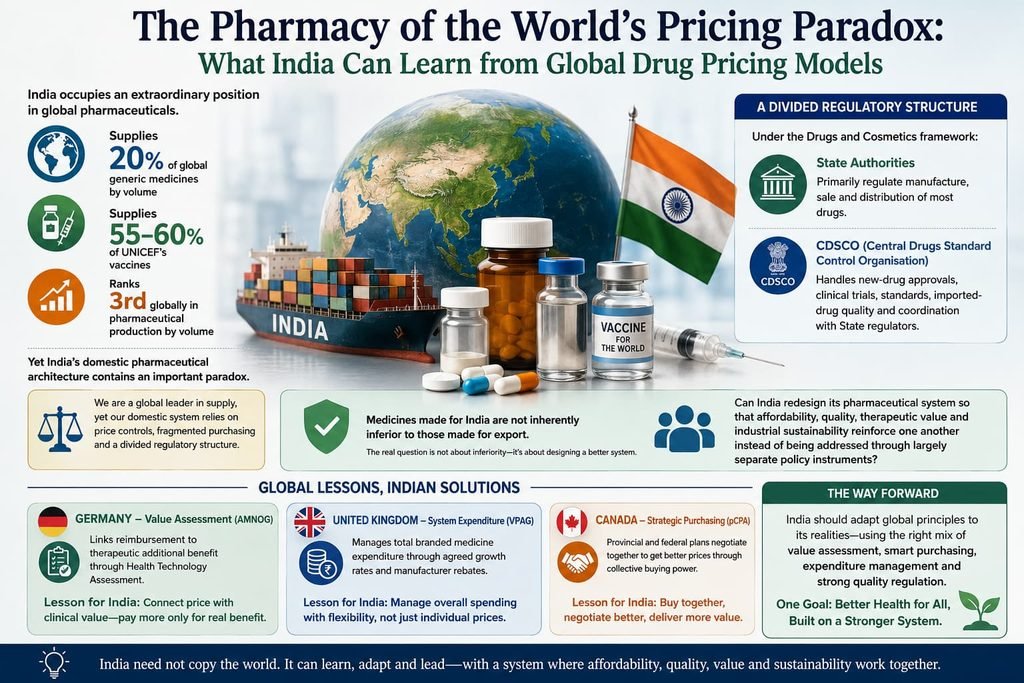
This does not mean that medicines made for India are inherently inferior to medicines made for export. Such a claim would be both inaccurate and unfair. The more defensible policy question is different:
Can India redesign its pharmaceutical system so that affordability, quality, therapeutic value and industrial sustainability reinforce one another instead of being addressed through largely separate policy instruments?
The experience of countries such as Germany, the United Kingdom and Canada offers useful lessons. But India should adapt their principles rather than import their systems wholesale.
India’s Current Pricing Model: An Important Clarification
India does not, as is sometimes suggested, primarily operate a cost-plus drug-pricing system.
Under the Drugs Prices Control Order, 2013, scheduled formulations are subject to ceiling prices determined using a market-based methodology. For medicines covered by the National List of Essential Medicines, the ceiling price is broadly calculated using the simple average price-to-retailer of brands with at least one per cent market share, with the prescribed retailer margin added.
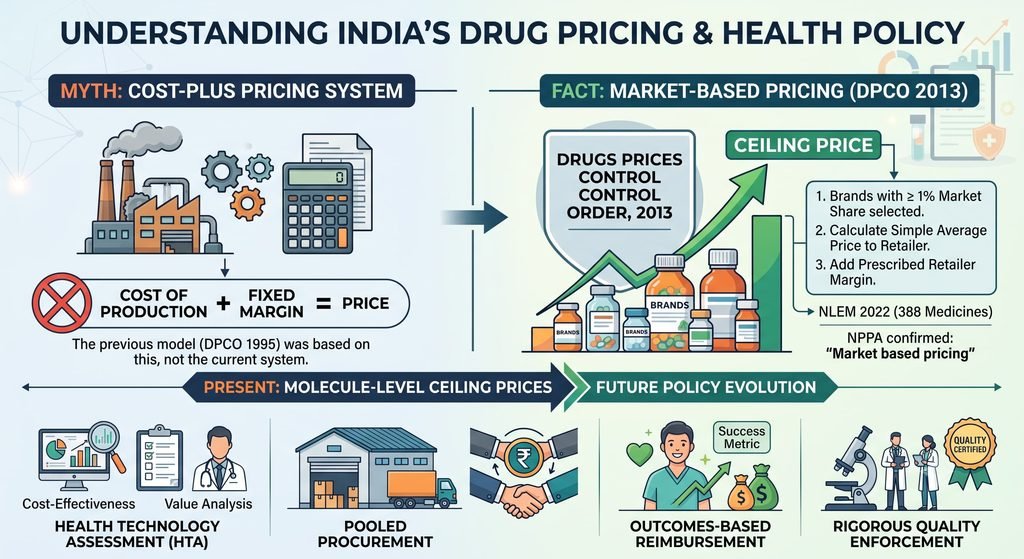
NPPA explicitly describes DPCO 2013 as based on “market-based pricing”.
NLEM 2022 contains 388 medicines, which form the basis for scheduled medicines brought under price control.
The policy debate, therefore, should not be framed as “cost-plus versus value-based pricing”.
The more meaningful question is whether a system centred heavily on molecule-level ceiling prices should gradually be complemented by stronger health-technology assessment, pooled procurement, outcomes-based reimbursement and much more rigorous quality enforcement.
That is where international experience becomes relevant.
1. From Price Alone to Therapeutic Value: The Lesson from Germany
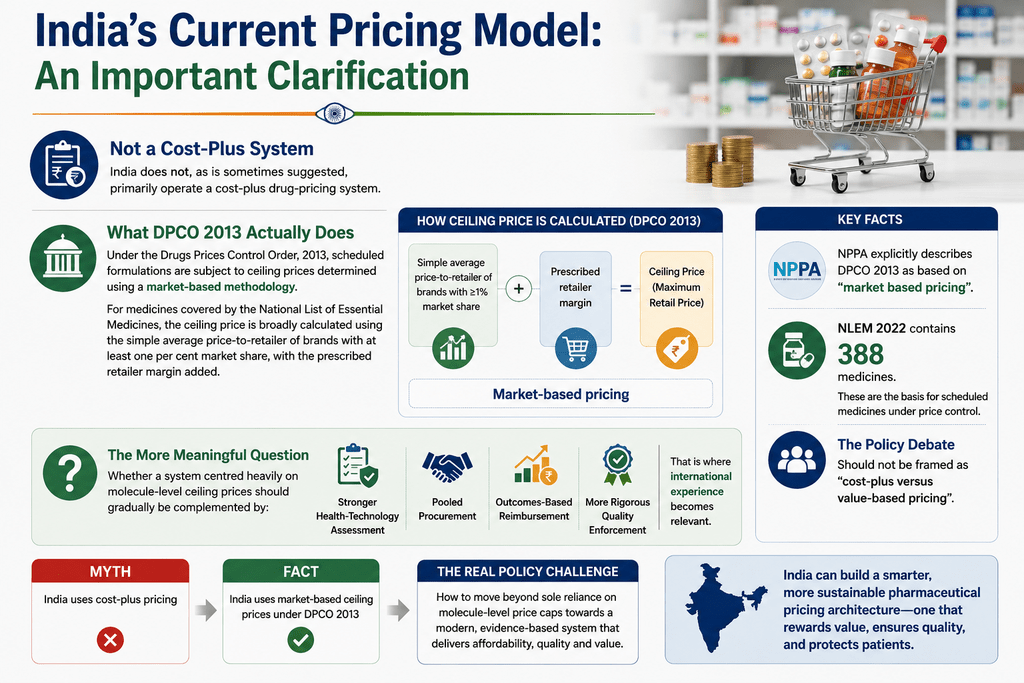
Germany’s AMNOG system offers perhaps the clearest lesson in separating regulatory approval from reimbursement value.
Under AMNOG, newly authorised medicines with new active ingredients undergo an early benefit assessment. The Federal Joint Committee, or G-BA, evaluates whether the medicine provides additional benefit compared with an appropriate comparator. IQWiG may undertake the scientific assessment. The outcome becomes an important basis for determining what Germany’s statutory health-insurance system will ultimately reimburse. This is fundamentally different from paying more simply because a manufacturer has better factories.
India should not create premium prices merely for complying with Good Manufacturing Practices. GMP compliance should be the minimum requirement for participating in the pharmaceutical market, not an optional attribute for which patients or governments pay extra. Nor should manufacturers receive price premiums merely for demonstrating bioequivalence where bioequivalence is already a regulatory requirement. The lesson India should take from AMNOG is instead this:
Therapeutic value and price should be more closely connected. Where a new medicine demonstrates meaningful additional clinical benefit over existing alternatives, the public reimbursement system may have a legitimate basis for accepting a higher price. Where no additional benefit is demonstrated, reimbursement should gravitate toward the cost of established alternatives. For mature multisource generics, competition and procurement may be more appropriate price-setting mechanisms than an AMNOG-style assessment.
That distinction is crucial. AMNOG is primarily a framework for evaluating additional therapeutic benefit. It is not a system for grading generic manufacturers according to manufacturing quality.
2. From Individual Prices to System Expenditure: The Lesson from Britain
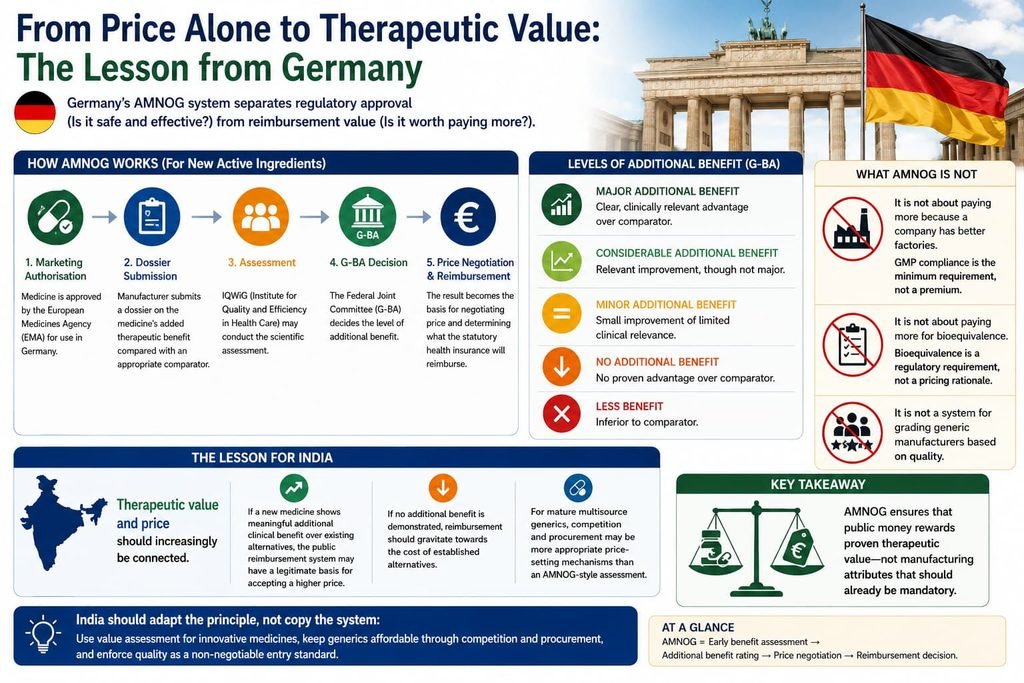
India’s pharmaceutical policy understandably focuses heavily on the price patients pay for individual medicines. But another question matters just as much: How much should the healthcare system spend on medicines overall? The United Kingdom offers an interesting model through the 2024 Voluntary Scheme for Branded Medicines Pricing, Access and Growth, or VPAG. VPAG is an agreement between the UK Department of Health and Social Care, NHS England and the Association of the British Pharmaceutical Industry. It seeks to balance patient access, NHS financial sustainability and life-sciences industry growth.
The scheme establishes allowed growth rates for measured sales of branded medicines and uses manufacturer payments to manage expenditure above the agreed trajectory. The allowed growth rate was set at 2 per cent for 2024, 3.75 per cent for 2025 and 2026, and 4 per cent for 2027 and 2028. For 2026, the headline VPAG payment percentage for eligible newer medicines was set at 14.5 per cent.
India cannot simply copy VPAG. Britain has a predominantly publicly financed healthcare system and a purchasing structure very different from India’s fragmented mix of private out-of-pocket expenditure, insurance, Central schemes and State procurement. Nevertheless, the principle is valuable. Governments do not necessarily have to control every pharmaceutical expenditure problem by continuously adjusting the price of every tablet. For selected publicly financed pharmaceutical categories, India could explore expenditure agreements that give manufacturers greater commercial predictability while allowing governments to recover expenditure when defined budgets or growth corridors are exceeded. Such approaches would be particularly relevant to expensive new therapies rather than inexpensive mature generics.
3. From Fragmented Buying to Strategic Purchasing: The Canadian Lesson
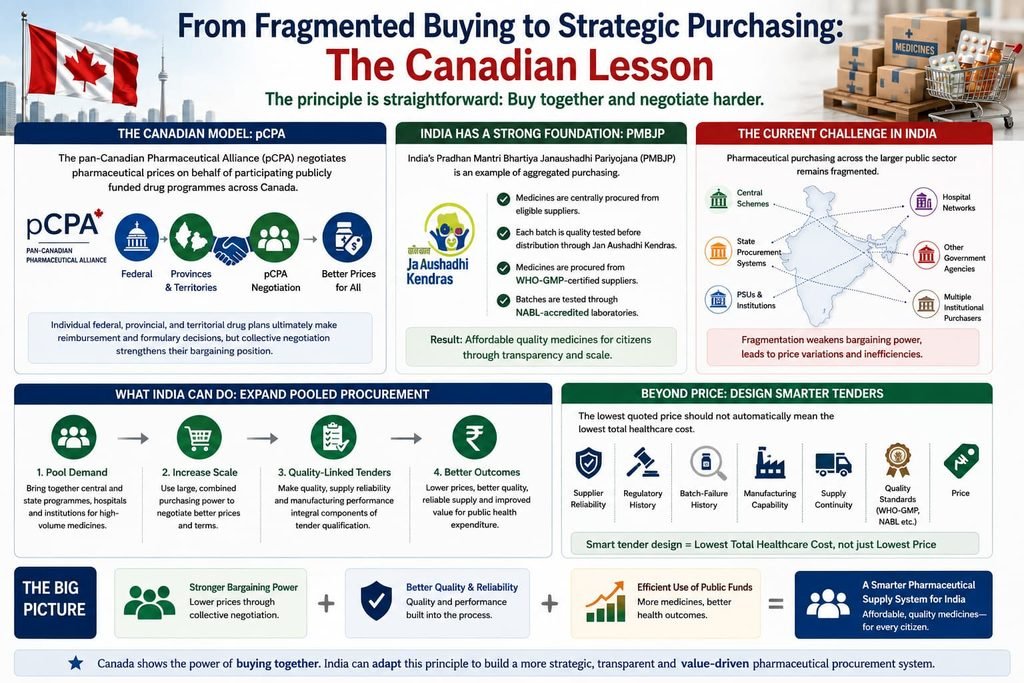
Canada provides another useful principle. The pan-Canadian Pharmaceutical Alliance, or pCPA, negotiates pharmaceutical prices on behalf of participating publicly funded drug programmes across Canada. Individual federal, provincial, and territorial drug plans ultimately make reimbursement and formulary decisions, but collective negotiation strengthens their bargaining position.
The principle is straightforward: Buy together and negotiate harder.
India already possesses examples of aggregated pharmaceutical purchasing, including the Pradhan Mantri Bhartiya Janaushadhi Pariyojana. Under PMBJP, medicines are centrally procured from eligible suppliers, and each batch undergoes quality testing before distribution through Jan Aushadhi Kendras. Official programme documents state that medicines are procured from WHO-GMP-certified suppliers and batches are tested through NABL-accredited laboratories.
But pharmaceutical purchasing across the larger Indian public sector remains spread among State procurement systems and multiple institutional purchasers. India could expand pooled procurement for appropriate high-volume medicines across participating government purchasers. This would allow the government to use purchasing power rather than retail price regulation alone to obtain lower prices. It would also create an opportunity to make quality, supply reliability and manufacturing performance integral components of tender qualification.
The lowest quoted price should not automatically mean the lowest total healthcare cost. Tender design can incorporate supplier reliability, regulatory history, batch-failure history, manufacturing capability, supply continuity and appropriate quality standards alongside price.
Quality Must Be a Gate, Not a Premium
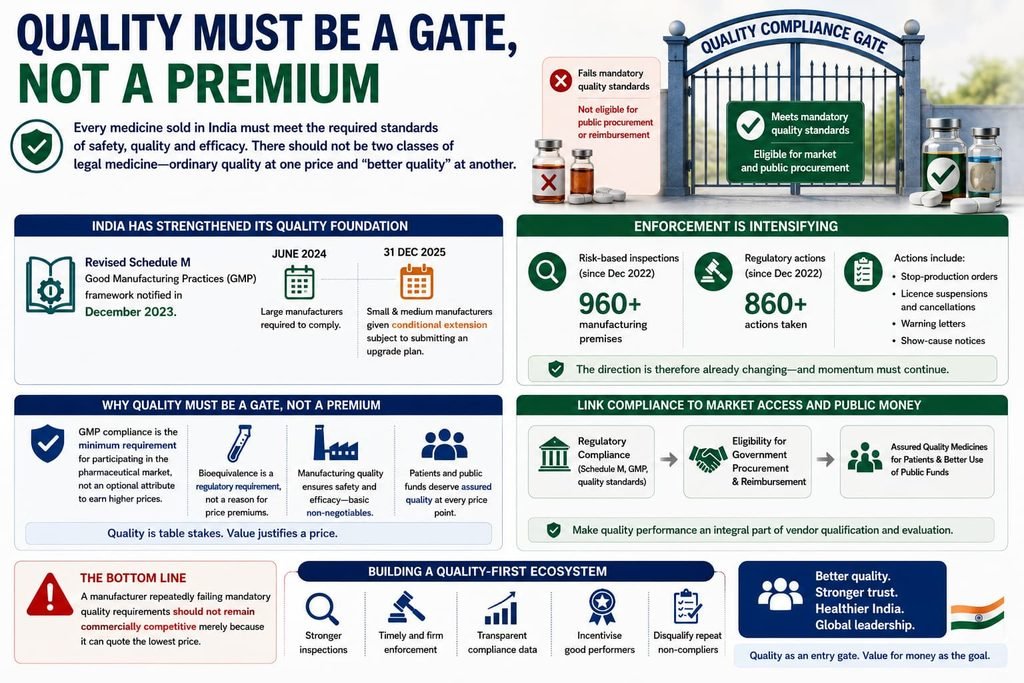
This is perhaps the most important distinction in any reform programme. India should not create two classes of legal medicine — ordinary quality at one price and “better quality” at another. Every medicine legally sold to a patient must meet the required standards of safety, quality and efficacy. India has already strengthened its manufacturing requirements through the revised Schedule M Good Manufacturing Practices framework notified in December 2023. Large manufacturers were required to comply from June 2024. Smaller and medium-sized manufacturers were subsequently given a conditional extension until 31 December 2025 subject to submitting an upgrade plan.
Enforcement is also intensifying. The Government reported in March 2026 that CDSCO and State authorities had conducted risk-based inspections of more than 960 manufacturing premises since December 2022 and had taken more than 860 regulatory actions, including stop-production orders, licence suspensions and cancellations, warning letters and show-cause notices. The direction is therefore already changing. The next step should be to connect regulatory compliance more systematically with eligibility for government procurement and reimbursement.
A manufacturer repeatedly failing mandatory quality requirements should not remain commercially competitive merely because it can quote the lowest tender price.
India Already Has an HTA Platform
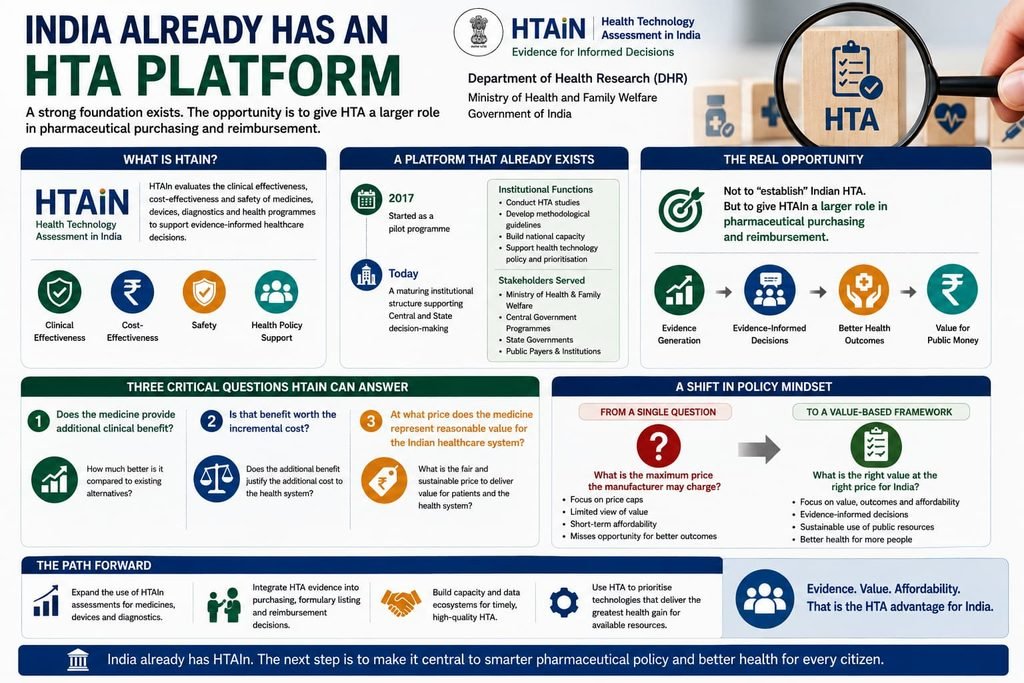
India does not need to create a health-technology assessment institution from scratch. Health Technology Assessment in India, or HTAIn, already operates under the Department of Health Research, Ministry of Health and Family Welfare. Its mandate includes evaluating the clinical effectiveness, cost-effectiveness and safety of medicines, devices and health programmes to support evidence-informed healthcare decisions.HTAIn began as a pilot programme in 2017 and has since developed into an institutional structure supporting Central and State decision-making. The opportunity is therefore not primarily to “establish” Indian HTA. It is to give HTA a larger role in pharmaceutical purchasing and reimbursement. India could progressively use HTAIn assessments to answer three questions:
Does the medicine provide additional clinical benefit?
Is that benefit worth the incremental cost?
At what price does the medicine represent reasonable value for the Indian healthcare system?
That would represent a significant shift from asking only: What is the maximum price the manufacturer may charge?
A Practical Reform Architecture for India
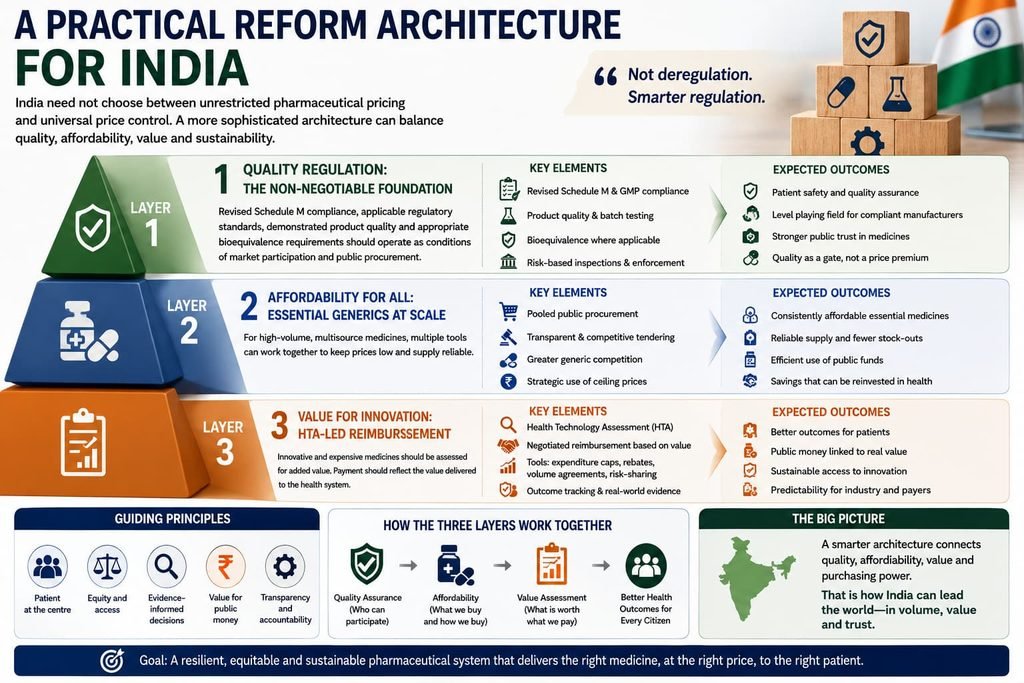
India need not choose between unrestricted pharmaceutical pricing and universal price control. A more sophisticated architecture could contain three distinct layers.
First, quality regulation should remain uncompromising. Revised Schedule M compliance, applicable regulatory standards, demonstrated product quality and appropriate bioequivalence requirements should operate as conditions of market participation and public procurement.
Second, mature essential generics should remain aggressively affordable. For high-volume multisource medicines, pooled procurement, transparent tendering, greater generic competition and strategically applied ceiling prices can coexist.
Third, innovative and expensive medicines should increasingly be subjected to HTA. Medicines demonstrating meaningful incremental benefit could receive negotiated reimbursement reflecting that value, potentially accompanied by expenditure caps, rebates, volume agreements or risk-sharing arrangements.
The objective, therefore, would not be deregulation for its own sake. It would be smarter regulation.
Comparing the Approaches
| Regulatory Dimension | India Today | Potential Reform Direction |
|---|---|---|
| Essential-medicine pricing | Ceiling prices for scheduled formulations under DPCO | Retain affordability safeguards while expanding pooled procurement |
| Pricing methodology | Primarily market-based ceiling pricing for scheduled formulations | Greater use of HTA and negotiated reimbursement for appropriate new therapies |
| Quality regulation | CDSCO and State regulatory responsibilities under national law | Stronger, more uniform enforcement and procurement consequences for non-compliance |
| Manufacturing standards | Revised Schedule M GMP requirements | Treat compliance as an eligibility threshold, not justification for a price premium |
| Public purchasing | Multiple Central, State and institutional procurement channels | Greater aggregation of purchasing where economically and operationally feasible |
| Innovative medicines | Pricing, market access and procurement mechanisms remain relatively separate | HTA-informed price and reimbursement negotiation |
| Budget management | Significant focus on individual medicine prices | Explore expenditure caps, rebates and outcome-linked agreements for selected therapies |
What India Should Not Copy
Global models should provide principles, not templates. Germany’s AMNOG works within Germany’s statutory health insurance architecture. Britain’s VPAG operates inside the NHS and applies to branded medicines. Canada’s pCPA coordinates negotiations among publicly funded drug programmes but is not literally a single national pharmaceutical procurement agency. India’s healthcare financing structure is fundamentally different from all three. India therefore needs an Indian model built around its own realities: very high out-of-pocket pharmaceutical expenditure, thousands of manufacturers, an enormous branded-generics market, Central and State regulatory responsibilities, multiple public purchasers and extreme differences in purchasing power among patients. The objective should not be to become Germany, Britain or Canada. It should be to borrow the mechanisms that solve specific Indian problems.
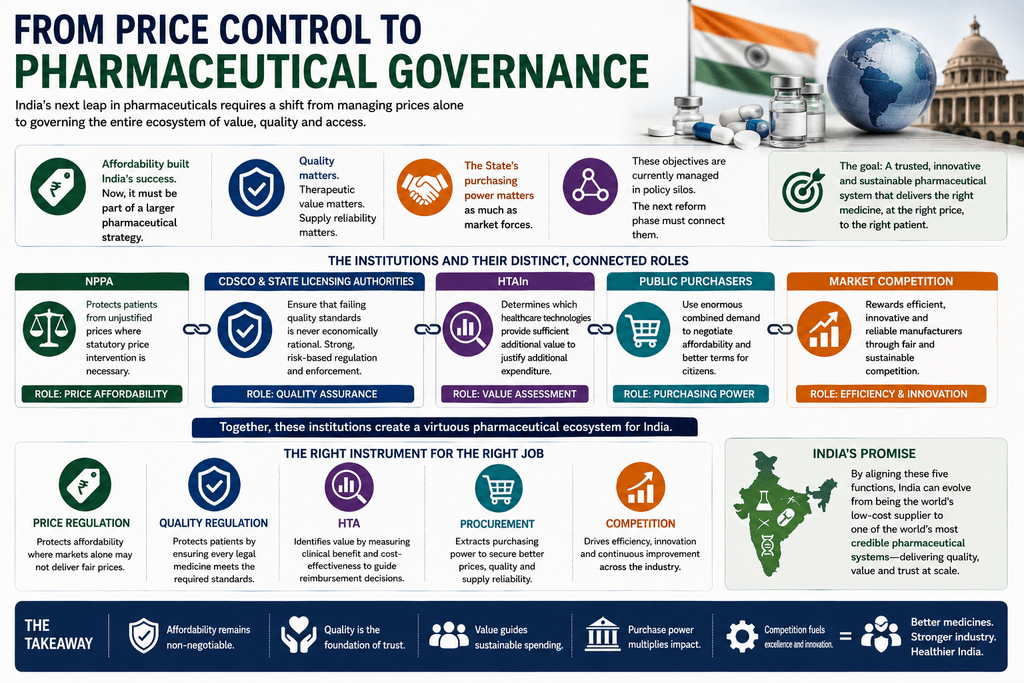
From Price Control to Pharmaceutical Governance
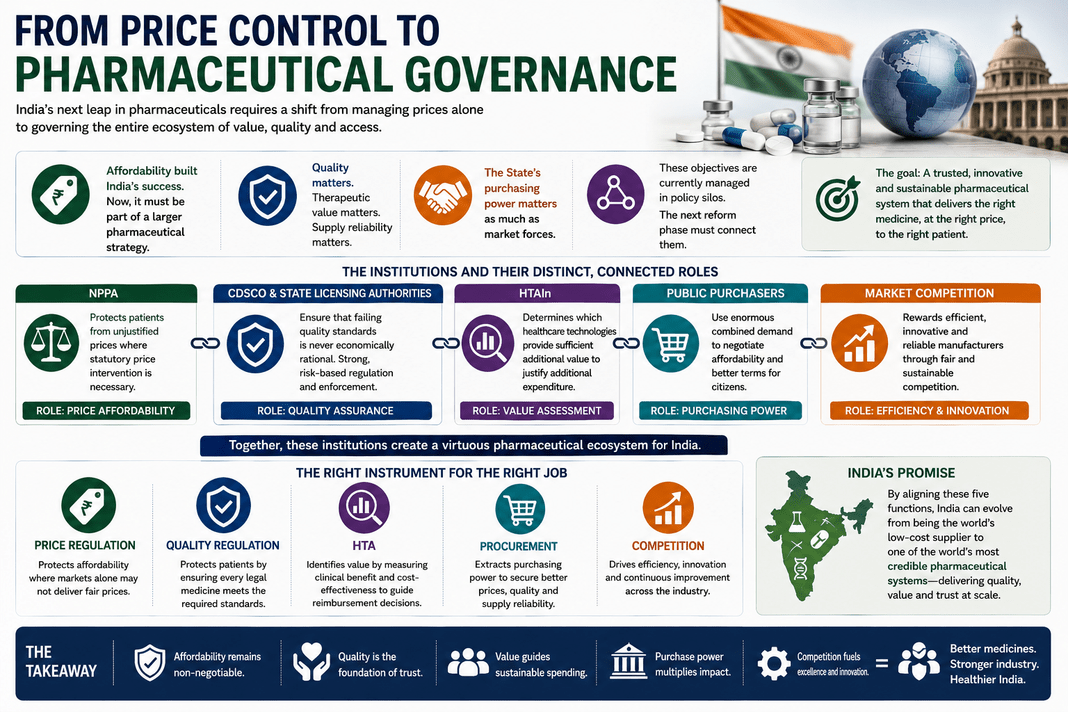
For decades, India’s pharmaceutical policy achievement has been affordability. That achievement should not be discarded. But affordability alone is no longer an adequate pharmaceutical strategy for a country seeking to move from leadership in generic volume to complex generics, biosimilars, biologics, and pharmaceutical innovation. The policy vocabulary, therefore, needs to expand.
Price matters. Quality matters. Therapeutic value matters. Supply reliability matters. And the State’s purchasing power matters. These objectives are currently managed through institutions that frequently operate in separate policy silos. The next generation of pharmaceutical reform should begin connecting them. NPPA can continue to protect patients from unjustified prices when statutory price intervention is necessary. CDSCO and State Licensing Authorities must ensure that failing quality standards is never economically rational. HTAIn can increasingly determine which healthcare technologies provide sufficient additional value to justify additional expenditure. And public purchasers can use their enormous combined demand to negotiate affordability rather than expecting retail price controls to carry the entire burden. That is the larger lesson from international pharmaceutical policy.
Affordability does not require abandoning markets. Nor does market competition eliminate the need for regulation. The challenge is to determine which instrument should perform which job. Price regulation should protect affordability. Quality regulation should protect patients. HTA should identify value. Procurement should extract purchasing power. And competition should reward efficient, reliable manufacturers. If India can align those four functions, the Pharmacy of the World can evolve from being predominantly the world’s low-cost supplier into one of its most credible pharmaceutical systems.

Appendix: Key Sources and Analytical References
- Government of India, Press Information Bureau, “India’s Pharma Edge: Scaling Manufacturing and Exports”, August 2026. India ranks third globally by pharmaceutical volume and supplies approximately 20 per cent of global generic medicines.
- Government of India, Press Information Bureau, “India’s Transformation into a Global Health Powerhouse”, March 2026. Reports approximately 20 per cent of global generic supply and 55–60 per cent of UNICEF vaccine supply.
- National Pharmaceutical Pricing Authority, Government of India, DPCO 2013 and proactive disclosure material. Confirms that DPCO 2013 uses market-based pricing and describes the methodology for scheduled formulations.
- Federal Joint Committee, Germany, “Benefit Assessment of Medicinal Products”. Official description of the AMNOG early-benefit-assessment process and its relationship to reimbursement pricing.
- UK Department of Health and Social Care, “2024 Voluntary Scheme for Branded Medicines Pricing, Access and Growth”. Sets out VPAG objectives, permitted expenditure growth and payment mechanisms.
- UK Department of Health and Social Care, “VPAG Payment Percentage for 2026”, December 2025. Sets the 2026 headline payment percentage for eligible newer medicines at 14.5 per cent.
- Government of Canada and Patented Medicine Prices Review Board. Description of the pan-Canadian Pharmaceutical Alliance and its role in negotiating prices on behalf of publicly funded drug programmes.
- Department of Health Research, Ministry of Health and Family Welfare, Health Technology Assessment in India. HTAIn mandate, institutional structure and objectives covering clinical effectiveness, cost-effectiveness, safety and health-policy decision-making.
- Ministry of Health and Family Welfare, Government of India, revised Schedule M implementation documents. Revised GMP requirements were notified in December 2023, with transitional implementation provisions for different manufacturer categories.
- Ministry of Health and Family Welfare, Government of India, “Steps taken to ensure drug quality and curb counterfeit medicines”, March 2026. Reports more than 960 risk-based inspections and more than 860 regulatory actions since December 2022.
- Department of Pharmaceuticals, Government of India, PMBJP documentation. Describes procurement from WHO-GMP-certified suppliers and batch testing through NABL-accredited laboratories.
- CDSCO, Government of India: official functions and responsibilities. Describes the division of regulatory functions between Central and State drug authorities.