
Thursday, June 18, 2026
24.5 C
Bengaluru

Navigating the Jungle: How to Turn Field Chaos Into Your Brand’s Competitive Advantage

To navigate chaos, you first need to know who you are dealing with. Not all doctors are the same, and treating them as a uniform segment is the fastest route to rejection in the field.

The head office loves building neat, macro-segmented brand plans based on clean, clinical criteria. But the medical representative (MR) marching through a crowded clinic doesn’t see clean segments; they see a chaotic waiting room, a shrinking access window, and a distracted clinician.

To bridge this disconnect, field forces need a rapid triage tool—a mental shortcut to decide what to say, how to say it, and whether to stay or move on, all within a 45-second window.


The Customer Quadrant™

Use this behavioural framework to classify and approach every doctor on your beat:

QuadrantDoctor TypeBehavioral TraitsThe Strategic Field Approach
CCost-Conscious
(Value-Seeker)
Prescribes generics, is highly samples-driven, and is intensely price-sensitive.Focus on cost-effectiveness, free samples, and patient affordability programs. Do not waste precious time on premium brand stories.
SSophisticated
(Opinion Leader)
Reads international journals, attends global conferences, and demands robust evidence.Present high-quality clinical data, real-world evidence (RWE), and Key Opinion Leader (KOL) endorsements. They respect intellectual depth.
DDifficult
(Gatekeeper)
Hard to access, dismissive, time-poor, and chronically overbooked.Drop the product pitch entirely. Deliver immediate utility—patient aids, quick-reference diagnostic cards, and time-saving tools. Earn trust through respect, not persistence.
HHigh Ticket
(High-Volume)
Writes large script volumes and routinely sees 80+ patients per day.Protect this relationship at all costs. Prioritize seamless access, highly personalized support, and proactive problem-solving. They are your core revenue engine.

Which Customer Do We Want?

The honest answer: All of them—but differently.

  • S and H are your strategic anchors. Invest a disproportionate amount of time, clinical bandwidth, and marketing resources here.
  • C requires transactional efficiency, not scientific depth. Swift sample drops and clear affordability messaging work best.
  • D demands extreme patience and tactical utility. They open up the moment you stop selling a drug and start solving their administrative headaches.

Face the Reality: Helping the Field Force Adapt

How can pharmaceutical marketing and sales leaders better support their teams on the ground? It requires three fundamental shifts in perspective:

  1. From “Product Pitching” to “Micro-Contextual Relevance”If an MR only has a 45-second window in a chaotic environment, they cannot deliver a macro brand message. They need high-impact “capsule messages” tailored to exactly what that specific doctor is facing that day, filtered through their behavioral quadrant.
  2. Solve the Doctor’s Chaos, Don’t Just Sell a DrugClinicians restrict access because they are overwhelmed by high patient volumes and acute time poverty. If marketing shifts from creating promotional brochures to creating utility assets—like simplified patient compliance checklists—that save the doctor time, the door opens naturally.
  3. Move from Rigid KPIs to “Agile Autonomy”Corporate systems demand rigid call metrics, but chaos requires the freedom to pivot. Sales management must empower the field force to dynamically adapt their routes and strategies on the ground without being penalized by an inflexible plan.

If we want our teams to thrive, we have to stop building beautiful maps for a jungle that doesn’t exist, and start giving them the agility to navigate the jungle they actually march through every day.

The Remedy: From “Planning for Control” to “Engineering for Flow”

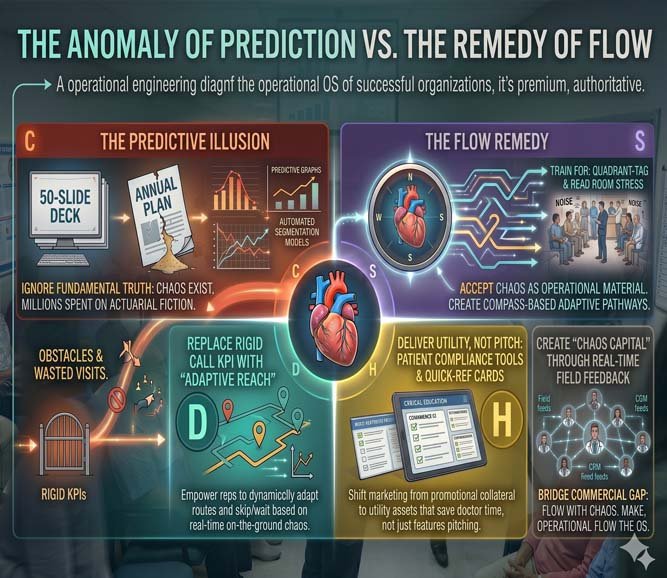
Diagnosing this structural disconnect is only step one. The real challenge is establishing a systemic remedy: we must stop treating chaos as a bug in the pharmaceutical sales model and start treating it as the operating system.

This requires shifting our commercial execution away from rigid planning and toward operational flow. Here are five practical ways to engineer that shift.

1. Replace the “Brand Plan” with “Battle Rhythms”

Annual brand plans are often actuarial fiction in a volatile market; by month three, they are obsolete. Instead, transition to a dynamic, 10-day battle rhythm:

  • Friday: Field inputs regarding changing doctor access, sudden patient walk-in surges, and localized competitor tactics are uploaded via the CRM.
  • Monday Morning: Marketing synthesizes this data into a brief “Chaos Report” highlighting three micro-opportunities and two emerging obstacles.
  • The Execution: No 50-slide decks, no quarterly re-forecasts—just highly adaptive tactics.

Applying the Quadrant Lens: The brief should feature quadrant-specific intelligence. For example: “This week, Dr. Patel (S) is attending the national cardiology conference—share the new trial data. Dr. Rao (D) has a new outpatient schedule—bring the patient diary tool, not the pitch.”

2. Train for “Chaos Fluency,” Not Just Product Mastery

Most sales training modules assume a calm, deeply attentive clinician sitting across a quiet desk. That is delusional. Instead, corporate training must pivot to waiting-room simulations:

  • Reps practice under constraints: a 35-second limit, simulated background noise, and constant interruptions.
  • Reps learn to read a room’s real-time stress levels (e.g., Is the nurse short-staffed? Is the waiting room overflowing?) and deliver a single sentence of utility rather than an academic product feature.

Applying the Quadrant Lens: Reps are trained to quadrant-tag every doctor before entering the room so their opening lines align perfectly with the clinician’s immediate mindset:

  • C: “Doctor, we have introduced a new patient assistance program that lowers out-of-pocket therapy costs.”
  • S: “Doctor, the latest major meta-analysis supports our molecule’s efficacy—here is the two-sentence data summary.”
  • D: “Doctor, I know you are packed today. Here is a 30-second tool that reduces your team’s follow-up compliance calls.”
  • H: “Doctor, we have successfully restocked your clinical samples and assigned a dedicated helpline for your chronic patients.”

3. Move Past the Rigid Call Frequency KPI

The traditional commercial model dictates: “See Dr. Sharma exactly six times this quarter.” But what if Dr. Sharma is entirely unreachable in week two, yet highly accessible in week four? Rigid, automated targets actively punish street-smart, tactical adaptation.

Instead, companies should measure adaptive reach. Did the rep find someone highly valuable in that ecosystem—a nurse, a junior doctor, or a patient counselor—and deliver relevant assistance? Did they recognize when to skip a blocked call, pivot, and return at 2:00 PM when the morning rush subsided?

Applying the Quadrant Lens: Quadrant H and S doctors warrant higher, data-driven frequency; Quadrant C and D require high-impact quality over pure quantity. A single, perfectly timed, quadrant-relevant interaction always beats six forced, wasted visits.

4. Embed Brand Teams in Field Chaos

Once a quarter, every brand manager should spend two full days riding alongside a field representative. No corporate laptops, no checking emails—just sitting on waiting-room benches, experiencing access rejection, and watching prescriptions get written in frantic 20-second windows.

The new head-office rule should be simple: You cannot propose a new marketing or brand tactic until you have personally experienced access failure three times in a single day. That operational humility changes how collateral is designed.

Applying the Quadrant Lens: Following the field visit, marketing must map their field observations directly to behavioral profiles: “I observed three D-type clinicians today; they all flatly refused brand samples but eagerly accepted a practical patient checklist. Why aren’t we allocating more budget to creating these utilities?”

5. Build “Chaos Capital” Through Real-Time Insights

Most traditional CRM systems act as graveyards for historical, lagging data. To counter this, commercial organizations need to leverage lightweight mobile channels where reps can broadcast immediate, real-time insights:

  • “Dr. Mehta has shifted outpatient hours to 4:00–6:00 PM only.”
  • “Hospital security has tightened; mandatory institutional ID required at the gate.”
  • “Competitor X is currently running a free localized diagnostics camp nearby.”

Applying the Quadrant Lens: Track behavioral shifts in real time. For example: “Dr. Sen (S) has begun asking explicit questions regarding patient out-of-pocket expenses—signaling a shift toward a C-type profile. Adjust messaging accordingly.” Marketing’s role shifts from long-term prediction to real-time broadcasting, allowing the entire commercial team to adapt in unison.

Conclusion: Mastering the Jungle

The structural anomaly in pharma is not that chaos exists. The anomaly is that companies continue to spend millions on long-range predictive analytics and rigid segmentations while ignoring the fundamental truth every field officer knows: You do not control the jungle. You learn its patterns, move lightly, and carry something genuinely useful every single time you step into it.

The Customer Quadrant™ does not try to predict the jungle; it serves as a reliable compass to help field forces decide, in real time, exactly which path to take. The organisations that successfully bridge the commercial gap won’t be those with the most elaborate head-office plans—they will be the ones that accept chaos as their raw operational material and build a system designed to flow smoothly with it.

📚 Appendix: Strategic Insights & Industry Sources

To anchor this framework within broader pharmaceutical management trends, sales leaders and brand managers can cross-reference these validated industry insights and methodologies:

  • Micro-Contextual Messaging & Time Poverty: The concept of the “45-second window” aligns directly with global physician access trends documented by Veeva Systems in their ongoing Pulse Field Trends Reports. Their data consistently confirms that while physical access to clinicians remains viable, the duration of meetings has systematically decreased, making concise, high-utility interactions mandatory.
  • The Power of Utility in Pharma Marketing: Shifting from pure detailing to offering practical clinical utility (e.g., patient aids, checklists) is rooted in modern Value-Based Care (VBC) commercial strategies. Research from McKinsey & Company on pharmaceutical launch excellence frequently highlights that brands providing comprehensive ecosystem support—rather than just a product features pitch—achieve significantly higher long-term physician loyalty.
  • Agile Commercial Models vs. Rigid KPIs: The critique of rigid, frequency-driven KPIs mirrors the shift toward Agile Commercial Models in Pharma pioneered by firms like ZS Associates and the Boston Consulting Group (BCG). These firms advocate for replacing static CRM activity metrics (e.g., standard call frequencies) with dynamic, multi-channel impact tracking that rewards field force responsiveness and regional autonomy.
  • Ethnographic Field Work for Marketers: The practice of embedding brand managers into the field force is an adaptation of commercial ethnography. In business frameworks like Design Thinking (popularized by Harvard Business School and IDEO), direct user empathy—in this case, experiencing the rep’s and doctor’s actual environments—is considered the single most effective way to eliminate friction from commercial collateral design.

Author’s Note: This article builds on my earlier article: Why Pharma Field Force Fails: The Missing MAP of Motivation https://medicinman.net/2026/06/why-pharma-field-force-fails-the-missing-map-of-motivation/ via @MedicinMan

Watch Deep Bhandari’s session on the MedicinMan YouTube channel → https://www.youtube.com/watch?v=0mzpS2ip_j8

Hot this week

Cipla appoints Shivam Puri as CEO of One India Business

Shivam Puri has been appointed Chief Executive Officer of...

Mounjaro Upends Semaglutide Gold Rush: IPM May 2026

1. The Eli Lilly & Mounjaro Disruption: A New...

Why Pharma Field Force Fails: The Missing MAP of Motivation

Executive Summary Most healthcare organizations fail at execution, not...

Online Pharmacy:Modest but Accelerating Share of the Retail Pharma Market

India’s pharmaceutical retail landscape remains one of the world’s...

Topics

Cipla appoints Shivam Puri as CEO of One India Business

Shivam Puri has been appointed Chief Executive Officer of...

Mounjaro Upends Semaglutide Gold Rush: IPM May 2026

1. The Eli Lilly & Mounjaro Disruption: A New...

Why Pharma Field Force Fails: The Missing MAP of Motivation

Executive Summary Most healthcare organizations fail at execution, not...

Online Pharmacy:Modest but Accelerating Share of the Retail Pharma Market

India’s pharmaceutical retail landscape remains one of the world’s...

Will Paras IPO Disrupt Non-Metro Hospitals Like Mankind Pharma?

India's next healthcare opportunity may not be in the...

Not Everything is a Problem to be Solved

As professionals, we are conditioned to be "fixers." We...

Indian Pharma: The Marketing – Field Disconnect and Its Remedy

The Anomaly Unless you learn to accept that chaos is...
spot_img

Related Articles

spot_imgspot_img