
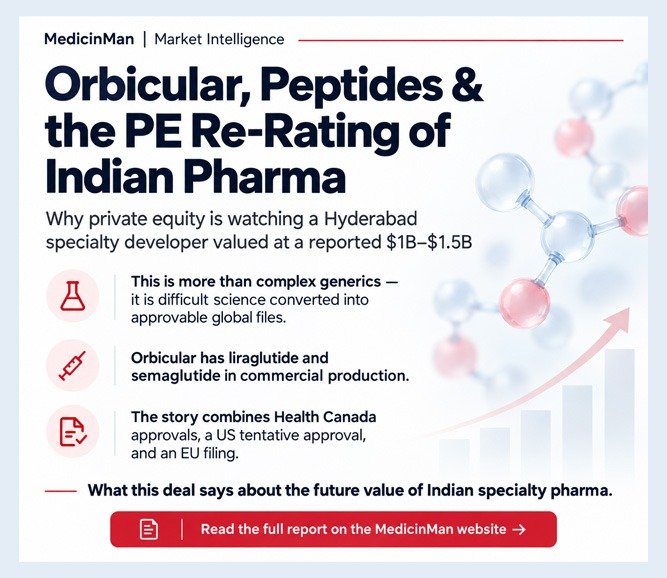

Private equity does not pay a billion-dollar multiple simply because a company describes itself as a “complex generics” player. It pays when scientific complexity has been converted into regulatory approvals, commercial capability and assets that can travel across major global markets.
That is what makes Orbicular Pharmaceutical Technologies worth watching.
Warburg Pincus and CVC Capital Partners have reportedly begun evaluating the Hyderabad-based specialty developer, with Jefferies advising on a potential stake sale. Tata Capital Healthcare Fund may seek a partial or full exit, while early reports place Orbicular’s valuation in the $1 billion to $1.5 billion range. The process remains at an early stage and nothing has yet been signed.
But the more important story is what sits behind that valuation.
Orbicular has moved beyond the traditional complex-generics model into GLP-1 peptides, with liraglutide and semaglutide already in commercial production. Its semaglutide programme has secured Health Canada approvals, an FDA tentative approval for generic Ozempic in the US, and an EU filing, supported by a development and manufacturing ecosystem spanning Orbicular, Apotex and OneSource Specialty Pharma.
The implication extends well beyond one transaction. It raises a larger question for Indian pharma: What happens to valuations when India moves from manufacturing scale to owning difficult science, regulatory files, devices and peptide-development capability?
MedicinMan examines the Orbicular story, the economics behind the proposed valuation, the GLP-1 opportunity, the risks PE investors will scrutinise, and what this transaction could signal about the next phase of Indian specialty pharma.
Read the full MedicinMan Market Intelligence report →
https://medicinman.net/storage/2026/09/MedicinMan_Orbicular_Peptides_PE_15Sep2026.pdf