
The Two-Tier Reality of Indian Pharma: Patient Safety, Pharmacovigilance, and the Regulatory Divide
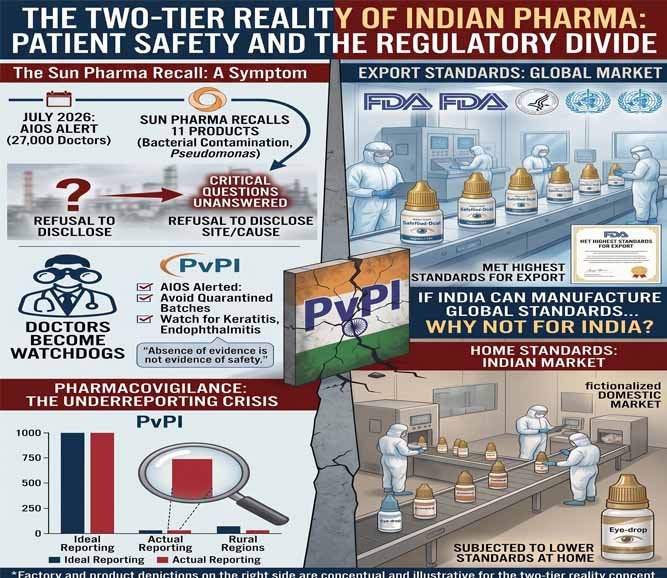
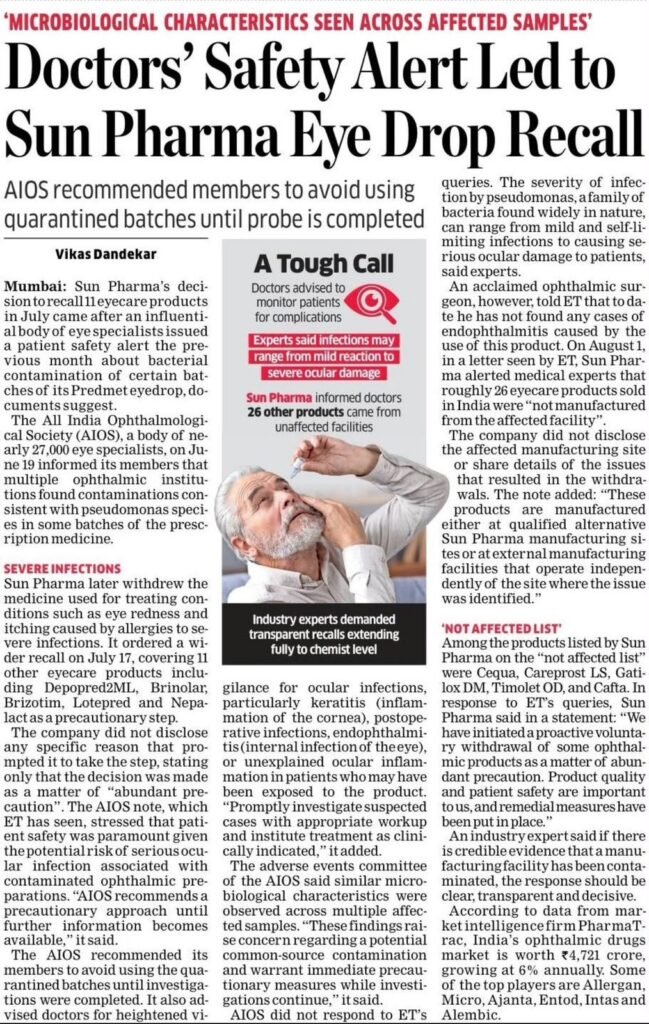
In July 2026, Sun Pharma recalled eleven eye care products after the All India Ophthalmological Society (AIOS) – a body of nearly 27,000 eye specialists – issued a patient safety alert about bacterial contamination consistent with pseudomonas species in certain batches of its Predmet eye drop. The company later expanded the withdrawal, calling it a matter of “abundant precaution”.
Yet weeks later, critical questions remain unanswered. Sun Pharma confirmed that 26 other products were “not manufactured from the affected facility” but refused to disclose which site was contaminated or the root cause. Industry experts have called this response inadequate: “if there is credible evidence that a manufacturing facility has been contaminated, the response should be clear, transparent and decisive,” one expert told ET.
This incident is a microcosm of deeper systemic failures in India’s pharmaceutical ecosystem – failures that span patient safety, drug safety monitoring, and regulatory oversight. It forces a question that Anup Soans, editor of MedicinMan, has been asking for years: If India can manufacture medicines that meet the world’s toughest standards for export, why are Indian patients subjected to lower standards at home?
Patient Safety at Risk: When Doctors Must Become Watchdogs
The Sun Pharma case reveals a troubling pattern: it took an independent body of doctors, not the company or the regulator, to identify a potential public health threat. The AIOS had to step in, recommending members avoid quarantined batches and heighten vigilance for keratitis, endophthalmitis, and unexplained ocular inflammation.
The severity of pseudomonas infections can range from mild to causing serious ocular damage, yet no confirmed cases have been reported so far. But the fact that clinicians had to become de facto safety monitors highlights a broken system. As one acclaimed ophthalmic surgeon noted, to date he has found no cases of endophthalmitis caused by the product. But absence of evidence is not evidence of safety – and the lack of robust pharmacovigilance means we may never truly know.

Pharmacovigilance in India: The Underreporting Crisis
India established the Pharmacovigilance Programme of India (PvPI) to detect, assess, and prevent Adverse Drug Reactions (ADRs). Yet ADR underreporting remains a critical challenge, particularly in rural and underserved regions.
A recent visit to over 15 pharmacies in Tiruchy found that more than half had failed to display a mandatory QR code – mandated by the CDSCO in December 2025 – enabling the public to report suspected ADRs directly. This is not a failure of technology; it is a failure of enforcement. As one doctor put it: “If reporting tools are not visible at pharmacies – the first point of contact – adverse reactions will continue to be under-reported.”
The barriers to effective pharmacovigilance in India mirror those seen in other low- and middle-income countries: lack of training and infrastructure, cultural barriers, resource limitations, and fragmented regulatory systems. Many organisations are not well-versed in new technologies and use outdated systems that lead to poor reporting of adverse events. A lack of workforce for pharmacovigilance functions leads to missed signals, and pharmacists often lack intrinsic motivation to take on additional reporting responsibilities.
While countries like Nigeria have addressed underreporting through nationwide training programs, and Ghana has modernised ADR reporting through international partnerships, India’s efforts remain piecemeal.
The Regulatory Divide: Two Standards, One Industry
Perhaps the most uncomfortable truth about Indian pharma is the regulatory asymmetry that allows two parallel quality realities to coexist.
When Indian companies supply medicines to the United States, they operate under the USFDA’s demanding jurisdiction, demonstrating strict compliance with current Good Manufacturing Practices (cGMP), full data integrity, and readiness for unannounced inspections. Failure is costly and public: warning letters, import alerts, plant shutdowns, and loss of market access.
By contrast, medicines sold exclusively in India fall under the CDSCO and state drug authorities. While India’s legal framework recognises quality standards, enforcement intensity, inspection frequency, and evidentiary requirements have historically been uneven. Anup Soans has highlighted this divergence, noting that even within the same company, medicines for the Indian market may use different API sources, different manufacturing sites, and face fewer requirements to prove equivalence and ongoing quality.
This is not a question of illegal production – it is differential regulatory expectations by destination market. And it creates unequal confidence. As Soans asks: “If India wants to be the ‘pharmacy of the world,’ one question must be asked: should Indian patients accept lower standards than patients abroad?”
This divergence is not rooted in scientific incapacity, but in regulatory asymmetry, enforcement gaps, and market incentives that allow two parallel quality realities to coexist.

Learning from Others: China’s Regulatory Evolution
While India’s pharmacovigilance system struggles with underreporting and enforcement gaps, China has made substantial progress in modernising its drug safety framework. China’s National Adverse Drug Reaction Monitoring Centre reported significant increases in the number of ADR reports and ongoing optimisation of the monitoring network.
China’s regulatory approach has several strengths India can learn from:
First, legal codification. China’s recent revisions to its “Provisions for Adverse Drug Reaction Reporting and Monitoring” are grounded in the Drug Administration Law, which explicitly requires the state to “establish a pharmacovigilance system.” This provides a strong legal mandate.
Second, phased strengthening. China has revised its ADR provisions multiple times – in 1999, 2004, 2011, and beyond – with each iteration expanding reporting requirements, strengthening supervision, and enhancing risk control.
Third, focus on key populations. China is prioritising medication safety for vulnerable groups such as children and the elderly, and strengthening lifecycle supervision for high-risk drugs like novel antitumor agents and biologics.
Fourth, technological integration. China is working to integrate IT and AI technologies into monitoring. Chinese researchers have launched the “Inquiring Drug Safety (iDS)” platform, an online service that provides drug safety information and personalised interactive counselling for physicians, pharmacists, researchers, regulators, and the public. The platform includes over 2.7 million items of drug information, 18,754 searchable drugs and health products, and uses artificial intelligence for drug identification. However, China’s system is not without challenges – inadequate participation by reporting entities and slow progress in information technology remain issues.

What India Must Do: From Reactive to Proactive Safety
India’s pharmaceutical industry is a global powerhouse, with the domestic ophthalmic drugs market alone valued at Rs 4,721 crore, growing at 6 per cent annually. But market size must be matched by market accountability.
The Indian government has taken some steps. Risk-based inspections of more than 960 drug manufacturing premises have been conducted since December 2022, resulting in more than 860 regulatory actions for non-compliance. The government has revised Schedule M for Good Manufacturing Practices, mandated QR codes on the top 300 drug formulation brands, and introduced the SUGAM labs portal to digitise drug testing. The Parliamentary panel has commended the effectiveness of the risk-based inspection program but has also flagged concerns about significant manpower gaps in the regulatory workforce.
Yet more is needed. Specifically:
First, close the regulatory divide. The CDSCO must apply the same rigorous standards to domestically consumed medicines as are required for exports. As Anup Soans has argued, “Stronger domestic regulation is not anti-industry. It is pro-patient and pro-trust”.
Second, strengthen pharmacovigilance infrastructure. India must move beyond passive, under-resourced ADR reporting. This means mandatory training for healthcare workers on ADR reporting, the integration of ADR reporting systems to expand coverage, especially in rural areas, and public awareness campaigns to overcome cultural barriers.
Third, enforce existing mandates. The QR code mandate for pharmacies is a good idea, but compliance must be enforced with penalties. Without consequences, such measures remain aspirational.
Fourth, mandate transparency in recalls. Companies like Sun Pharma must be required to disclose affected manufacturing sites and root causes – not hide behind “abundant precaution” language. Transparency is not optional; it is the foundation of trust.
Fifth, empower patients as safety partners. Patient engagement in pharmacovigilance is low across LMICs, but examples from South Africa show that mobile-friendly reporting tools can significantly increase involvement. India should adopt similar patient-centric approaches. Additionally, pharmacovigilance training should be integrated into medical and pharmacy curricula to build a culture of safety reporting from the ground up.
Conclusion: Safety Cannot Be a Two-Tier Commodity
The Sun Pharma recall is a warning. It shows what happens when patient safety depends on doctors sounding alarms rather than robust regulatory oversight. It reveals a pharmacovigilance system crippled by underreporting and weak enforcement. And it exposes a regulatory schism in which Indian patients receive lower-quality vigilance than patients in the US or Europe.
India has proven it can manufacture medicines that meet the world’s highest standards when the market demands it. It is time to demand that same standard for Indian patients. As Anup Soans rightly observes: “This divergence is not rooted in scientific incapacity, but in regulatory asymmetry, enforcement gaps, and market incentives that allow two parallel quality realities to coexist.”
The question is not whether India can do better – it is whether India will.

Appendix: Sources and Further Reading
1. ET Pharma / The Economic Times. (August 2026). “Doctors’ Safety Alert Led to Sun Pharma Eye Drop Recall.” Detailed reporting on the Sun Pharma recall timeline and AIOS safety alert.
2. Soans, A. (February 2026). “US vs India: Regulatory Differences for Generics.” LinkedIn post via MedicinMan, highlighting the “two regulatory universes”.
3. Chinese Journal of Pharmacovigilance. (2025). “Takeaways from the National Annual Reports on Adverse Drug Reaction Monitoring (2020-2024)” – analysis of China’s pharmacovigilance progress and challenges.
4. Chinese Journal of Pharmacovigilance. (2025). “Revision of the Provisions for Adverse Drug Reaction Reporting and Monitoring” – legal evolution of China’s pharmacovigilance framework.
5. Doomra, R., Inder, D., & Kumar, P. (2025). “Way forward to pharmacovigilance and adverse drug reaction monitoring in India: A critical review.” Journal of Integrative Medicine and Research – overview of PvPI and ADR tools.
6. Pharmacovigilance Programme of India (PvPI) – India’s national ADR monitoring framework, backed by WHO’s Uppsala Monitoring Centre.
7. The New Indian Express. (January 2026). “Compliance to QR code mandate for reporting drug reactions patchy among Tiruchy pharmacies” – enforcement gaps in India’s ADR reporting infrastructure.
8. Pandit, N., Mahavarakar, V., Narwane, S. et al. (2026). “Dawn of Community Pharmacovigilance-A Scope and Opportunity in India.” Journal of Young Pharmacists – grassroots pharmacovigilance potential.
9. PIB Release. (March 2026). “Steps taken to ensure drug quality and curb counterfeit medicines” – CDSCO regulatory measures and enforcement data.
10. Uppsala Reports. (December 2025). “Chinese researchers launch new drug safety platform” – China’s iDS platform for pharmacovigilance.
11. Insights / Pink Sheet. (April 2026). “India Must Institutionalise Risk-Based Inspections, Harness AI For Pharmacovigilance, Says Panel” – Parliamentary committee report on regulatory gaps.
12. James, J. (2024). “Empower Future Professionals: Integrate Pharmacovigilance Training for a Safer Healthcare Tomorrow.” Asian Journal of Pharmaceutical Research and Health Care – training gaps in pharmacovigilance.