
Monday, August 10, 2026
26.5 C
Bengaluru

The Anatomy of a Miscalculation: Why Maharashtra’s Homeopathic Prescription Policy Defies Global Medical Standards

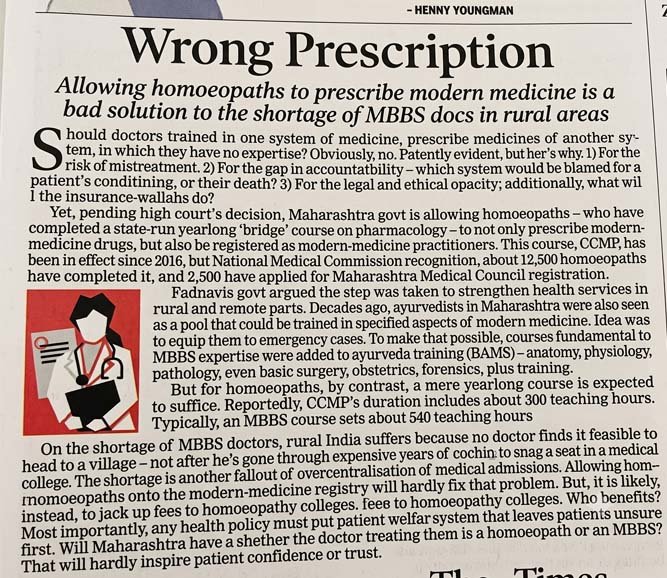
In an attempt to bridge the urban-rural healthcare divide, the Maharashtra government passed a policy allowing homoeopathic practitioners—upon completing a one-year Certificate Course in Modern Pharmacology (CCMP)—to prescribe select modern allopathic medicines. While framed by state authorities as a pragmatic solution to a shortage of MBBS doctors in primary health centres, the policy flies in the face of established medical protocols regarding scope of practice, cross-prescription, and patient safety.

An analysis of treatment protocols in India, the United States, and Europe reveals a universal truth: prescriptive authority is inextricably tied to the depth and rigour of medical education, not the completion of a supplementary bridge program.

The Indian Jurisprudential and Legislative Context

The Maharashtra policy does not exist in a vacuum; it directly conflicts with established jurisprudence from the Supreme Court of India. In the landmark judgment Poonam Verma v. Ashwin Patel and Ors. (1996), the Supreme Court held that a medical practitioner trained in one system of medicine (such as homeopathy) who practices another system (such as allopathy) without statutory authorization and adequate training commits medical negligence per se. The court noted that a person who does not possess knowledge of a particular system of medicine but practices in that system is a quack and a pretender.

While the Maharashtra government sought to bypass this by amending state regulations under the Maharashtra Medical Council (MMC) Act and the Maharashtra Homeopathic Practitioners Act—thereby creating a separate registry for CCMP certificate holders—the policy faces ongoing challenges in the Bombay High Court brought by the Indian Medical Association (IMA). The central conflict lies between state-level administrative convenience and central statutory frameworks governing modern medicine.

The Global Stance on Cross-Prescription

In international healthcare systems, prescriptive authority is tied strictly to comprehensive pharmacology education within the framework of modern evidence-based medicine.

The United States (FDA and State Medical Boards): In the U.S., non-physician prescribing is permitted for Advanced Practice Registered Nurses (APRNs) and Physician Assistants (PAs). However, these professionals complete thousands of hours of standardized clinical pharmacology within the modern medical framework. Homeopaths and naturopaths are strictly governed by state-specific scopes of practice. In states where Naturopathic Doctors (NDs) hold limited prescribing rights (e.g., Oregon, Washington), those rights are restricted to a defined formulary and follow standardized doctoral-level coursework.

Prescribing outside this defined scope is prosecuted as practising medicine without a license.

The European Union (EMA and EU Directives): Under EU Directive 2005/36/EC, basic medical training for an allopathic practitioner requires a minimum of five years or 5,500 hours of theoretical and practical instruction. The European Committee for Homeopathy (ECHAMP) maintains that homeopathy is a distinct therapeutic discipline. In countries like the UK, Germany, and France, a statutory homeopath cannot prescribe synthetic pharmaceuticals (controlled or legend drugs) unless they hold a full, accredited medical degree (MD or MBBS equivalent) and independent prescriber registration.

The Scientific Failure of the Bridge Course

The Maharashtra government’s rationale treats rural health as an issue of provider headcount while ignoring the scientific prerequisites of clinical pharmacology. An MBBS curriculum in India requires approximately 540 instruction hours dedicated solely to basic human anatomy, alongside over 300 hours specifically focused on basic and clinical pharmacology. The CCMP, by contrast, is a one-year certificate program comprising approximately 300 total didactic teaching hours, supplemented by brief clinical postings.

To safely prescribe synthetic pharmaceuticals—such as Metformin for diabetes, Atenolol for hypertension, or broad-spectrum antibiotics—a provider must understand pharmacokinetics, pharmacodynamics, renal and hepatic clearance, drug-drug interactions, and adverse event management. A 300-hour bridge course cannot impart the diagnostic reasoning necessary to evaluate complex comorbidities. When diagnostic or therapeutic errors occur, rural patients are often forced to seek emergency tertiary care, worsening healthcare outcomes rather than improving them.

Bioethical Accountability and WHO Frameworks

Medical liability provides a final structural barrier. If a homeopath prescribing allopathic drugs under CCMP authorisation commits a diagnostic or therapeutic error, legal frameworks struggle to assign accountability. Global bioethics guidelines, including those articulated by the Nuffield Council on Bioethics, emphasise that legal liability cannot replace clinical competence. Holding a practitioner strictly liable for an error in a discipline in which they were never comprehensively trained creates a systemic accountability gap, violating the foundational bioethical principle of non-maleficence (primum non nocere).

Furthermore, while the World Health Organisation (WHO) Traditional Medicine Strategy advocates integrating Traditional and Complementary Medicine (T&CM) into health systems, it emphasises collaborative care and structured referrals rather than direct cross-prescription or provider substitution.

Conclusion: A Structural Vulnerability

Maharashtra’s CCMP policy attempts to solve a systemic shortage of rural medical professionals by lowering training standards rather than bolstering workforce incentives. Modern pharmaceuticals require formal, comprehensive education to be administered safely.

To sustainably address rural health disparities, policy must align with established standards: increasing MBBS and postgraduate seats, enforcing mandatory rural service bonds with competitive compensation, expanding telemedicine networks linked to urban teaching hospitals, and utilising homeopaths within their trained scope of practice. Substituting comprehensive medical education with a condensed certificate course compromises patient safety at the point of delivery.

Appendix: Policy Documents, Legal Precedents, and Guidelines

Indian Supreme Court Jurisprudence on Crosspathy
Citation: Poonam Verma v. Ashwin Patel & Ors. (1996) 4 SCC 332.
Scope: Ruling by the Supreme Court of India establishing that practising a system of medicine without statutory qualification in that specific system constitutes medical negligence per se.

Indian Statutory Frameworks and Curriculum Benchmarks
Source: National Medical Commission (NMC) – Competency-Based Undergraduate Curriculum for the Indian Medical Graduate.
Access: https://www.nmc.org.in/information-desk/for-colleges/under-graduate-curriculum
Scope: Details the mandatory credit hours, clinical rotations, and pharmacology training requirements for the MBBS degree in India.

European Union Medical Education Mandates
Source: European Parliament and Council – Directive 2005/36/EC on the recognition of professional qualifications.
Access: https://eur-lex.europa.eu/legal-content/EN/TXT/?uri=CELEX%3A32005L0036
Scope: Mandates a minimum of 5,500 hours of theoretical and practical instruction for basic medical training across EU member states.

United States Scope of Practice and Prescriptive Standards
Source: Federation of State Medical Boards (FSMB) – Assessing Scope of Practice Parameters.
Access: https://www.fsmb.org/siteassets/advocacy/policies/assessing-scope-of-practice-parameters.pdf
Scope: Outlines the criteria state boards use to determine prescriptive authority, emphasising that scope must reflect the depth of accredited education.

World Health Organisation Framework on T&CM
Source: WHO Traditional Medicine Strategy: 2014-2023.
Access: https://www.who.int/publications/i/item/9789241506096
Scope: Provides guidelines for integrating traditional and complementary medicine practitioners through regulatory oversight, referral networks, and team-based care without compromising safety standards.

Hot this week

Platforms Are Owning the Patient While Pharma Waits

The future of experimental medicine is not simply a...

Samit Mehta has been appointed Chief Operating Officer (COO) of Emcure Pharmaceuticals Ltd.

Samit Mehta brings extensive experience in healthcare leadership, business...

Indian Hospitals and Private Equity: Healthy for Patients?

If healthcare is so lucrative that global private equity...

What ChrysCapital’s Takeover Of Novartis India Really Means

When ChrysCapital, one of India's oldest and largest homegrown...

Topics

Platforms Are Owning the Patient While Pharma Waits

The future of experimental medicine is not simply a...

Samit Mehta has been appointed Chief Operating Officer (COO) of Emcure Pharmaceuticals Ltd.

Samit Mehta brings extensive experience in healthcare leadership, business...

Indian Hospitals and Private Equity: Healthy for Patients?

If healthcare is so lucrative that global private equity...

What ChrysCapital’s Takeover Of Novartis India Really Means

When ChrysCapital, one of India's oldest and largest homegrown...

Big Pharma and the Obesity War – Science to Subpoenas

Two pharmaceutical giants are currently locked in a high-stakes...
spot_img

Related Articles

spot_imgspot_img