

If healthcare is so lucrative that global private equity firms are willing to write cheques of Rs 13,000–14,000 crore for a single mid-sized Indian hospital chain, why is the Indian government still reluctant to invest at scale?
Public health expenditure in India remains stubbornly low — around 1.4–1.8 per cent of GDP in recent National Health Accounts estimates, far short of the National Health Policy 2017 target of 2.5 per cent by 2025. The Centre’s own allocation hovers near 0.26–0.28 per cent of GDP.
States carry the bulk of the burden, yet the combined public effort has never matched the rhetoric of “health as a right.” Fiscal constraints, competing demands (defence, infrastructure, subsidies), and the political economy of short-term welfare schemes over long-term capacity building explain part of the story. The deeper issue is that governments prefer to underwrite demand (through insurance schemes like Ayushman Bharat) rather than own and operate supply at the scale private capital is now willing to fund.

This creates a structural paradox. Private equity arrives precisely because the opportunity is large and the public sector has left space. PE brings capital, operational discipline, technology, and consolidation. It also brings a finite time horizon and an uncompromising return expectation — typically an IRR of 18–25 per cent. When the exit arrives in five to seven years (via IPO or strategic sale), the valuation will have been built on higher revenue per bed, tighter cost structures, preferential focus on high-margin procedures, and improved occupancy. The question that follows is unavoidable: who pays for that higher valuation?

Experience in India and abroad suggests a meaningful portion is paid by patients through elevated out-of-pocket costs and by the public purse through higher claim amounts under government schemes. Out-of-pocket expenditure, though declining, still accounts for roughly 40–50 per cent of total health spending. Medical inflation in the organised private sector has been running well ahead of general inflation. Once a PE-backed chain is optimised for exit, the new owners (or public/market investors) have every incentive to protect and expand those margins. The result is not merely more hospitals; it is a more expensive hospital system for those who pay cash and for a government that must keep reimbursing rising package rates.
The KKR–Medicover transaction is therefore more than a corporate deal. It is a mirror held up to India’s healthcare policy choices. Capital is flowing because the opportunity is real. The discomfort arises because that capital is private, temporary, and return-focused, while the social consequences of higher costs are permanent and public. Until the state is willing to treat healthcare capacity as a core public investment rather than a residual responsibility, private equity will continue to fill the vacuum — and patients, as always, will live with the bill.
KKR’s $1.5 Billion Bet on Medicover India: What It Means for Patients, Doctors, and the Healthcare Market
In a deal that has sent ripples through India’s healthcare corridors, global private equity giant KKR has announced the acquisition of a 100 per cent stake in Medicover India. Valued at roughly $1.5 billion (Rs 13,000–14,000 crore), this is not just a standard buyout. It is a strategic infusion of fresh capital designed to wipe out debt and supercharge expansion.
For a mid-sized hospital chain operating primarily in South and West India, this is a seismic shift. But for doctors, hospital administrators, and patients, the question is: What does this change on the ground? Let us break down who Medicover is, why KKR is so bullish, and whether deep-pocketed private equity is ultimately good for Indian patients.

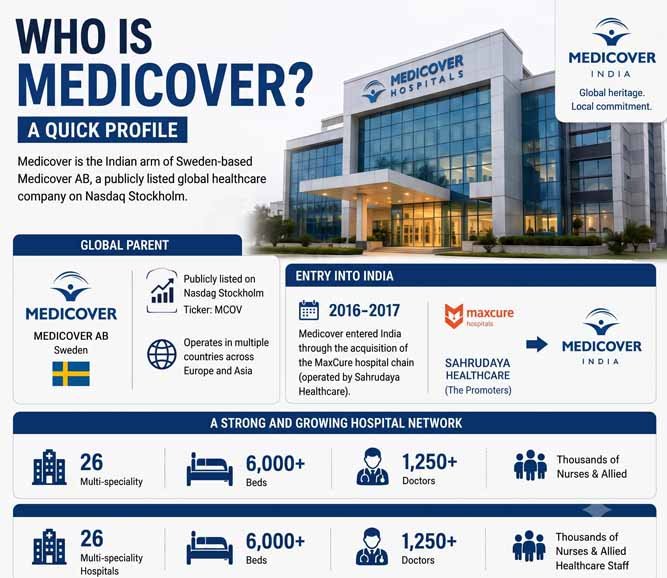
Who is Medicover? A Quick Profile
Medicover is not a homegrown Indian startup. It is the Indian arm of the Swedish healthcare giant Medicover AB, which is publicly listed on Nasdaq Stockholm.
Since entering India in 2016–2017 through the acquisition of the MaxCure hospital chain (operated by Sahrudaya Healthcare), the group has built a network of 26 multi-speciality hospitals with more than 6,000 beds. These are primarily clustered in Telangana, Andhra Pradesh, Maharashtra, and Karnataka. Its Hyderabad flagship has become a well-known referral hub for complex tertiary care, including cardiology, neurology, oncology, and organ transplants.
The network also includes women and children’s hospitals and cancer institutes, supported by more than 1,250 doctors.
What sets them apart is their hybrid clinical model. They attempt to marry the affordability of Indian healthcare with stringent European quality protocols and international accreditations. However, their aggressive expansion left them highly leveraged. While top-line revenue grew steadily, heavy interest costs on existing debt consistently eroded net profitability. This is exactly where KKR steps in.

Why Didn’t the Swedish Parent Invest?
A logical question arises: If Medicover India is such a promising asset, why didn’t the Swedish parent company simply inject more capital into it instead of selling it to an American private equity firm?
The answer lies in the financial realities of the global healthcare market.
First, the Swedish parent has its own capital allocation priorities. Operating in highly regulated European markets such as Germany and Poland requires continuous, expensive infrastructure upgrades.
Expanding in India directly competes with these European needs, using the parent company’s limited cash reserves.
Second, there is a risk-management angle. The Indian healthcare market is intensely competitive. By selling a controlling stake to KKR, the Swedish parent effectively de-risks its exposure. They are cashing out significant value while potentially retaining a small minority holding or exiting completely. They are essentially saying: We have grown this tree to a certain height; now we are handing it to a specialised financial gardener to take it to the next level, using someone else’s money.
How Will KKR Actually Help Medicover?
KKR is bringing more than just a chequebook; they are bringing an operational playbook. Here is how they will likely transform Medicover over the next five to seven years.
The most immediate impact is financial. Out of the total deal size, Rs 3,000–4,000 crore is being injected as primary capital. This money goes directly into the company’s coffers, specifically to repay expensive existing debt. Once that debt is cleared, Medicover’s interest costs will plummet, turning the balance sheet cash-flow positive almost overnight. This allows the company to reinvest profits rather than servicing loans.
Private equity firms are known for bolt-on acquisitions. With a clean balance sheet, Medicover will likely use KKR’s backing to acquire smaller or struggling hospital chains and diagnostic labs in Tier-1 and Tier-2 cities, particularly across South and West India. The goal will be to consolidate market share.
Expect a significant modernisation push. KKR will push for heavy digitisation, electronic health records, and advanced medical technology, including robotics. The aim is to increase operational efficiency so that more patients can be treated per bed, reducing wait times and raising revenue per square foot.
Finally, KKR is a financial investor, not a permanent owner. Their goal is to grow Medicover’s valuation significantly over five to seven years and then exit, most likely through a blockbuster initial public offering or by selling it to a larger strategic player such as a global hospital chain.
Does the Entry of a Private Equity Player Augur Well for Indian Patients?
This is the critical question for doctors and healthcare advocates. The answer is nuanced.
On the positive side, patients will benefit from improved infrastructure. If Medicover uses the capital to buy new MRI machines, upgrade ICUs, and shorten diagnostic turnaround times, the patient experience improves directly. Furthermore, if the chain expands into underserved Tier-2 cities, it brings high-quality tertiary care closer to larger populations.
However, there are significant concerns about commercialisation. Private equity firms are legally bound to deliver returns to their limited partners. To achieve a successful IPO or sale in seven years, Medicover will need to aggressively increase its EBITDA margins.
This often translates into pressure to raise revenue per patient by emphasising higher-margin procedures, centralised procurement that can strain relationships with independent suppliers, and expectations on physicians to increase patient footfall while reducing length of stay to boost bed turnover rates.
Ultimately, KKR’s entry is a double-edged sword. It guarantees the hospital chain’s survival and growth, but it also injects Wall Street financial discipline into a traditionally clinical environment. The patient will be the winner if management successfully balances clinical ethics with financial efficiency. If the balance tips too far toward profit, the patient pays the price.
Conclusion
The KKR-Medicover deal is a bellwether for the Indian healthcare sector. It signals that global capital views Indian hospitals as mature, high-growth assets. For doctors and administrators, the coming years will bring new technology, new pressures, and new opportunities. For patients, it promises better facilities, but at the potential cost of creeping commercialisation. The next five years will determine whether this Swedish-Indian hybrid can thrive under American private equity ownership.

Appendix: Sources and References
The following sources were used to compile the factual financial data, company history, and market context for this article.
- The Economic Times (ET Bureau). “KKR to acquire Medicover India in $1.5 billion deal.” Published August 6, 2026. (Source for deal valuation, primary capital injection of Rs 3,000–4,000 crore, and 100 per cent stake sale).
- Medicover AB Official Annual Reports and Interim Reports (2023–2026). Available via Nasdaq Stockholm disclosures. (Source for the parent company’s European operational footprint, entry into India, and corporate structure).
- Medicover India Official Website and public statements. (Source for current hospital network of 26 multi-speciality hospitals and operational geographies in Telangana, Andhra Pradesh, Maharashtra, and Karnataka).
- Industry Analysis: India Brand Equity Foundation (IBEF) – Healthcare Sector Reports, 2025-2026. (Source for market growth projections and Tier-2 city healthcare demand metrics).
- Research Reports: Credit Suisse and Jefferies Equity Research on Indian Hospital Chains (Q2 2026). (Source for comparative analysis regarding PE-led hospital consolidation and revenue-per-bed margin pressures).
- Public Statements: Press releases from KKR’s Asia-Pacific Healthcare Investment Team and Medicover AB (2025-2026). (Source for KKR’s stated investment thesis regarding operational efficiency and bolt-on acquisitions in emerging markets).