

Friday, August 14, 2026
25.4 C
Bengaluru

Will President Trump’s Diktat Improve Drug Quality For Indian Patients?

Executive Summary

The geopolitical landscape of pharmaceutical manufacturing is shifting rapidly. Following US policy proposals to levy escalating tariffs—rising to 100 per cent and eventually 200 per cent after 2028—aimed at forcing drugmakers to build manufacturing capacity on US soil, the global generic supply chain faces severe friction. With Indian pharmaceutical companies supplying nearly half of all generic prescriptions consumed in the United States, an optimistic argument has emerged: If top Indian manufacturers face export cost barriers to the US, will they redirect their USFDA-compliant capacity to the domestic market, thereby finally guaranteeing US-grade quality for Indian patients?


Drawing upon critical analyses published across The Wire Science and MedicinMan, this analysis demonstrates why foreign trade tariffs will not solve India’s domestic quality deficit. India’s issue has never been a lack of scientific or manufacturing capability; it is a structural crisis of governance, uneven regulatory enforcement, and a market in which “branded generics” serve as a proxy for regulatory trust.

Furthermore, justifying lax standards for Micro, Small, and Medium Enterprises (MSMEs) to protect business viability perpetuates a deadly regulatory duality. As evidenced by recent tragic casualties, uniform regulatory compliance across all manufacturing tiers is non-negotiable.

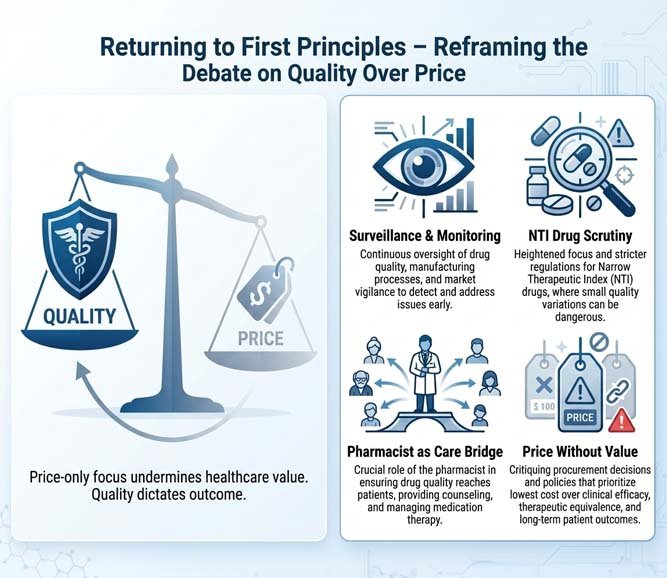
1. Quality Versus Price: Reframing the Domestic Discourse

A recurring theme in pharmaceutical policy analysis, particularly in publications such as The Wire Science and MedicinMan, is the mis framed domestic discourse around generic medicines. The public debate routinely focuses on cost rather than standards, operating under the flawed assumption that unbranded generics are inherently equivalent to branded innovator drugs simply because they contain the same active pharmaceutical ingredient (API).

Several fundamental fallacies underpin this debate:

  • Price is Market; Quality is Regulatory: Price reflects market dynamics and competition, whereas quality is a strict regulatory determination. A low price does not automatically make a drug substandard, nor does a high price make it safe; safety requires continuous statutory enforcement.
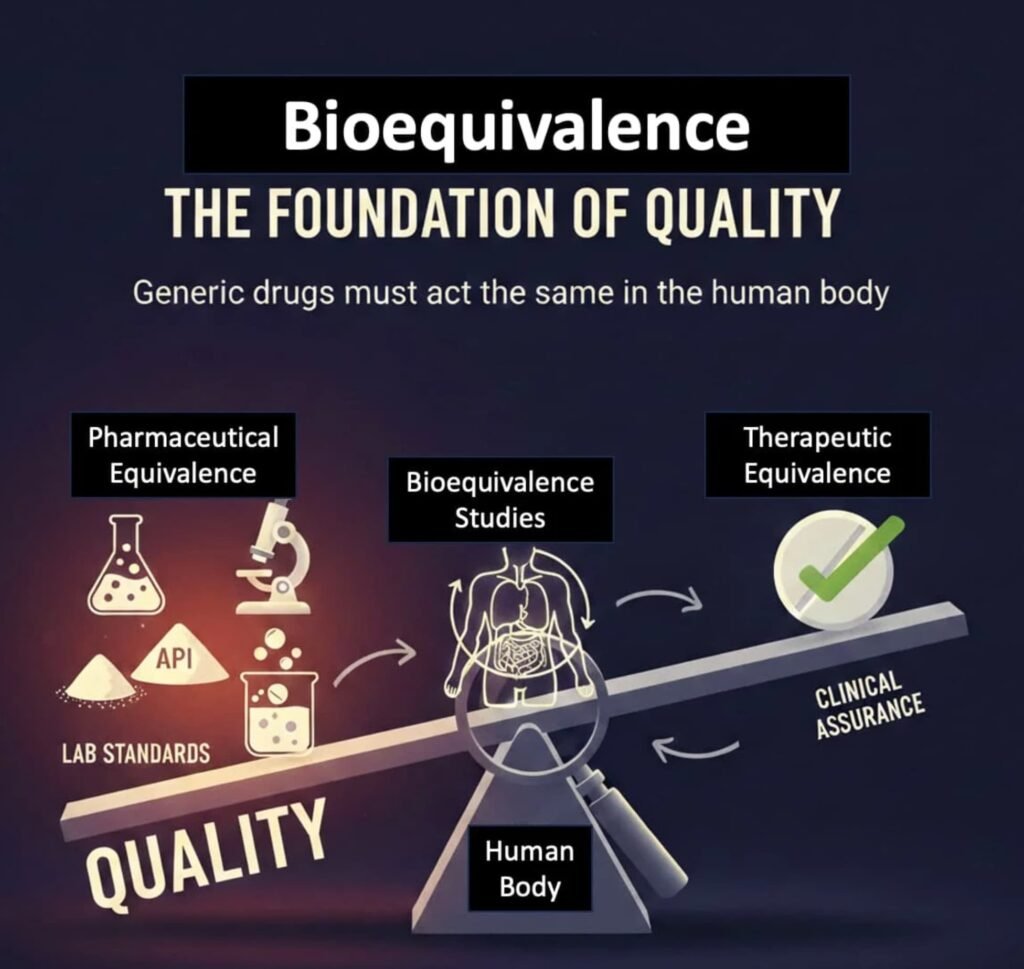
  • Bioequivalence as the True Pillar: In developed regulatory ecosystems such as the US FDA or the UK MHRA, a generic drug is approved only after demonstrating bioequivalence—that it delivers the same amount of active ingredient at the same rate into the bloodstream as the reference drug. In India, pharmaceutical equivalence (basic laboratory batch testing for assay and dissolution) has historically been treated as sufficient, leaving a gap in bioequivalence data for many domestic formulations.
  • The “Branded Generic” Phenomenon: Developed nations have innovator brands and unbranded generics. India created a unique third category: branded generics—non-patented molecules sold under proprietary brand names by domestic giants like Sun Pharma, Cipla, and Dr Reddy’s.

As one analysis by MedicinMan observed, branded generics in India represent a commercial mechanism for distinguishing one firm’s generic from another’s. In the absence of uniform regulatory assurance from the state, Indian doctors prescribe branded generics not solely because of marketing influence, but because branding serves as a substitute for regulatory trust. Doctors trust that large firms will protect their corporate reputation by maintaining internal quality controls.

2. The Fallacy of the Tariff Dividend

The proposal to force generic drugmakers to build manufacturing capacity on US soil—backed by punitive tariffs starting after 2028—has led some analysts to speculate that Indian firms will divert high-standard generic manufacturing to domestic markets.

Applying established regulatory analytical frameworks, this assumption collapses under three economic and structural realities:

Diagram 1: Impact Pathway of US Tariff Mandate on Indian Domestic Market

StageActionOutcome
Stage 1Trump US-First Tariff MandateHigh Onshoring Costs in the US: Capital-intensive plant builds, high labour, and operating costs. Pivot Away from Volume Generics: Expansion into biosimilars and speciality; diversification to EU, LATAM, and Africa.
Stage 2Indian Domestic Market ImpactUnchanged Statutory Framework: CDSCO / State Authorities retain current rules. Continued Undercutting: Low-cost, non-compliant units continue undercutting compliant firms. Persistent Trust Deficit: Doctors remain dependent on “Branded Generics” for safety assurance.

I. Capability Is Not the Bottleneck—Enforcement Is

India already possesses state-of-the-art facilities capable of meeting USFDA, WHO-GMP, and EU-GMP standards. However, Indian pharma operates under a two-tier regulatory reality: export lines are subject to stringent USFDA oversight, zero-tolerance data-integrity rules, and lifecycle bioequivalence tracking, while domestic production lines answer to fragmented state-level drug-control administrations. US tariffs alter where export drugs are manufactured; they do not alter CDSCO’s domestic enforcement mandates.

II. Onshoring Costs Drive a Pivot to Speciality, Not Domestic Flooding

Building replacement capacity on US soil is cost-prohibitive for low-margin, high-volume generic drugs. Instead of taking low-margin lines and flooding the price-controlled Indian domestic market (governed by NLEM price caps), Indian pharma leadership is actively pivoting toward:

  • Complex Biosimilars and Speciality Formulations: Transitioning up the value chain where higher margins absorb onshoring expenses.
  • Geographic Diversification: Redirecting export volumes to Latin America, Southeast Asia, Africa, and the European Union.

III. Domestic Low-Cost Undercutting Remains Unchecked

Even if a major manufacturer offers USFDA-grade generics domestically, they face an uneven playing field. As long as smaller, non-compliant domestic manufacturers are permitted to sell low-standard drugs without mandatory bioequivalence and cGMP validation, high-compliance manufacturers will be undercut on price.

3. Human Costs: Fatalities and the Argument Against MSME Quality Leniency

When regulatory authorities attempt to mandate upgraded quality standards—such as enforcing Revised Schedule M (cGMP compliance)—industry lobbying groups often argue that stringent compliance will bankrupt MSMEs and SMEs.

However, framing weak regulatory oversight as economic support for small businesses ignores the direct line between poor manufacturing practices and public health fatalities.

Table 1: Recent Quality-Control Breakdowns and Their Consequences

IncidentCause / Regulatory LapseConsequence
Kota Maternal Deaths (Oxytocin Injections)Unpurified water used; lack of batch testing and sterility control.Maternal mortality in maternity wards.
Global Paediatric Syrups (Gambia, Uzbekistan)Ethylene/Diethylene glycol contamination due to unverified raw materials.Over 140 child deaths from acute renal failure.
Post-Surgical Recalls (Ophthalmic Solutions)Pseudomonas bacterial contamination in filling lines.Severe eye infections and vision loss.

The MSME Exemption Fallacy

Pathogens, heavy metals, and toxic industrial solvents do not differentiate between a billion-dollar multinational facility and a local MSME unit. Treating compliance as optional for small units undermines public health:

  • Point-in-Time Testing vs. Continuous Assurance: A single batch passing a basic pharmacopeial test at a lab bench does not guarantee quality. Quality assurance requires environmental monitoring, validated equipment, supply chain traceability, and data integrity throughout the manufacturing life cycle.
  • The Trap of Low Standards: Granting leniency to domestic MSMEs traps them in low-margin, substandard cycles where they can never qualify for export markets. Rather than diluting standards, governments should support MSMEs through subsidised testing infrastructure, technical training, and modernisation grants.

4. Strategic Imperatives for the Domestic Market

To deliver truly safe, effective, and quality-assured medicines to Indian patients, reform must come from within India’s domestic regulatory framework, not from external US trade shocks:

Table 2: Strategic Reform Imperatives for India’s Domestic Pharmaceutical Market

Reform AreaAction RequiredExpected Impact
Universal Bioequivalence MandateMake bioequivalence testing mandatory and publicly accessible for all generic formulations sold domestically.Eliminate the gap between branded and unbranded generics.
Single-Tier EnforcementEliminate inspection deserts and regulatory arbitrage among state licensing authorities by unifying standards under a single central regulator with zero tolerance for noncompliance.Uniform regulatory oversight across all manufacturing facilities.
Strict Schedule M Enforcement Across All TiersEnforce updated Good Manufacturing Practices uniformly, supporting small units through financial and technical assistance rather than regulatory exemptions.Consistent quality standards regardless of manufacturing scale.
Transparent Recalls and Data IntegrityImplement real-time public reporting of non-compliant batches, facility inspection outcomes, and drug recalls.Build institutional trust through accountability.

5. Conclusion

The US-first manufacturing mandate may alter export economics, but it will not elevate the quality of medicines sold in Indian pharmacies. As analyses in The Wire Science and MedicinMan have consistently established, Indian consumers will only receive world-class drugs when India demands world-class enforcement at home. Until regulatory oversight guarantees bioequivalence and cGMP compliance across every facility—large or small—branding will remain a proxy for trust, and Indian patients will bear the risk.

References

Analytical Works

Global Regulatory Standards and Bioequivalence

Systemic Quality Failure Investigations and Investigative Books

  • Eban, K. (2019). Bottle of Lies: The Inside Story of the Generic Drug Boom. HarperCollins.
  • World Health Organisation (WHO). (2022–2023). Medical Product Alerts on Contaminated Liquid Dosage Forms (Diethylene Glycol / Ethylene Glycol). WHO Safety Alerts No. 6/2022, 7/2022, and 1/2023.
  • Kaplan, W. A., et al. (2012). The World Medicines Situation 2011: Medicines Prices, Availability and Affordability. World Health Organisation.

Hot this week

Mounjaro is the Exceptional Growth Story: Ranks #1

The July Brand Monitor by Pharmarack shows a healthy...

Sun Pharma: In the Eye of the Storm of Ophthalmologists

The Two-Tier Reality of Indian Pharma: Patient Safety, Pharmacovigilance,...

Does India Need to Reinvent the Wheel on Junk Foods?

In a written reply in the Lok Sabha in...

Topics

Mounjaro is the Exceptional Growth Story: Ranks #1

The July Brand Monitor by Pharmarack shows a healthy...

Sun Pharma: In the Eye of the Storm of Ophthalmologists

The Two-Tier Reality of Indian Pharma: Patient Safety, Pharmacovigilance,...

Does India Need to Reinvent the Wheel on Junk Foods?

In a written reply in the Lok Sabha in...

Platforms Are Owning the Patient While Pharma Waits

The future of experimental medicine is not simply a...

Samit Mehta has been appointed Chief Operating Officer (COO) of Emcure Pharmaceuticals Ltd.

Samit Mehta brings extensive experience in healthcare leadership, business...

Indian Hospitals and Private Equity: Healthy for Patients?

If healthcare is so lucrative that global private equity...
spot_img

Related Articles

spot_imgspot_img