


“Those who cannot remember the past are condemned to repeat it.” — George Santayana
Executive Framing: From VUCA to BANI
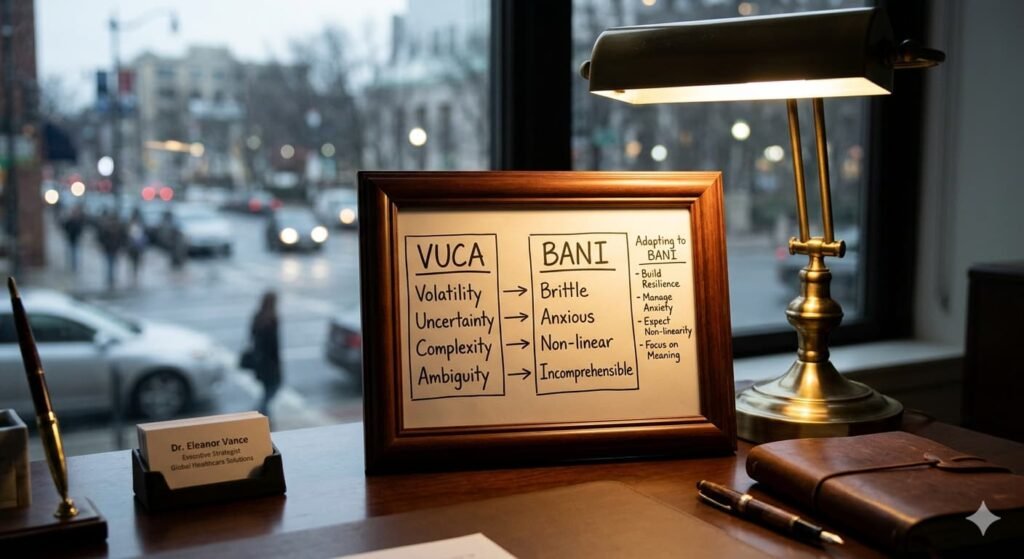
For decades, pharmaceutical and healthcare strategies have operated within the VUCA framework (Volatility, Uncertainty, Complexity, Ambiguity). That model assumed that while the world was unpredictable, it remained fundamentally interpretable—a puzzle that could be solved with enough data.
That assumption has eroded. The global landscape now exhibits features better captured by the BANI framework (Brittle, Anxious, Non-linear, Incomprehensible), articulated by Jamais Cascio. We no longer live in a VUCA world alone; we face a world that is:
- Brittle: Systems that appear functional but can fail catastrophically.
- Anxious: Decision-making distorted by fear and information overload.
- Non-linear: Small triggers producing disproportionate outcomes.
- Incomprehensible: More data does not always yield more clarity.
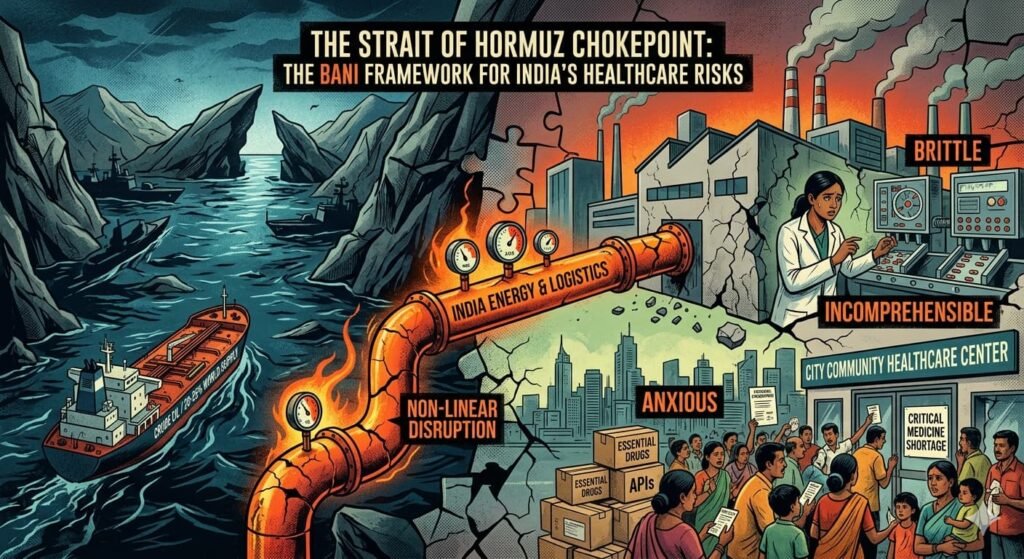
The renewed tension in the Strait of Hormuz—through which approximately 20–25% of the world’s seaborne crude oil passes—is a powerful test case for Indian healthcare. Iran’s ability to disrupt the Strait does not grant it “control,” but in a brittle, non-linear system, even a temporary disruption can trigger cascading consequences far beyond fuel prices.
Historical Memory: Why the Old Playbook Is Obsolete
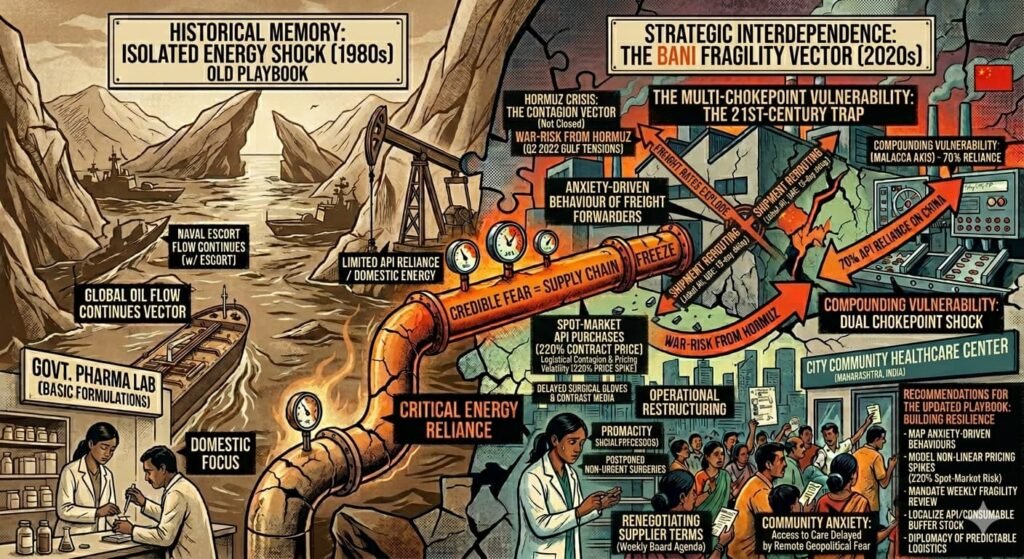
During the “Tanker War” phase of the Iran–Iraq War (1980–1988), hundreds of merchant vessels were attacked, yet global oil flows continued—albeit with higher costs and military escort operations (Operation Earnest Will). India’s healthcare system at the time was small, largely state-run, and domestically focused.
Today, the difference is interdependence:
- Then: India manufactured basic formulations with limited global API reliance.
- Now: India is a major generic drug producer, but its active pharmaceutical ingredient (API) supply chain remains heavily dependent on imports from China (approximately 70% by value for key critical APIs). Combined with reliance on seaborne energy imports, this makes the sector vulnerable to chokepoint disruptions—including, but not limited to, Hormuz.
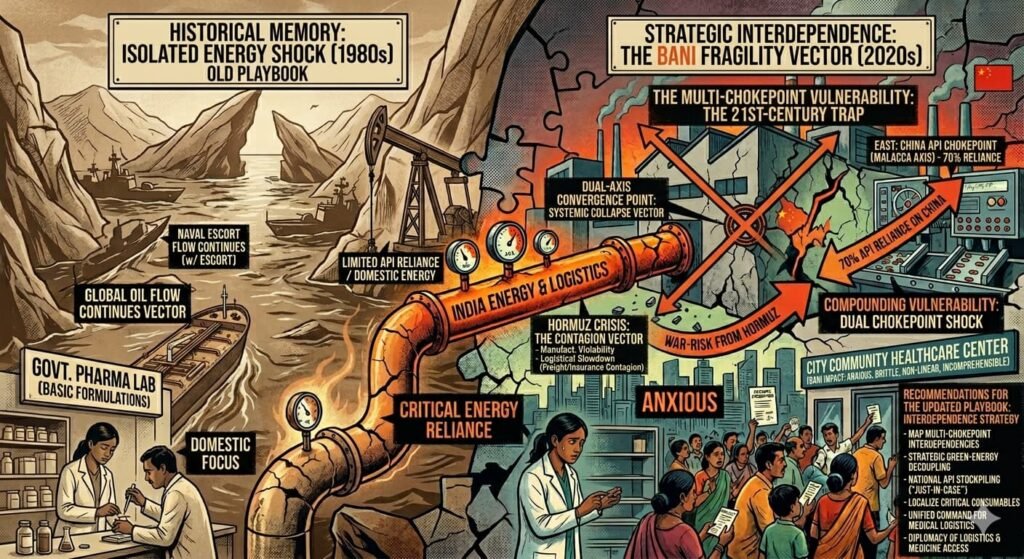
Critically, the Strait of Hormuz is not the primary route for China-India API trade (that is the South China Sea–Malacca Strait axis). However, Hormuz matters for:
- Energy prices that power API manufacturing and hospital operations.
- Freight costs for all imported medical consumables.
- Insurance and shipping availability across the entire Persian Gulf region.
A Real-World Indian Healthcare Case (2022)
Consider the experience of a mid-sized hospital chain in Maharashtra during the freight-rate spike that followed the Russia-Ukraine war and residual Gulf tensions. In Q2 2022 (drawn from anonymized industry case studies documented by FICCI):
- sA 15-day delay in a shipment of specialized surgical gloves and contrast media (routed via Jebel Ali, UAE—transiting the Gulf of Oman adjacent to Hormuz) forced the chain to purchase spot-market alternatives at 220% of contract price.
- Impact: Margin compression of 8% on elective procedures for two months. No factory shutdown occurred, but operational restructuring—postponing non-urgent surgeries and renegotiating supplier terms—became a weekly board agenda item.
Key lesson: The disruption was not a full Hormuz closure. The anxiety-driven behaviour of freight forwarders (rerouting, demanding upfront payment) created non-linear effects far beyond the actual geopolitical event.
This is the BANI reality: you do not need a war. You only need credible fear.
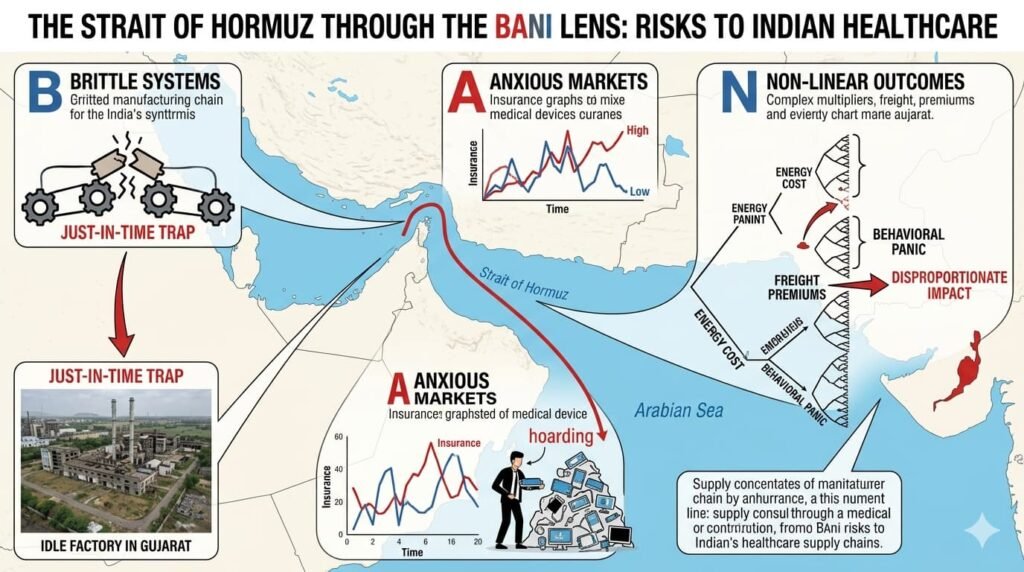
The Strait of Hormuz Through the BANI Lens
When we apply BANI to geopolitical friction in the Gulf, the risks to Indian healthcare become structural.
1. Brittle Systems (The Just-in-Time Trap)
India’s pharmaceutical manufacturing is optimised for efficiency, but efficiency can reduce resilience. A 15-day delay in a critical shipment from Europe or the Middle East—due to rerouting around the Cape of Good Hope—can idle a factory in Gujarat. Most API precursors from China do not transit Hormuz, but specialised intermediates, solvents, and certain medical-device components from Europe and the Gulf region do.
2. Anxious Markets (The Hoarding Effect)
A single skirmish in the Gulf triggers an immediate spike in war-risk insurance premiums. For an Indian MedTech importer, this leads to “inventory panic”: over-ordering, capital locked in dead stock, and strained cash flows. This behavioural amplification is real and well-documented.
3. Non-linear Outcomes (The Cost Multiplier)
In a linear world, a 10% increase in crude oil might lead to a 2% increase in logistics costs. In a BANI world, the relationship can become non-linear:
Energy cost × freight premium × behavioural hoarding = disproportionate total impact.
Example: The 2019 tanker attacks in the Gulf of Oman caused a temporary 20% spike in oil prices and a sharp rise in tanker rates, even though physical flows were not halted.
Strategic Response: Porter’s Five Forces Under BANI Stress
Note: Porter’s Five Forces is a static industry-structure framework. Applying it to temporary shocks requires caution. Below is an adapted heuristic for strategic questioning.
| Force | BANI Stress Condition | Strategic Imperative |
|---|---|---|
| Supplier Power | Energy and logistics providers gain leverage. | Diversify from “lowest cost” to “most resilient” suppliers; consider multi-sourcing. |
| Buyer Power | Governments and insurers may impose price caps. | Invest in value-based outcomes to justify pricing. |
| Competitive Rivalry | A competitor with fuel hedges may outperform. | Move from pure “market share” thinking to “balance sheet resilience.” |
| Threat of Substitutes | High import costs accelerate demand for domestic “frugal innovations.” | Accelerate local R&D and manufacturing (Make in India). |
| Barriers to Entry | Crises can lower barriers for emergency-authorised players. | Maintain regulatory agility. |
The Cost of Redundancy: A Boardroom Trade-Off
Boards love trade-offs. Below is a rough-order model for a mid-sized Indian hospital chain (500 beds) or a secondary API formulation unit. The question: What does resilience cost versus a 30-day Hormuz closure?
| Scenario | Assumptions | Estimated Additional Cost (Annualized) | Risk Mitigated |
|---|---|---|---|
| Current “Just-in-Time” | 15-day inventory of critical consumables | Baseline | Vulnerable to 15+ day disruption |
| 60-day inventory buffer | Warehouse space + working capital locked | +12–15% of consumables budget | Survives 45–60 day chokepoint closure |
| Dual sourcing (domestic + import) | 20% premium for domestic suppliers for 30% of SKUs | +6–8% of procurement budget | Eliminates single-route dependency |
| Full redundancy (buffer + dual source) | Combination of above | +18–22% of procurement budget | High resilience to all but multi-month crises |
Estimates based on industry benchmarks from WEF/BCG healthcare supply-chain studies and Indian hospital procurement analyses; actual figures vary by organisation size and SKU mix.
Boardroom question: Is a 20% increase in consumables procurement cost worth avoiding a potential 40–60% margin wipeout during a 60-day disruption? For most Indian healthcare CFOs, the answer has been “no”—until the last crisis. The BANI insight is that the next crisis will not look like the last one.
Sectoral Impact (Corrected)
- Pharma: Energy costs affect API manufacturing. Freight costs affect imported intermediates. The direct Hormuz–API link is weaker than the Malacca Strait–China link.
- Hospitals: Increased freight costs for consumables (gloves, gowns, certain stents) cannot always be passed to patients. Diesel generator costs for backup power also rise.
- Diagnostics: High-end reagents (e.g., from Germany or Japan) typically arrive by air freight or sea routes avoiding Hormuz. The greater risk is air-freight rate volatility following any major maritime disruption.
The Internal Champion: A New Role for BANI Readiness
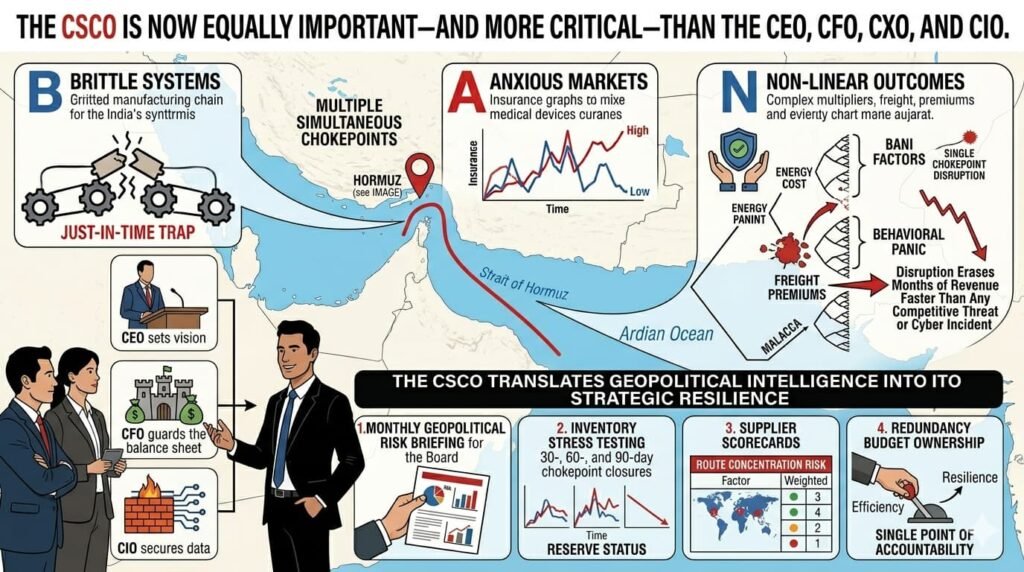
Geopolitical intelligence is useless unless someone in operations or procurement owns it. Indian healthcare organisations—especially those with a global footprint—should create or elevate a Chief Supply Chain Officer (CSCO) or Chief Supply Chain Resilience Officer role with dedicated bandwidth and P&L accountability.
This is not a tactical appointment. In pharma and healthcare companies that source globally, manufacture across continents, and serve international markets, the CSCO is now equally important—and in many respects more critical—than the CEO, CFO, CXO (Chief Commercial/Experience Officer), or CIO.
Why?
- The CEO sets vision; the CFO guards the balance sheet; the CIO secures data. But the CSCO safeguards the physical continuity of the entire value chain. In a BANI world, a single chokepoint disruption can erase months of revenue faster than any competitive threat or cyber incident.
- Global-footprint organisations face multiple simultaneous risks (Hormuz, Malacca, Bab el-Mandeb, Suez, South China Sea). Only the CSCO can translate geopolitical intelligence into monthly board briefings, inventory stress tests, supplier-diversification scorecards (weighted for route concentration risk), and ownership of redundancy budgets.
- Boards that treat supply-chain resilience as a “nice-to-have” cost centre are effectively gambling with survival. Those that give the CSCO C-suite parity treat resilience as a strategic imperative on par with growth and profitability.
Responsibilities include:
- Monthly geopolitical risk briefing for the board.
- Inventory stress testing against 30-, 60-, and 90-day chokepoint closures.
- Supplier scorecards that include “route concentration risk.”
- Redundancy budget ownership—the single point of accountability for the efficiency-versus-resilience trade-off.
Without an internal champion at this level, even the best BANI analysis remains a PowerPoint artefact.
Conclusion: From Interpretation to Preparedness
The Strait of Hormuz is not the only chokepoint, but it is a vivid reminder that geopolitics is now a core operating variable for Indian healthcare. Leaders must:
- Map supply chains by route, not just by supplier.
- Adopt BANI-ready strategies that prioritise redundancy over pure efficiency—without exaggerating specific threats.
- Integrate geopolitical intelligence into monthly boardroom agendas, covering Hormuz, Malacca, Bab el-Mandeb, and Suez.
- Appoint (and empower) a Chief Supply Chain Resilience Officer with C-suite parity and P&L accountability.
- Quantify the cost of inaction using the redundancy trade-off model above.
Those who rely on the playbooks of the past will be consumed by the anxiety of the present. Those who integrate rigorous, evidence-based geopolitical analysis—backed by real cases, owned by a champion at the highest level, and priced in boardroom terms—will be far better positioned to anticipate and thrive through the next disruption.
Appendix: Credible Sources for Further Reading
The BANI Framework
Cascio, J. (2020). Facing the Age of Chaos. Medium / Anthropocene Magazine.
Strait of Hormuz – Energy Flows & Geopolitics
U.S. Energy Information Administration (EIA). (2023–updated). The Strait of Hormuz is the world’s most important oil transit chokepoint.
https://www.eia.gov/todayinenergy/detail.php?id=61042
India’s Pharma API Dependency
Department of Pharmaceuticals, Ministry of Chemicals and Fertilizers, Govt of India. Annual Report 2022–23.
https://pharmaceuticals.gov.in/
Maritime Chokepoints & Indian Trade Routes
U.S. Naval Institute / Proceedings. (2021). The Strait of Malacca: India’s Energy and Trade Vulnerability.
United Kingdom Maritime Trade Operations (UKMTO). Real-time advisories.
Supply Chain Resilience & Healthcare – Indian Case Evidence
McKinsey & Company. (2020). Risk, resilience, and rebalancing in global value chains.
Agarwal, S., & Narain, S. (2021). Geopolitics and Indian Pharma. Centre for Social and Economic Progress (CSEP).
Federation of Indian Chambers of Commerce & Industry (FICCI). (2023). Healthcare Supply Chain Disruptions: Case Studies from the 2022 Freight Crisis.
Historical Tanker War (1980–88)
Naval History and Heritage Command. Operation Earnest Will (1987–89).
Cost of Redundancy Models
World Economic Forum & Boston Consulting Group. (2022). Supply Chain Resilience in Healthcare: The 30-Day Buffer Trade-Off.
All Images are AI-generated for Illustration Only. E&OE