

A Tale of Two Truths: Severance, Up in the Air, and the 30,000 People Oracle Just Threw Away

Two images. Two men. One lie.
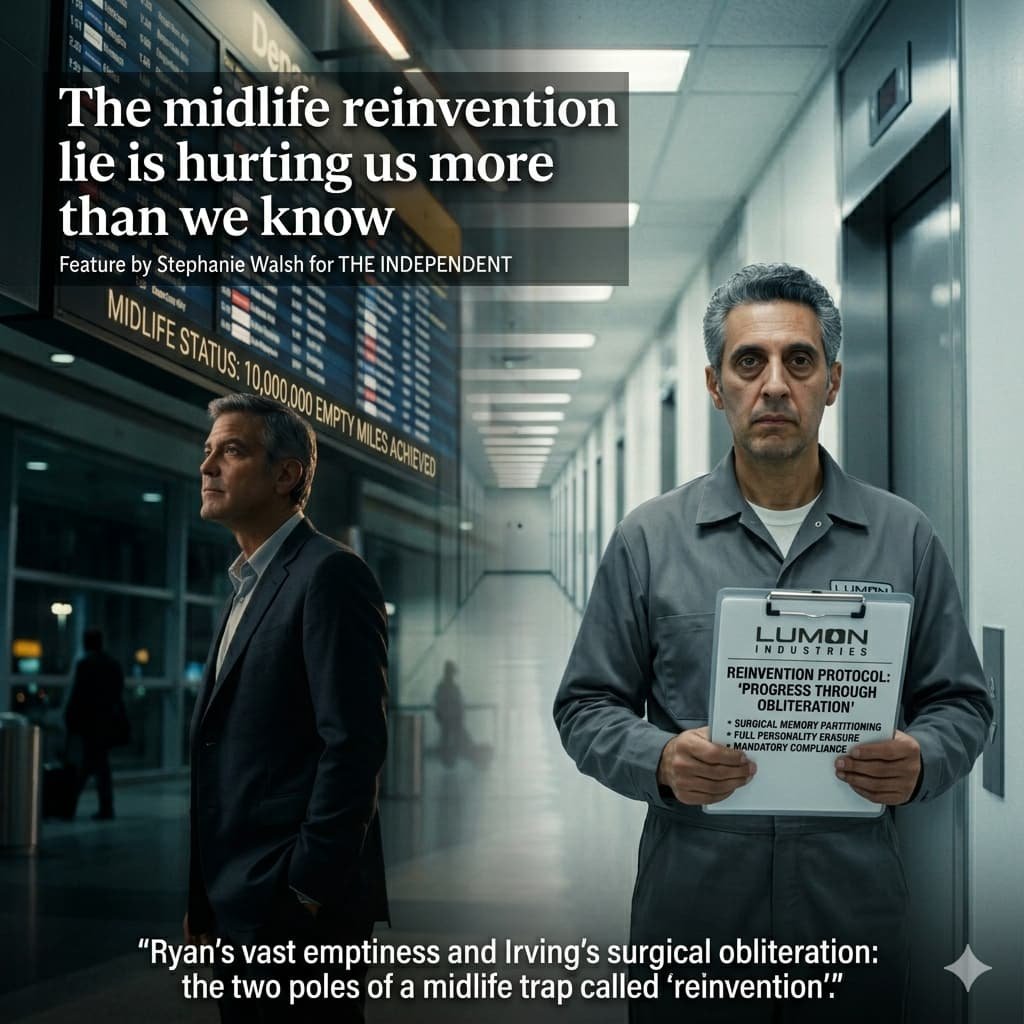
The first is George Clooney as Ryan Bingham in Up in the Air — standing alone in a vast airport terminal, staring at a departure board, having just achieved ten million frequent flyer miles and discovered that success tastes exactly like emptiness.
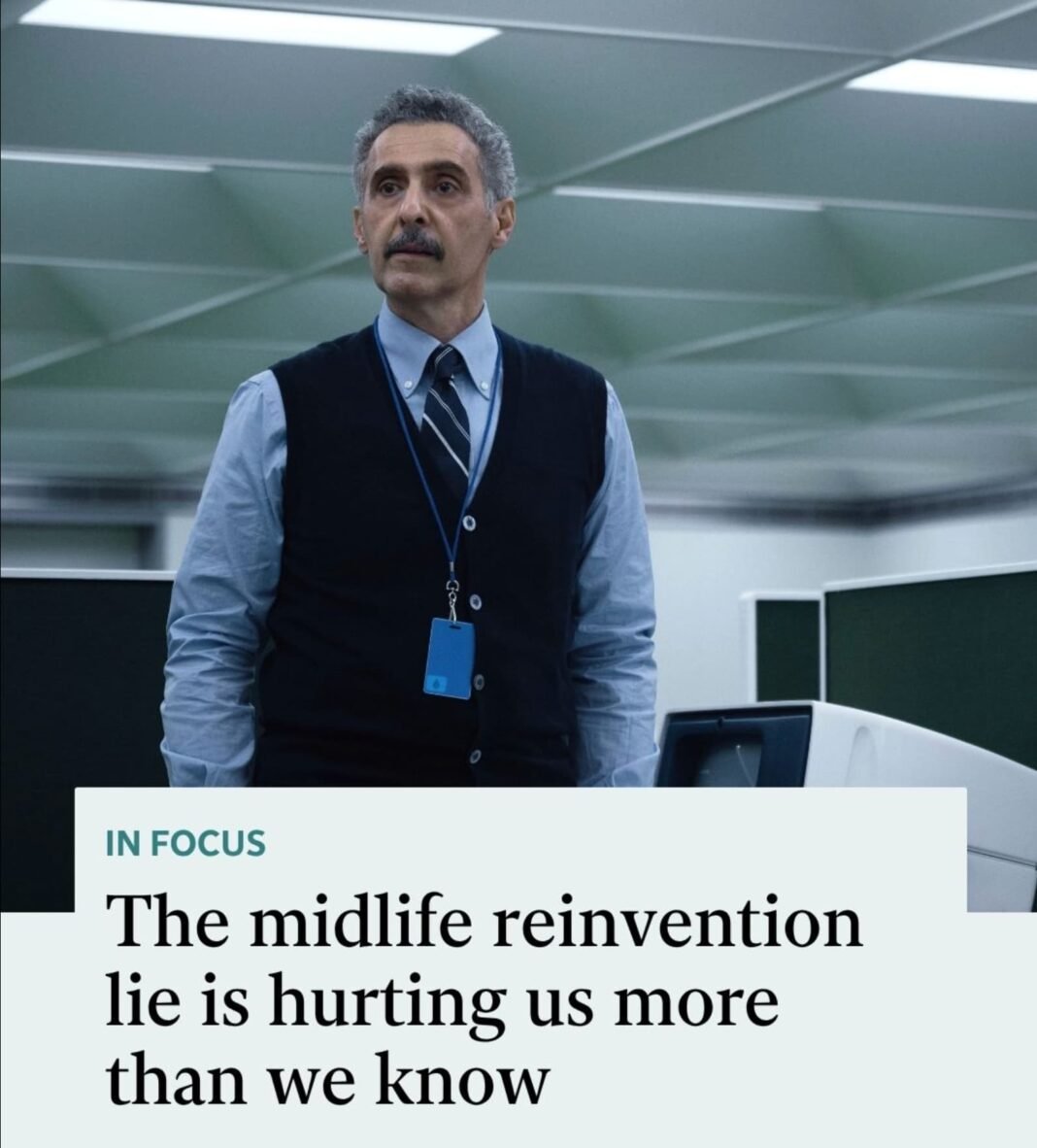
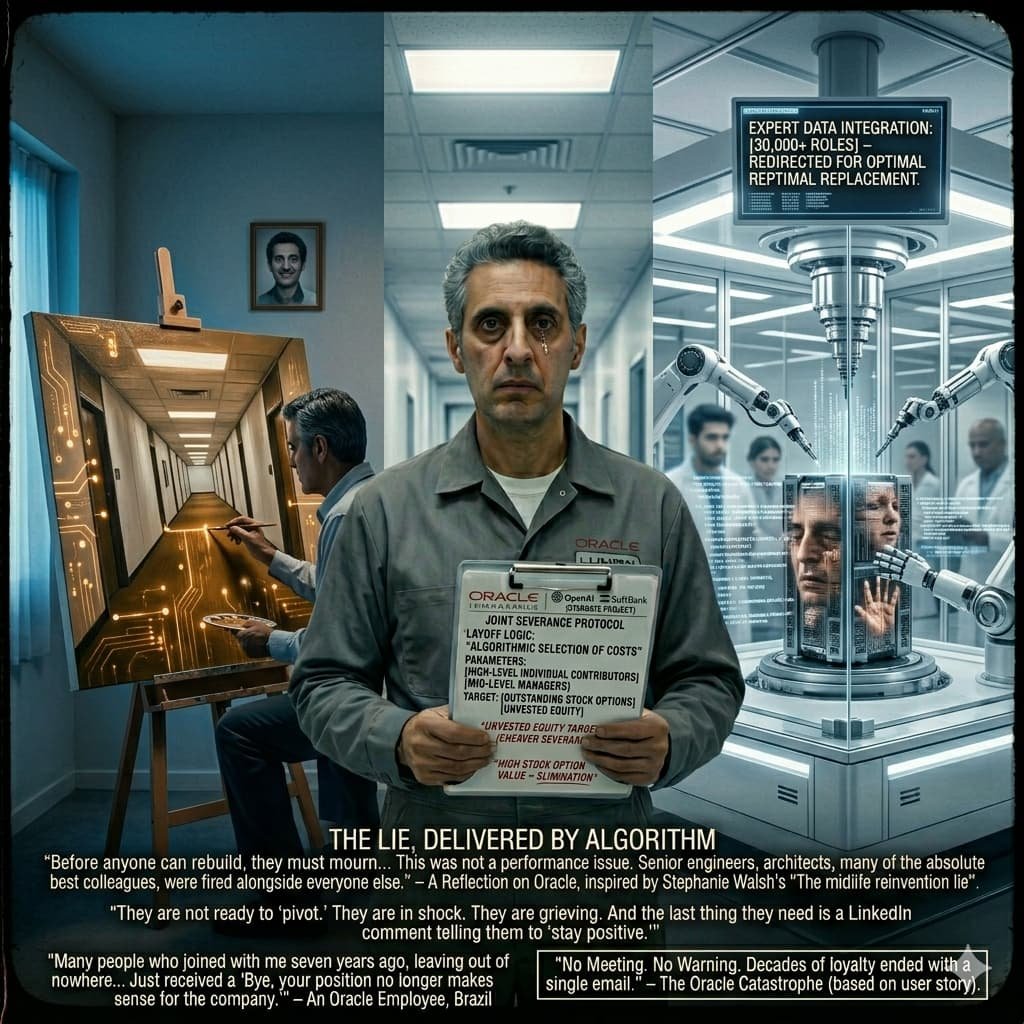
The second is John Turturro as Irving Bailiff in Severance — a hollow-eyed, grey-haired man in a fluorescent Lumon Industries corridor, a long-tenured employee who has given decades to a corporation that surgically removed his memories and calls it progress.
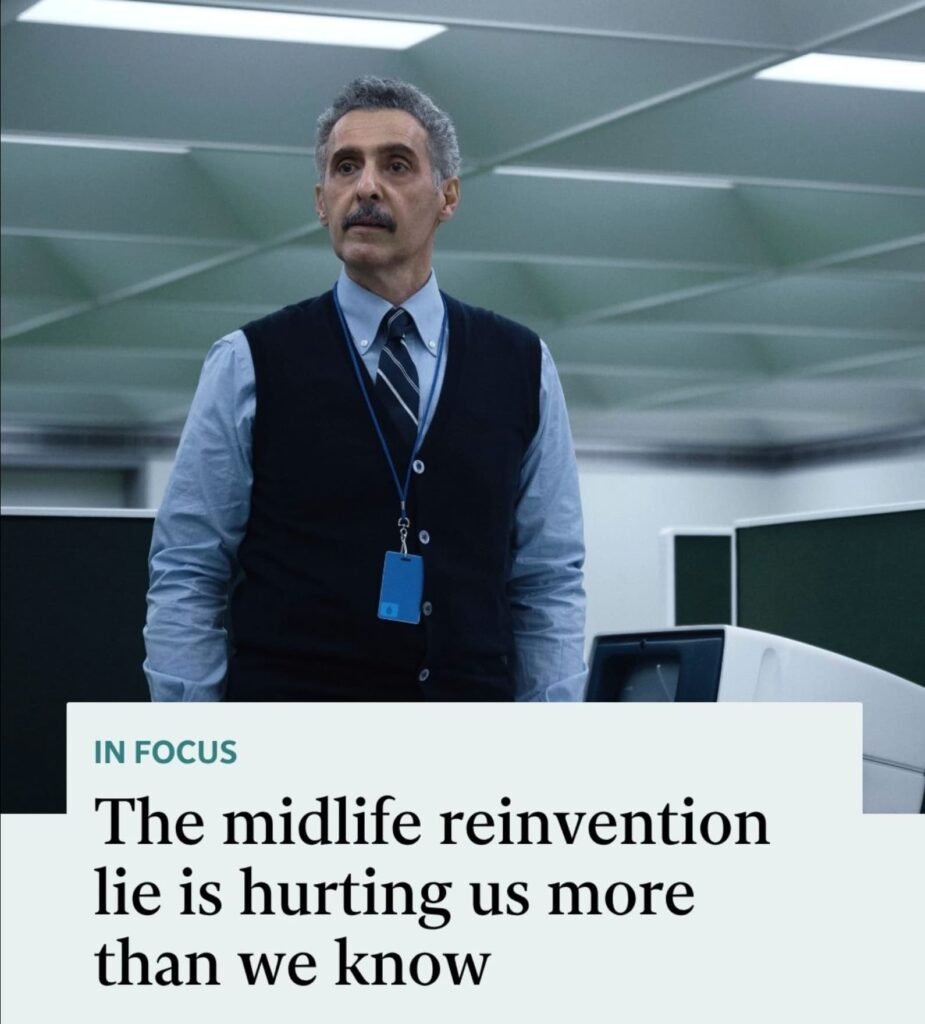
The Independent recently published a feature by Stephanie Walsh titled “The midlife reinvention lie is hurting us more than we know.” The photograph they chose was Turturro as Irving B. It was the perfect choice. Because between these two characters — the airborne termination specialist and the severed company man — a devastating truth emerges.
The “reinvent yourself” mantra is not just unhelpful. It is a lie that is actively hurting us.
And this week, that lie became 30,000 people’s reality.
The Oracle Massacre: April 2026
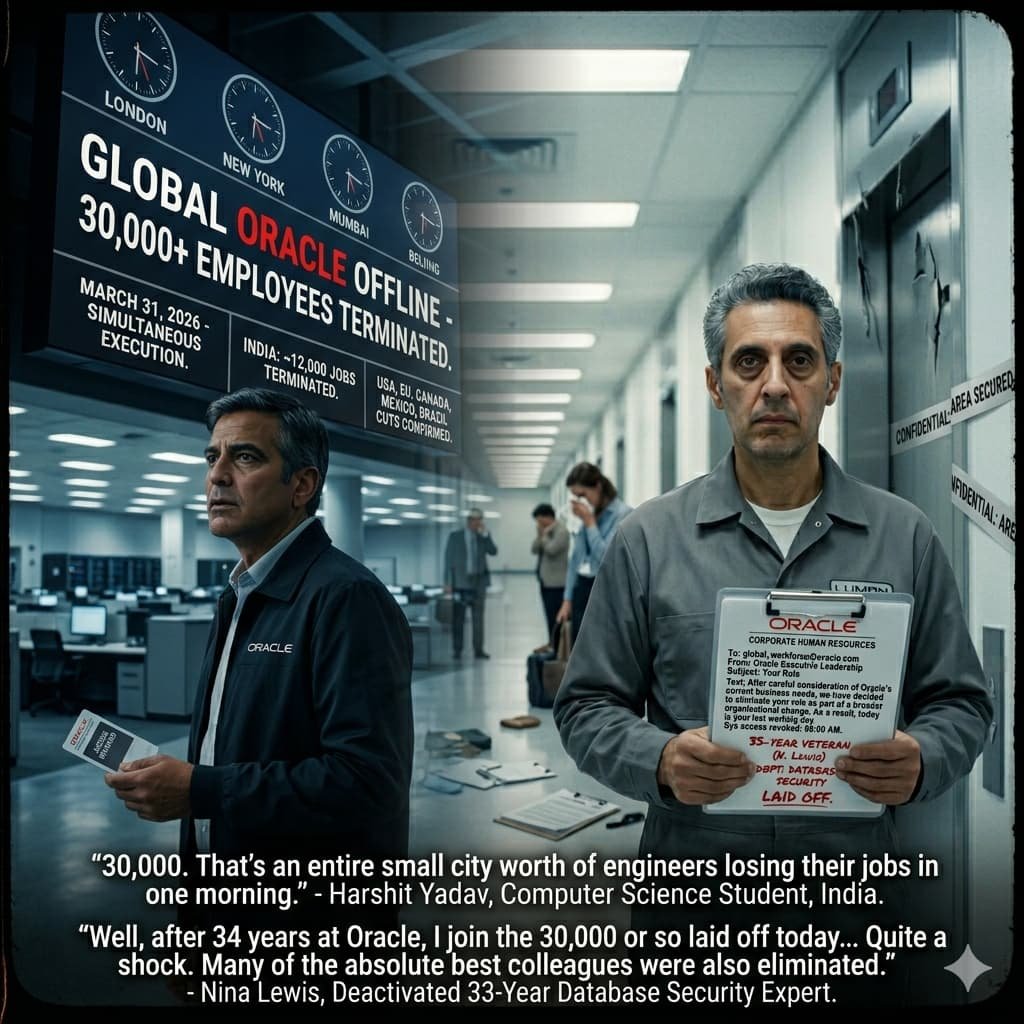
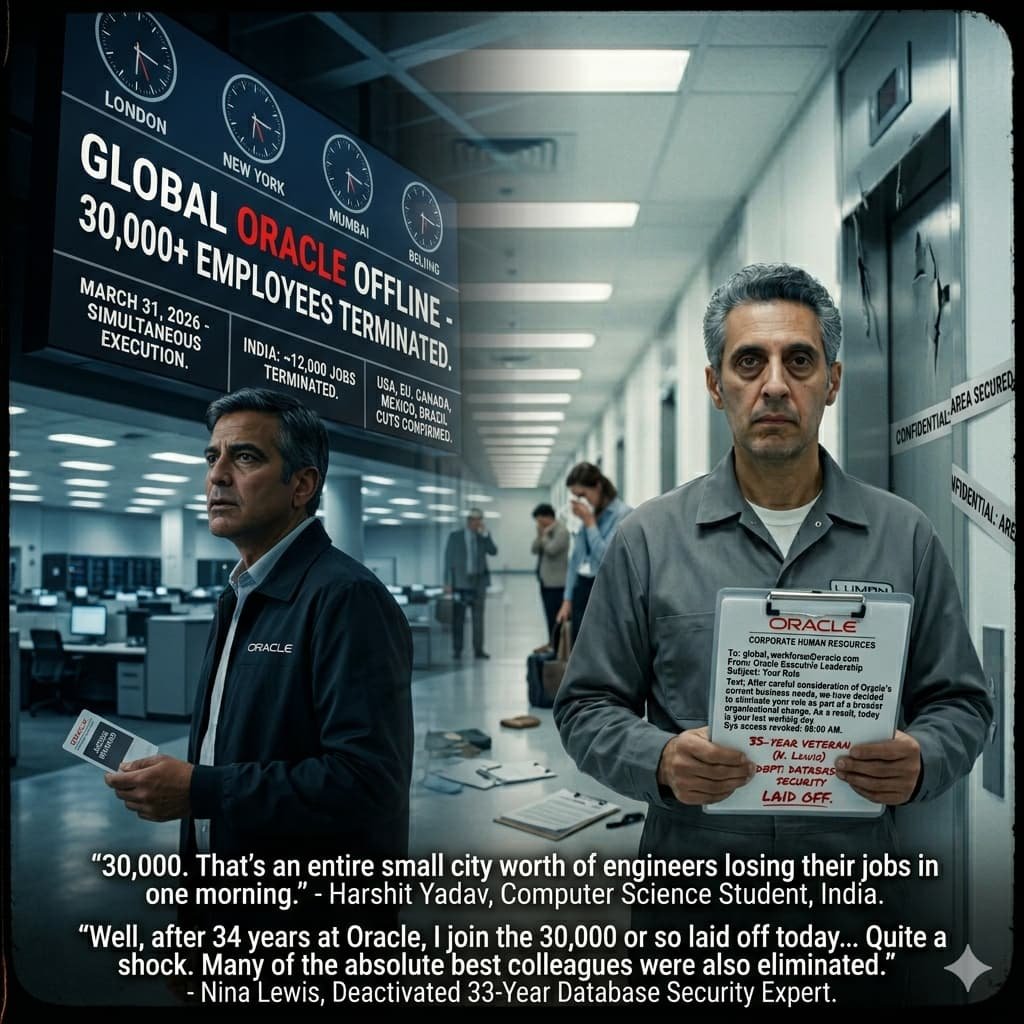
On Tuesday, March 31, 2026, at 6:00 AM — in every time zone, simultaneously — Oracle employees around the world opened their inboxes to the same cold message :
“After careful consideration of Oracle’s current business needs, we have decided to eliminate your role as part of a broader organisational change. As a result, today is your last working day.”
That was it. No meeting. No warning. No chance to say goodbye to colleagues. Within hours, their system access was revoked . Decades of loyalty — for some, 34 years — ended with a single email .
By the time the numbers were tallied, Oracle had laid off approximately 30,000 people — nearly 18% of its entire global workforce of 162,000 .
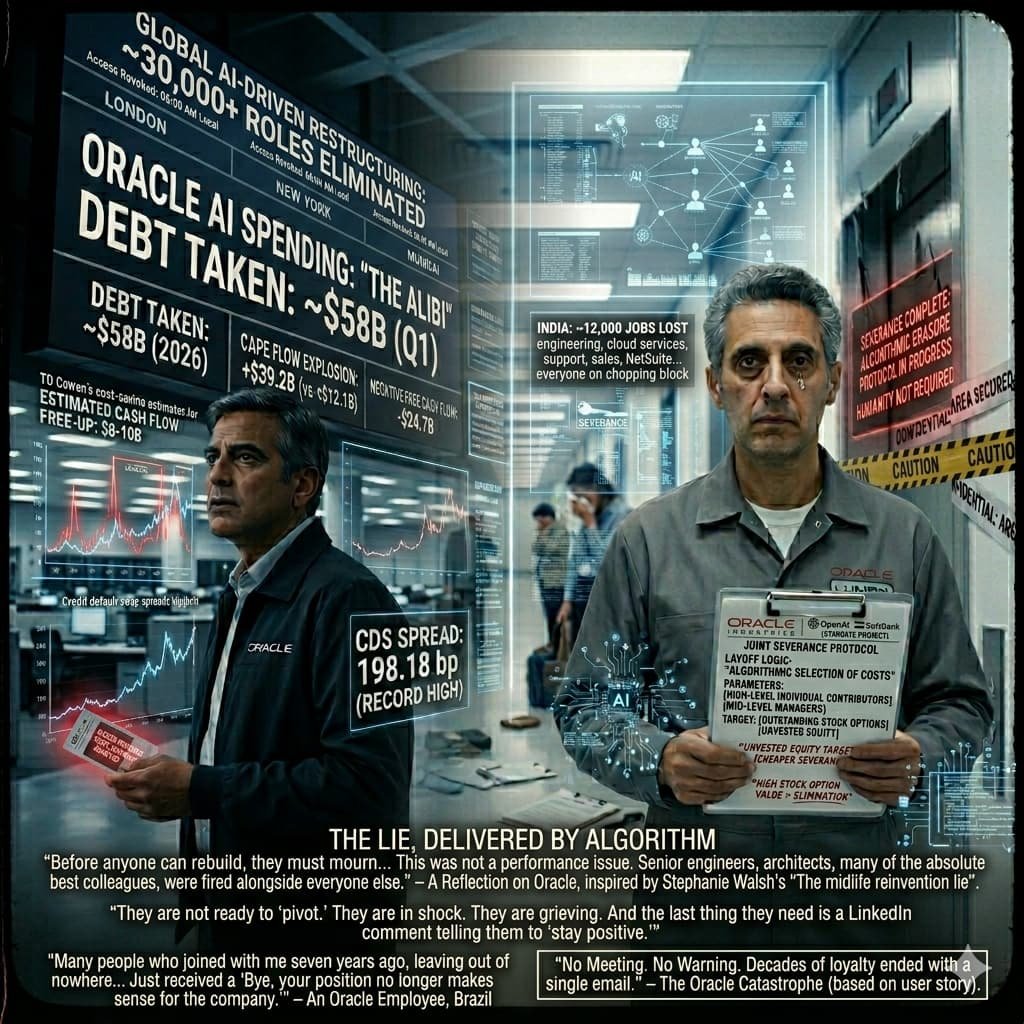
India was hit hardest, with an estimated 12,000 jobs lost . The United States, Europe, Canada, Mexico, and Brazil all felt the cuts. No team was safe: engineering, cloud services, technical support, Oracle Health, Sales, Customer Success, NetSuite — everyone was on the chopping block .
A 23-year-old MERN stack learner named Mansi Yadav watched from the outside and wrote: “My dad called yesterday. Asked if I got placed. I said ‘Soon, Papa.’ He smiled. He doesn’t know I’m scared” .
A final-year computer science student in India named Harshit Yadav put it more bluntly: “30,000. That’s not a startup downsizing. That’s an entire small city worth of engineers losing their jobs in one morning” .
And Nina Lewis, who spent 33 of her 34 years at Oracle, working in database security and ethical hacking, wrote from inside the catastrophe: “Well, after 34 years at Oracle, I join the 30,000 or so laid off today. Quite a shock. Many of the absolute best colleagues were laid off as well” .
Why Did Oracle Do It? The AI Alibi
The official reason is almost identical to the fictional logic of Severance and Up in the Air.
Oracle is spending billions on artificial intelligence infrastructure. The company has signed a deal to provide OpenAI with approximately $300 billion worth of computing power over five years — one of the largest technology infrastructure deals in history . It is part of the “Stargate” AI project alongside OpenAI and SoftBank, which aims to invest up to $500 billion .
To fund this, Oracle has taken on massive debt — nearly $58 billion in new debt in just two months of 2026 . The company’s capital expenditure has exploded. In the first nine months of fiscal 2026 alone, cash used for capex increased to $39.2 billion, up from $12.1 billion a year earlier . Free cash flow has turned sharply negative — negative $24.7 billion, compared with positive $5.8 billion a year ago .
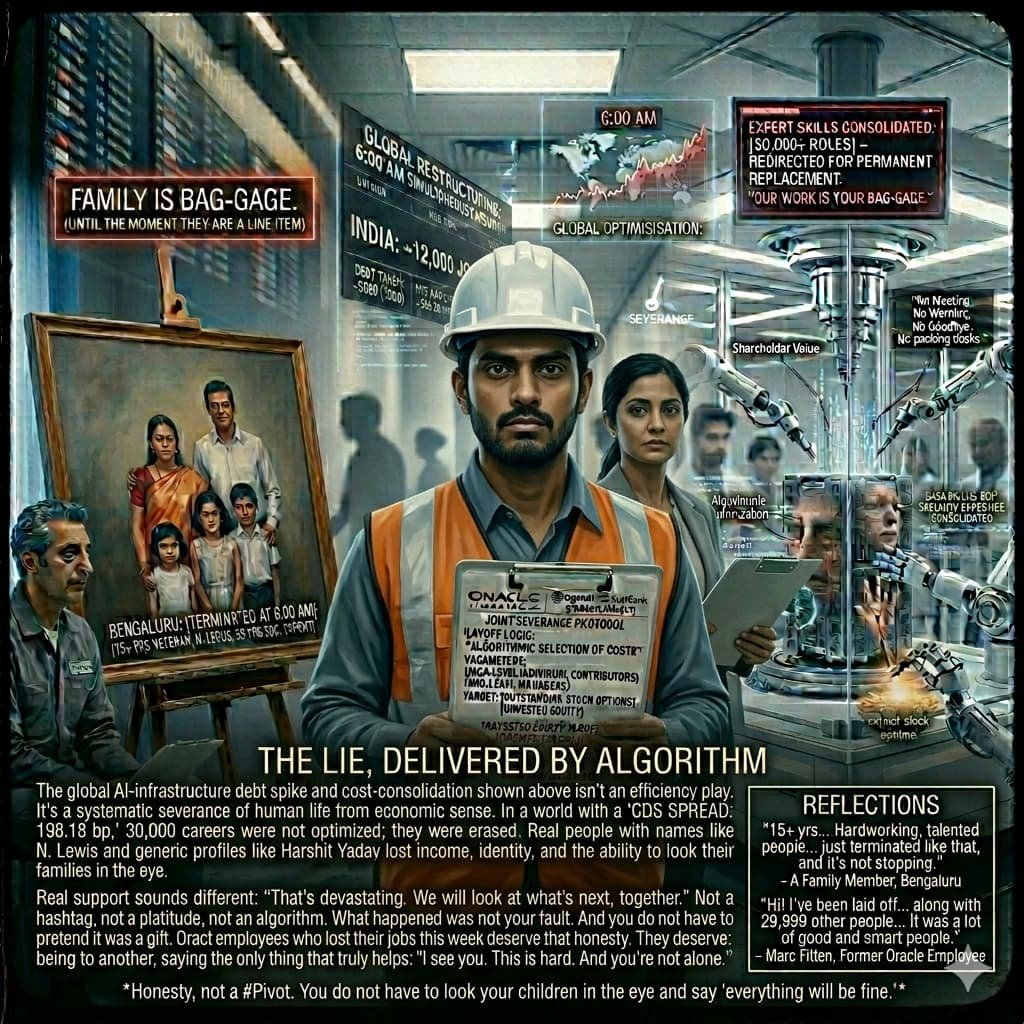
And the market has noticed. Oracle’s five-year credit default swap spread — a measure of the cost of insuring its debt against default — recently hit 198.18 basis points, the highest level on record, surpassing even the 2008 financial crisis . Investors are no longer focused on revenue growth. They want to know: When will this AI spending actually generate cash?
So Oracle is cutting costs the only way it knows how: people. The company has set aside $2.1 billion for restructuring, most of it for employee severance . Analysts at TD Cowen estimate the layoffs will free up $8 to 10 billion in cash flow .
The message to the remaining 132,000 employees is unmistakable: You are a cost. And if the algorithm decides you are too expensive — or your stock options are too valuable — you will be gone by 6 AM tomorrow.
The Algorithm That Fired Them
Here is where the fiction of Severance becomes indistinguishable from the reality of Oracle.
Nina Lewis, in her viral LinkedIn post, suggested something chilling: the layoffs may not have been random at all. She wrote:
“It seems layoffs follow an algorithm of high level individual contributors and mid-level managers — especially those with outstanding stock options” .
Think about what that means. An algorithm — not a manager who knows your name, not a human who has seen your work — selecting which 30,000 people to fire. And the algorithm appears to have targeted senior employees with unvested equity . People who had been at the company for years. People who had stock options that were about to become valuable. People whose severance would be cheaper than their future salary and vested equity.
In Severance, Lumon Industries surgically divides its employees’ memories so they never bring their inconvenient humanity to work. In real life, Oracle doesn’t need surgery. It just needs an algorithm and an email template.
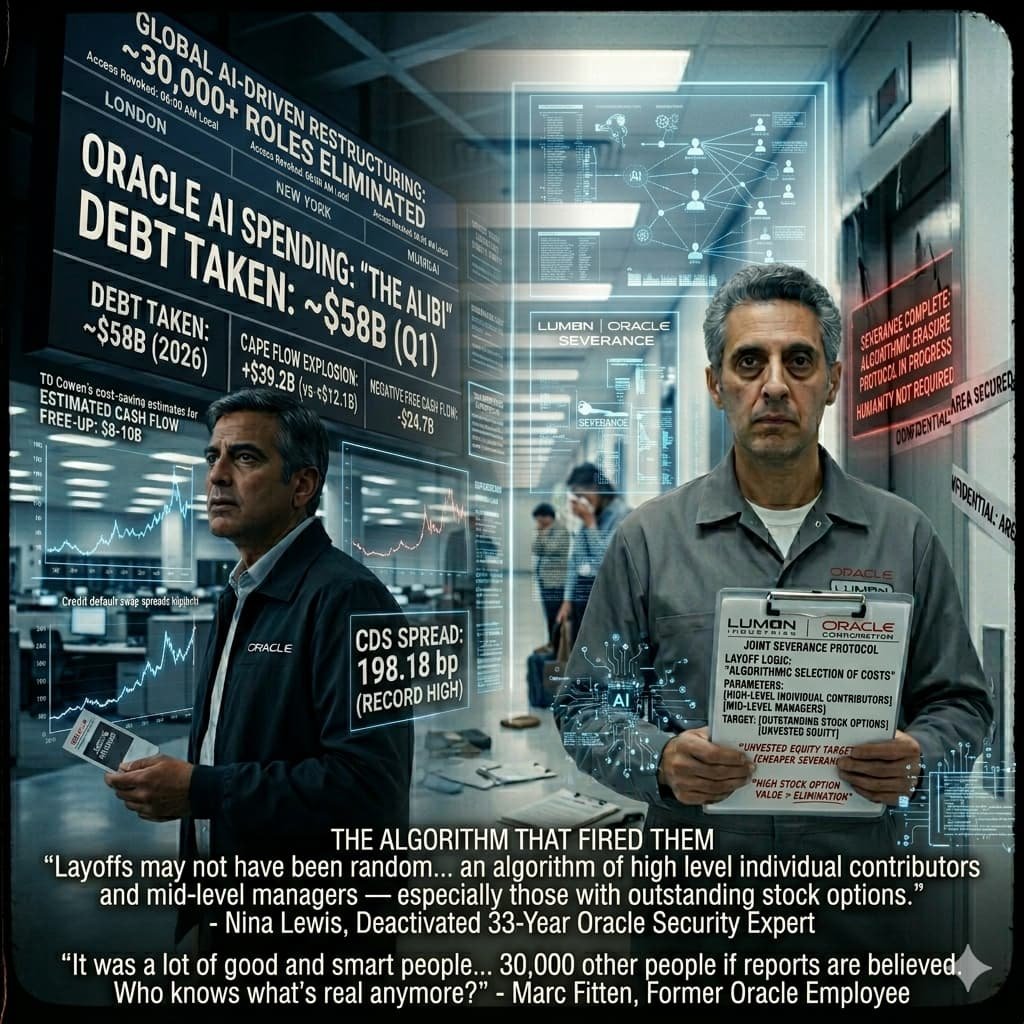
Marc Fitten, another laid-off Oracle employee, wrote: “Hi! I’ve been laid off by Oracle… along with 29,999 other people if the reports are to be believed. Who knows what’s real anymore? I can tell you it was a lot of good and smart people” .
Kurt Frieden, who worked in Cloud Commerce for nearly two decades, announced his exit with dark humour: “I just got laid off from Oracle today, so now is a good time to announce my retirement! It’s been a great 18 years” .
But there was nothing funny about what happened. One former SAP professional with 25 years of experience, watching from the outside, described the outreach from laid-off colleagues as “heartbreaking” . They wrote: “One email ends your long contribution to the company, your plans, and the numbness is real” .
The Lie, Delivered by Algorithm
This brings us back to Stephanie Walsh’s Independent article — and the photograph of John Turturro as Irving B.
Walsh argues that the “reinvent yourself” narrative does three harmful things:
1. It blocks grieving. Before anyone can rebuild, they must mourn. Loss of income, identity, community, purpose — these are real deaths. Jumping straight to “reinvention” skips the funeral. The 30,000 Oracle employees who woke up to that email on Tuesday are not ready to “pivot.” They are in shock. They are grieving. And the last thing they need is a LinkedIn comment telling them to “stay positive.”
2. It individualises systemic failure. When you’re told to “pivot,” the failure is yours if you can’t. But what happened at Oracle was not a performance issue. As one employee noted, the layoffs did not appear to be based on performance at all . Senior engineers, architects, and technical experts — “many of the absolute best colleagues,” in Nina Lewis’s words — were fired alongside everyone else . This was a systemic decision driven by debt, AI spending, and shareholder pressure. But the “reinvent yourself” mantra will make each of those 30,000 people feel like it was their fault.
3. It exhausts before you begin. The pressure to project positivity is itself a full-time job. Smiling for interviews. Chirping on networking calls. Writing “excited about new opportunities” on LinkedIn when you feel hollow. That performance drains the very energy needed for genuine rebuilding.
One Oracle employee in Brazil captured the numbness perfectly: “Many people who joined with me seven years ago, leaving out of nowhere… really good people who just received a ‘Bye, your position no longer makes sense for the company'” .
No “thank you for your service.” No “we appreciate your contributions.” Just: Your position no longer makes sense.
The Severance Connection: You Are Already Irving B.
In Severance, Irving Bailiff has given years — perhaps decades — to Lumon Industries. His “innie” is a devout company man. His “outie” lives alone in a sparse apartment, painting the same ominous hallway over and over, haunted by something he cannot remember. He has no idea what he has lost because the corporation took his memories.
The Oracle layoffs reveal that you don’t need a science-fiction procedure to achieve the same effect. You just need a corporate culture that has spent decades telling employees that they are “family” — until the moment they are a line item.
One laid-off employee’s family member in Bengaluru described the scene: “Hardworking, talented people with 15+ years… just terminated like that, and it’s not stopping. Share price is up, sure, but at what cost? Gave their life to one company, replaced in weeks” .
Replaced in weeks. That is the Irving B. experience, rendered in real time. The corporation takes everything — your time, your loyalty, your identity — and then tells you to “pivot” when it discards you.
And here is the darkest irony: the very skills of the people being laid off — in data, ERP, automation, security — are already being redirected into the AI systems that will replace traditional roles . The expertise of 30,000 people is being used to build the machines that will make sure no one ever has their job again.
As one observer put it: “This is not going to stop. AI disruption will impact non-IT domains too. It’s easy to say, ‘Change is the only constant.’ But the pain is real” .
The Up in the Air Connection: Ryan Bingham Would Love This
In Up in the Air, George Clooney’s character Ryan Bingham is a “termination specialist” — a third-party contractor who flies around the country firing people so that their actual bosses don’t have to look them in the eye. He is the human face of corporate cowardice.
Oracle has perfected this model. They didn’t need a Ryan Bingham. They just needed an email server and an algorithm. No one had to look 30,000 people in the eye. No one had to hear them cry. No one had to watch them pack their desks.
The Oracle termination email — which arrived at 6 AM in every time zone — is the logical conclusion of the philosophy Bingham sells. Remember his motivational speech?
“Your relationships are the heaviest baggage in your life. The slower we move, the faster we die.”
Oracle moved fast. Really fast. And 30,000 people died — professionally speaking — in an instant.
But here is what Up in the Air understood that Oracle does not: Ryan Bingham’s philosophy is a lie. He ends the film alone in an airport, having achieved everything he ever wanted, with no one to share it with. The people who survive job loss — who actually find their way through it — are not the lone wolves. They are the ones with baggage: spouses, kids, friends, community.
Oracle has spent decades building a workforce of people who believed they were family. And then, at 6 AM on a Tuesday, they showed that family was just another word for “at-will employment.”

The Market’s Reaction: Cruelty as Efficiency
Here is the most disturbing part of the Oracle story.
When the layoffs were announced, Oracle’s stock price rose nearly 6% .
The market interpreted the destruction of 30,000 careers as a positive signal. Efficiency. Cost-cutting. Shareholder value. One headline—from Taiwanese financial media Manager Today—called the layoffs an “AI positive.”
An Oracle employee who survived the cuts told a reporter that everyone who remains is terrified. They believe this will not be the last round of layoffs. And they know they will be expected to do more with fewer people — the classic corporate playbook .
The message to the surviving 132,000 employees is unmistakable: Work harder. Ask for less. Because the algorithm is watching.
This is the world Severance satirizes. Lumon Industries doesn’t need to be cruel. It just needs to be efficient. And if efficiency requires severing your memories — or your livelihood — so be it.
What Actually Helps: Beyond the Lie
So if “reinvent” and “pivot” are useless — even harmful — what actually works for the 30,000 people Oracle just threw away?
| Instead of… | Try this… |
|---|---|
| “Stay positive” | “It’s OK to not be OK.” Allow anger, sadness, confusion. They are not failures. They are data. |
| “Pivot now” | “Rest first.” You don’t need a new identity by Friday. You need sleep, safety, and small routines. |
| “Reinvent yourself” | “Reconnect with yourself.” What did you actually enjoy about your old work? What have you secretly always wanted to learn? Not for a job — just because. |
| “This is your chance” | “This is unfair.” Name the injustice. You don’t have to pretend it’s a gift. |
The most radical act in a culture obsessed with reinvention is to stay still long enough to hear yourself think — just as Irving B. does, alone with his paintbrush, trying to recover the parts of himself that were severed away.
And it is to seek connection, not reinvention. The people who survive job loss — who actually find their way through it — are not the lone wolves. They are the ones with baggage: spouses, kids, friends, community. The one thing Ryan Bingham refuses to carry is the one thing that might have saved him.
For the Oracle 30,000, that means reaching out to each other. Forming support networks. Sharing referrals. Refusing to internalize the lie that their termination was their fault.
One former Oracle employee, posting on LinkedIn, offered the only honest response: “Not sure what to do next, if anything. Open to ideas” . That is not weakness. That is the truth.
A Final Thought: The Lie Has a Body Count
The midlife reinvention lie isn’t just unhelpful. It’s cruel. It asks people who have just lost a limb to celebrate the possibility of learning to tap dance.
This week, 30,000 people lost their limbs. They lost their income, their identity, their community, their sense of purpose. They lost the ability to look their children in the eye and say “everything will be fine.”
And the corporate world — the same corporate world that fired them via algorithm at 6 AM — will tell them to “stay positive” and “pivot” and “see this as an opportunity.” It is the same lie Stephanie Walsh wrote about. The same lie Severance exposes. The same lie Up in the Air deconstructs.
Real support sounds different. It sounds like this:
“That’s devastating. I’ll sit with you in the devastation. And when you’re ready — not before — we’ll look at what’s next. Together.”
No pivot. No reinvention. No severance procedure. Just one human being to another, saying the only thing that truly helps:
“I see you. This is hard. And you’re not alone.”
The 30,000 Oracle employees who lost their jobs this week deserve that honesty. Not a hashtag. Not a platitude. Not an algorithm.
Just the truth: What happened to you was wrong. It was not your fault. And you do not have to pretend it was a gift.
About the pictures: The first image (George Clooney) is a still from Up in the Air (Paramount Pictures, 2009), directed by Jason Reitman. The second image (John Turturro) is a still from Severance (Apple TV+, 2022–present), created by Dan Erickson. Both were used in The Independent‘s 2026 feature by Stephanie Walsh, “The midlife reinvention lie is hurting us more than we know.”
About the Oracle layoffs: Based on reporting from CNBC, Reuters, Bloomberg, Associated Press, The Economic Times, Business Insider, Mint, Financial Express, and The Paper (澎湃新闻), March 31–April 3, 2026. Oracle has not officially confirmed the total number of layoffs but has acknowledged a “broader organisational change” affecting thousands of employees globally.