


From Nation-States to Corporate Titans: How Innovation is Redrawing the Global Power Map — and What India Must Do
The Rise of the Corporate Superpower
For most of modern history, power was firmly in the hands of nation-states. Governments controlled armies, borders, and economic policy; corporations were mere economic actors operating within those frameworks.
Today, the script is being rewritten. Tech-driven corporations now command influence across borders, rivaling — and sometimes surpassing — governments in economic reach, technological capability, and even geopolitical leverage.
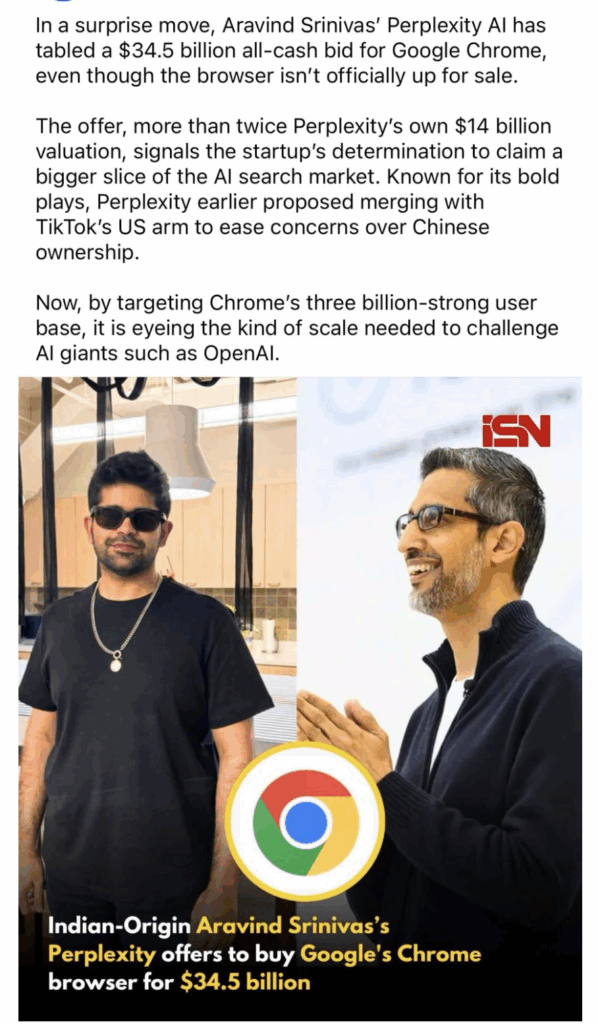
When Perplexity AI’s CEO Aravind Srinivas made global headlines with a $34.5 billion offer to buy Google Chrome, the story was more than clickbait. It was a signpost: innovation-led corporations are increasingly setting agendas, not just serving markets.
From the Silk Road to Silicon Valley — and Beyond
This power shift is not about companies merely getting “big” — it’s about controlling the levers of modern life:
• Data — harvested, analyzed, and monetized at a scale no government can match.
• Platforms — where billions communicate, trade, and learn.
• Supply Chains — spanning continents, creating mutual dependencies.
• Innovation — in AI, semiconductors, clean energy, biotech, and space.
The result? When corporations are indispensable to global systems, they wield a “soft veto” over state actions. This explains why the US can impose 50% tariffs on Indian goods while going softer on China — not because of geopolitics alone, but because US corporations are deeply entangled with Chinese manufacturing, minerals, and markets.
⸻
The China–US Lesson: Indispensability as Shield
Despite years of rivalry, China avoids the most severe trade penalties because:
• US giants — from Apple and Tesla to Qualcomm and General Motors — rely on Chinese manufacturing and rare earths.
• Wall Street is heavily invested in Chinese supply chains and consumer markets.
• Disengagement would hurt US corporate earnings and political stability.
This corporate interdependence turns boardrooms into informal diplomats, quietly lobbying against measures that would damage their own interests.
India’s Vulnerability — and Opportunity
India is one of the fastest-growing economies, yet not structurally indispensable to US corporate interests.
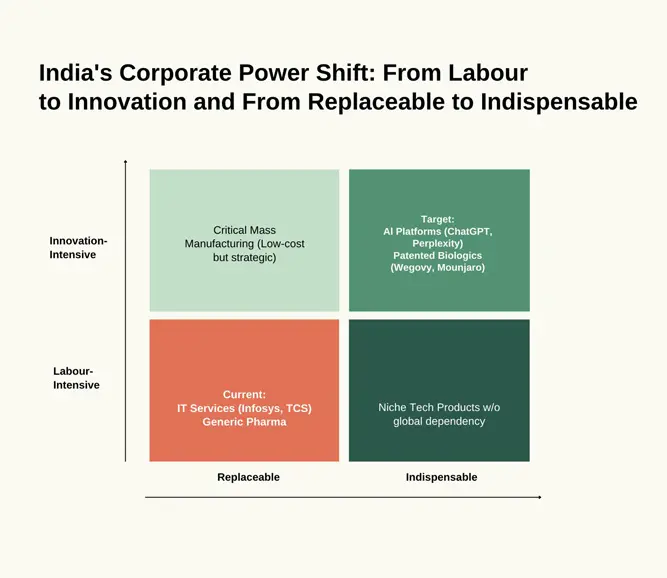
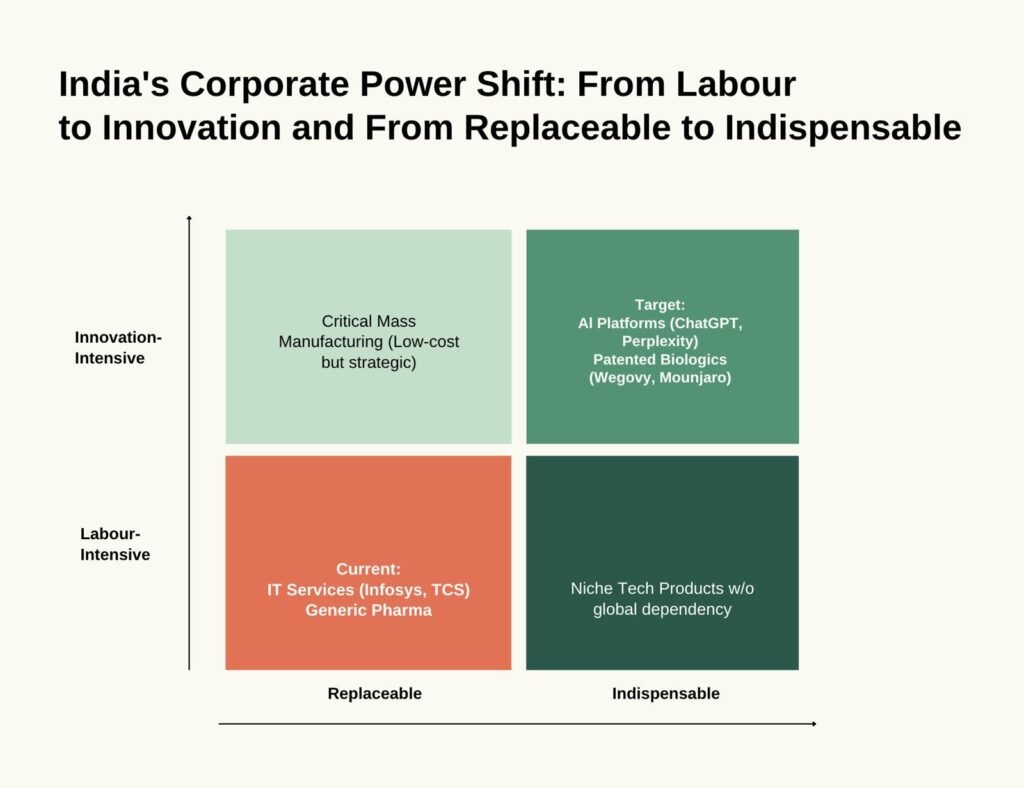
• Its primary exports to the US — IT services, textiles, generics — are valuable but replaceable in the global market.
• This makes India a politically “safe” target for tariffs.
To gain strategic immunity, India must become a hub global corporations cannot operate without — the way China is in manufacturing and South Korea is in semiconductors.
From Labour-Intensive to Innovation-Intensive
India’s corporate evolution must mirror its ambitions:
• IT Services → AI Products: Moving from Infosys and TCS as back-office outsourcing giants to building global AI platforms like ChatGPT, Perplexity, and sector-specific foundation models.
• Generics → Breakthrough Therapies: From producing low-cost generics to developing and owning patents for cutting-edge drugs like Wegovy (semaglutide) and Mounjaro (tirzepatide) in obesity and metabolic disease.
• Assembly → IP Ownership: Retaining and monetizing intellectual property in sectors from semiconductors to green energy.
Innovation intensity, not labour intensity, will determine bargaining power in the next decade.
Innovation Power as Geopolitical Insurance
China’s leverage comes from owning key links in critical value chains — 5G gear, EV batteries, solar, APIs — that the world cannot easily replace.
India’s pathway:
1. Move up the value chain from service delivery to IP creation.
2. Dominate niches where switching costs for global firms are high.
3. Tie US corporate profitability to Indian production, IP, and markets.
From Target to Power Player
In geopolitics, if you are indispensable, you are untouchable. The US softens its approach to China because US corporate health depends on it.
For India, building indispensability through innovation-intensive industries and deep corporate linkages will transform it from a tariff target into a trade partner whose prosperity is inextricably linked to the balance sheets of the world’s most powerful companies.
The Perplexity AI–Google Chrome episode is more than a tech headline. It’s a metaphor for our age: those who control innovation, control influence.
If India wants that influence, it must graduate from being the world’s back office and pill factory to being a creator of platforms, patents, and products that the world — and its most powerful corporations — cannot live without.